
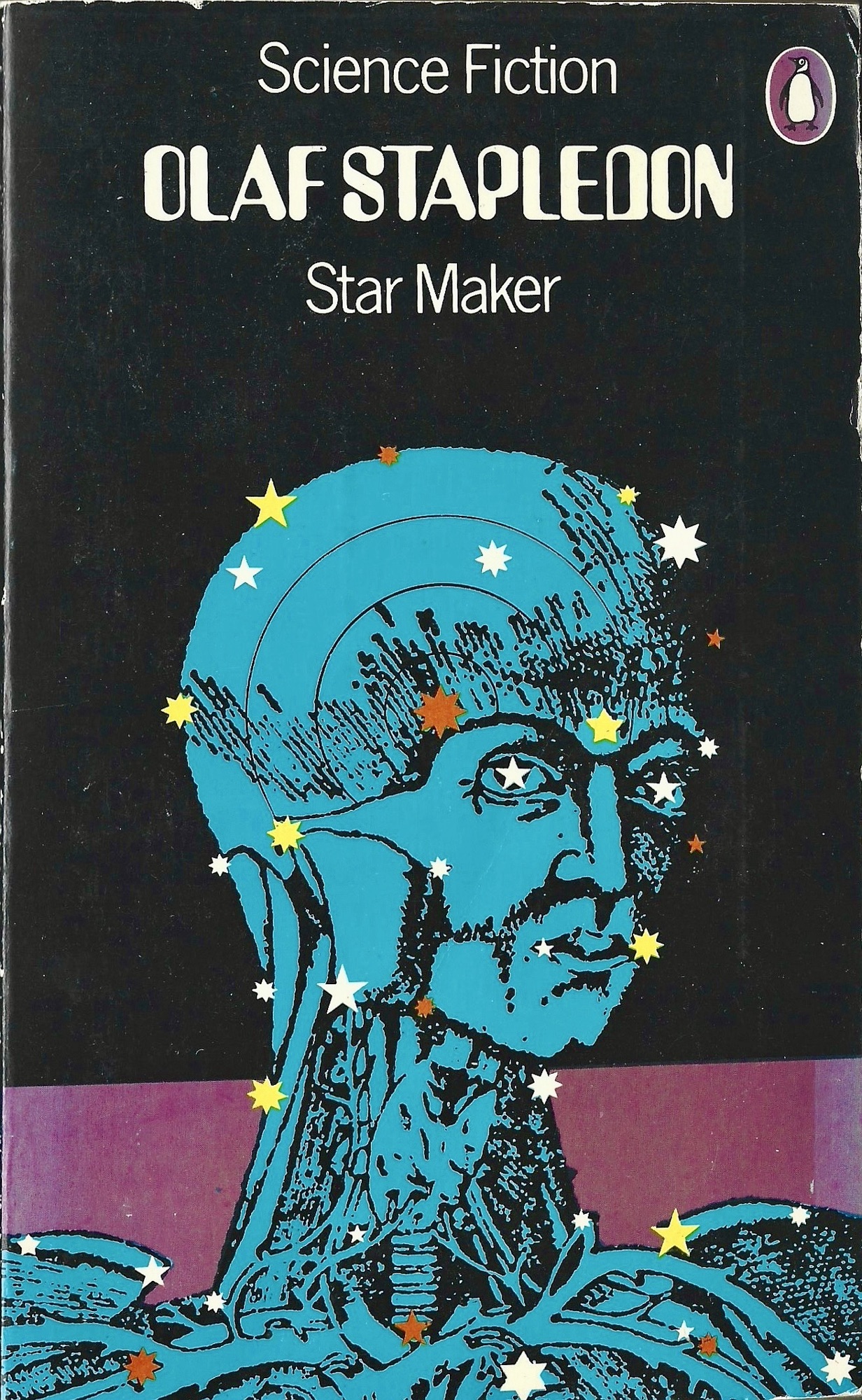
Star Maker, Olaf Stapledon. Penguin Books (1973). Cover design by David Pelham. 268 pages.
Here is the first paragraph of Star Maker:
ONE night when I had tasted bitterness I went out on to the hill. Dark heather checked my feet. Below marched the suburban lamps. Windows, their curtains drawn, were shut eyes, inwardly watching the lives of dreams. Beyond the sea’s level darkness a lighthouse pulsed. Overhead, obscurity. I distinguished our own house, our islet in the tumultuous and bitter currents of the world. There, for a decade and a half, we two, so different in quality, had grown in and in to one another, for mutual support and nourishment, in intricate symbiosis. There daily we planned our several undertakings, and recounted the day’s oddities and vexations. There letters piled up to be answered, socks to be darned. There the children were born, those sudden new lives. There, under that roof, our own two lives, recalcitrant sometimes to one another, were all the while thankfully one, one larger, more conscious life than either alone.
More David Pelham covers here.


 Biblioklept