“One Train May Hide Another” — Kenneth Koch

“One Train May Hide Another”

by Kenneth Koch


(sign at a railroad crossing in Kenya)

In a poem, one line may hide another line,
As at a crossing, one train may hide another train.
That is, if you are waiting to cross
The tracks, wait to do it for one moment at
Least after the first train is gone. And so when you read
Wait until you have read the next line—
Then it is safe to go on reading.
In a family one sister may conceal another,
So, when you are courting, it’s best to have them all in view
Otherwise in coming to find one you may love another.
One father or one brother may hide the man,
If you are a woman, whom you have been waiting to love.
So always standing in front of something the other
As words stand in front of objects, feelings, and ideas.
One wish may hide another. And one person’s reputation may hide
The reputation of another. One dog may conceal another
On a lawn, so if you escape the first one you’re not necessarily safe;
One lilac may hide another and then a lot of lilacs and on the Appia Antica
     one tomb
May hide a number of other tombs. In love, one reproach may hide
     another,
One small complaint may hide a great one.
One injustice may hide another—one colonial may hide another,
One blaring red uniform another, and another, a whole column. One bath
    may hide another bath
As when, after bathing, one walks out into the rain.
One idea may hide another: Life is simple
Hide Life is incredibly complex, as in the prose of Gertrude Stein
One sentence hides another and is another as well. And in the laboratory
One invention may hide another invention,
One evening may hide another, one shadow, a nest of shadows.
One dark red, or one blue, or one purple—this is a painting
By someone after Matisse. One waits at the tracks until they pass,
These hidden doubles or, sometimes, likenesses. One identical twin
May hide the other. And there may be even more in there! The
     obstetrician
Gazes at the Valley of the Var. We used to live there, my wife and I, but
One life hid another life. And now she is gone and I am here.
A vivacious mother hides a gawky daughter. The daughter hides
Her own vivacious daughter in turn. They are in
A railway station and the daughter is holding a bag
Bigger than her mother’s bag and successfully hides it.
In offering to pick up the daughter’s bag one finds oneself confronted by
     the mother’s
And has to carry that one, too. So one hitchhiker
May deliberately hide another and one cup of coffee
Another, too, until one is over-excited. One love may hide another love or
     the same love
As when “I love you” suddenly rings false and one discovers
The better love fingering behind, as when “I’m full of doubts”
Hides “I’m certain about something and it is that”
And one dream may hide another as is well known, always, too. In the
     Garden of Eden
Adam and Eve may hide the real Adam and Eve.
Jerusalem may hide another Jerusalem.
When you come to something, stop to let it pass
So you can see what else is there. At home, no matter where,
Internal tracks pose dangers, too: one memory
Certainly hides another, that being what memory is all about,
The eternal reverse succession of contemplated entities. Reading A
     Sentimental Journey look around
When you have finished, for Tristram Shandy, to see
If it is standing there, it should be, stronger
And more profound and theretofore hidden as Santa Maria Maggiore
May be hidden by similar churches inside Rome. One sidewalk
May hide another, as when you’re asleep there, and
One song hide another song; a pounding upstairs
Hide the beating of drums. One friend may hide another, you sit at the
     foot of a tree
With one and when you get up to leave there is another
Whom you’d have preferred to talk to all along. One teacher,
One doctor, one ecstasy, one illness, one woman, one man
May hide another. Pause to let the first one pass.
You think, Now it is safe to cross and you are hit by the next one. It can be
     important
To have waited at least a moment to see what was already there.
“Thanksgiving” — Kenneth Koch

“Thanksgiving”

by

Kenneth Koch


What’s sweeter than at the end of a summer’s day
To suddenly drift away
From the green match-wrappers in an opened pocketbook
And be part of the boards in a tavern?

A tavern made of new wood.
There’s an orange-red sun in the sky
And a redskin is hunting for you underneath ladders of timber.
I will buy this tavern. Will you buy this tavern? I do.

In the Indian camp there’s an awful dismay.
Do they know us as we know they
Know us or will know us, I mean a—
I mean a hostile force, the month of May.

How whitely the springtime is blossoming,
Ugh! all around us!
It is the brilliant Indian time of year
When the sweetest Indians mate with the sweetest others.

But I fear the white men, I fear
The rent apple blossom and discarded feathers
And the scalp lying secretly on the ground
Like an unoffending nose!

But we’ve destroyed all that. With shocking guns.
Peter Stuyvesant, Johnny Appleseed, Aaron Copeland.
We’ve destroyed all that. Come,
Do you believe right was on either side?

How would you like to be living in an Indian America,
With feathers dressing every head? We’d eat buffalo hump
For Thanksgiving dinner. Everyone is in a tribe.
A girl from the Bep Tribe can’t marry a brave from the Bap tribe. Is that democracy?
And then those dreary evenings around the campfires
Listening to the Chief! If there were a New York
It would be a city of tents, and what do you suppose
Our art and poetry would be like? For the community! the tribe!
No beautiful modern abstract pictures, no mad incomprehensible
Free lovable poems! And our moral sense! tribal.
If you would like to be living in an Indian America
Why not subscribe to the newspaper, Indian America?

In Wisconsin, Ben, I stand, I walk up and down and try to decide.

Is this country getting any better or has it gotten?
If the Indian New York is bad, what about our white New York?
Dirty, unwholesome, the filthy appendage to a vast ammunition works, I hate it!
Disgusting rectangular garbage dump sending its fumes up to suffocate the sky—
Foo, what fumes! and the scaly white complexion of her citizens.
There’s hell in every firm handshake, and stifled rage in every look.
If you do find somewhere to lie down, it’s a dirty inspected corner,
And there are newspapers and forums and the stinking breath of Broadway
To investigate what it feels like to be a source of stench
And nothing else. And if one does go away,
It is always here, waiting, for one to come back. And one does come back,
As one does come back to the bathroom, and to a fine suffering.

Where else would I find such ardent and grateful spirits
Inspired and wasted and using and used by this horrible city,
New York, New York? Can the Pilgrims’ Thanksgiving dinner really compare to it?
And the Puritans? And the single-minded ankle-divided Indians?
No, nothing can compare to it! So it’s here we speak from the heart
And it’s rotting so fast that what we say
Fades like the last of a summer’s day.
Rot which makes us as prolific as the sun on white unfastened clouds.

“Variations on a Theme by William Carlos Williams” — Kenneth Koch

“Variations on a Theme by William Carlos Williams”

by

Kenneth Koch


1

I chopped down the house that you had been saving to live in next
summer.
I am sorry, but it was morning, and I had nothing to do
and its wooden beams were so inviting.

2

We laughed at the hollyhocks together
and then I sprayed them with lye.
Forgive me. I simply do not know what I am doing.

3

I gave away the money that you had been saving to live on for the next ten
years.
The man who asked for it was shabby
and the firm March wind on the porch was so juicy and cold.

4

Last evening we went dancing and I broke your leg.
Forgive me. I was clumsy, and
I wanted you here in the wards, where I am the doctor!

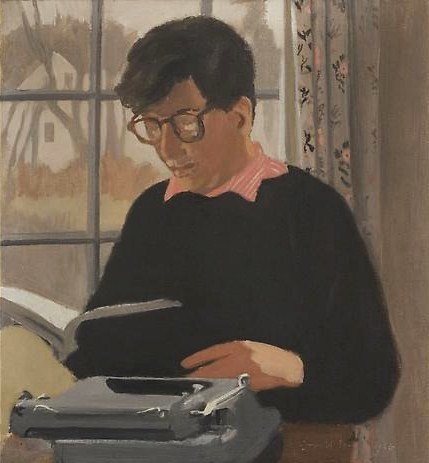
Kenneth Koch Reading — Fairfield Porter

fairfield-porter-portrait-of-kenneth-koch-reading-1968

Kenneth Koch Reading, 1966 by Fairfield Porter (1907-1975)