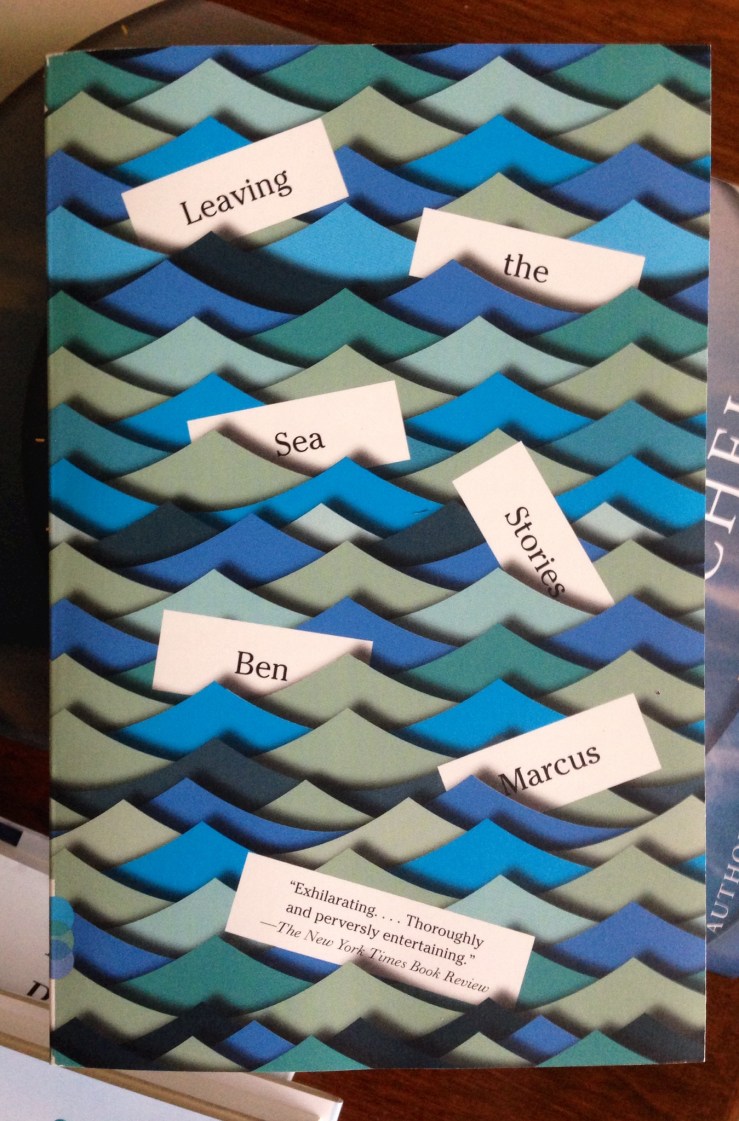
Microreview of Ben Marcus’s Leaving the Sea (Book Acquired, 9.17.2014)

IMG_3338

The kind people at Random House sent me a trade paperback of Ben Marcus’s latest collection, Leaving the Sea. The trade paperback comes out in early October.

I actually read the book this summer, and enjoyed it, was frustrated by it, occasionally sickened by it, was enthralled by at least two stories (“The Loyalty Protocol” and “The Moors”), and found one story to be so terribly sad and distressing and horrifying that I hope to never read anything like it again, which is kind of a compliment (“Rollingwood”).

I jammed Leaving the Sea into a riff on stuff I wished I’d written about in the first half of 2014. This is what I wrote:

Leaving the Sea, Ben Marcus: A weird and (thankfully) uneven collection that begins with New Yorkerish stories of a post-Lish stripe (like darker than Lipsyte stuff) and unravels (thankfully) into sketches and thought experiments and outright bizarre blips. Abjection, abjection, abjection. The final story ‘The Moors’ is a minor masterpiece.”

Read “On Not Growing Up” from the collection at Conjunctions. First paragraphs:

—HOW LONG HAVE YOU been a child?

—Seventy-one years.

—Who did you work with?

—Meyerowitz for the first phase: colic, teething, walking, talking. He taught me how to produce false prodigy markers and developmental reversals, to test the power in the room without speaking. I was encouraged to look beyond the tantrum and drastic mood migrations that depended on the environment, and if you know my work you have an idea what resulted. The rest is a hodgepodge, but I don’t advocate linear apprenticeships. A stint in the Bonn Residency. Fellowships at the Cleveland Place, then later a stage at Quebec Center. I entered that Appalachian Trail retreat in 1974, before Krenov revised it, but had to get helicoptered out. Probably my first infant crisis, before I knew to deliberately court interference. The debt to Meyerowitz is huge, obviously, if just for the innocence training. Probably I should have laid off after that, because now it’s all
about unlearning.

—Unlearning as Kugler practices it? That radical?

—I skip the hostility to animals. I skip the forced submersion and the chelation flush. That’s proven to be a dead end. But Kugler is a walking contradiction in that respect, isn’t he? He keeps a horse barn.
He does twilight childishness, and now he’s suddenly opposing the Phoenix baby-talk crowd, who I think are not as threatening as he makes out.

—They’re not registered.

“Graves were called homes, and apologies known as writing were carved in their surface” (Ben Marcus)

The time was technical summer, a season that had been achieved by nature so many times that a clotted arrangement of birds created splotches of ink called shadows, and whole days passed without gunfire. Shadows were blind spots that everyone shared. Graves were called homes, and apologies known as writing were carved in their surface. Rotten bags were called people. Milk was never sprayed from a fire hose at children until they skittered over the pavement like weevils, but the children wore shields of clothing regardless, and the people who guarded them were often trembling.

From Ben Marcus’s story”Against Attachment,” collected in Leaving the Sea.

“People have bones so insects won’t flood their limbs and inflate their bodies to normal size” (Ben Marcus)

People have bones so insects won’t flood their limbs and inflate their bodies to normal size. A person who is insect-controlled often sits and drinks tea, though an insect fluid called blood flows quickly beneath her skin. She has an accurate walking style and can converse in one or more languages. She sleeps lying down, and uses a filter called hair to attract her mates. The small people in her house call her “Mom,” and she answers them by collapsing the tension in her face, a surrendering of control that passes for listening. When she pursues an upper-level-difficulty slalom run of housekeeping throughout her house, she has most likely failed to seal her bones from escape with fixatives called clothing. Her actions become commanded for the good of something larger, such as a naked man who resembles her father, although he might be younger and smaller and weaker, as if playing the part of her husband, though not convincingly. Her motion is voice-activated. When he addresses her, she stands on her toes and lets her arms raise up at her sides. She does a forward bend in the morning to be sure her blood pools at the top of her head. If you sliced her arm open, you would hear a faint buzzing. She has one pair of eyes, and they are often tired and red. When she uses her arms to prop up a document of regret known as a book, her bones form an ancient shape, and a brief, flashing signal is sent out through the window into the fields beyond her house, where the hive is.

From Ben Marcus’s story “Origins of the Family.” Collected in Leaving the Sea.