Eudora Welty’s Jellied Apples

Pare and core one dozen apples of a variety which will jell successfully. Winesap and Jonathan are both good.

To each dozen apples moisten well two and one-half cups of sugar. Allow this to boil for about five minutes. Then immerse apples in this syrup, allowing plenty of room about each apple. Add the juice of one-half lemon, cover closely, and allow to cook slowly until apples appear somewhat clear. Close watching and frequent turning is necessary to prevent them from falling apart.

Remove from stove and fill centers with a mixture of chopped raisins, pecans, and crystallized ginger, the latter adding very much to the flavor of the finished dish. Sprinkle each apple with granulated sugar and baste several times with the thickening syrup, then place in a 350-degree oven to glaze without cover on vessel. Baste several times during this last process.

Eudora Welty’s recipe for jellied apples is from a pamphlet written for and distributed by the Mississippi Advertising Commission in 1936. Her recipes from that pamphlet are widely available online.
Ursula K. Le Guin’s Valley Succotash

Líriv Metadí or Valley Succotash

Wash about two cups of small red beans (the Valley metadí is very like the Mexican frijole), and cook till done (a couple of hours) with half an onion, three or four garlic cloves, and a bay leaf.

Simmer about a cup and a half of parched corn until thoroughly cooked, and drain (or in season use fresh corn cut off the cob, uncooked).

Simmer a handful of dried black mushrooms for half an hour or so, and keep them in their cooking broth.

When all these ingredients are done combine them, along with:

the juice and pulp of a lemon, or some preserved tamarind pulp an onion chopped and fried in oil with some finely chopped garlic and a spoonful of cumin seeds

a large, mild green chile of the chile verde type, or a small, hot green chile (but not bell pepper), seeded and chopped fine

three or four tomatoes peeled and chopped coarsely

add, as seasoning, oregano, winter savory, and more lemon to taste

add dried red chile if you want it hot

To thicken the sauce, one dried tomato-paste ball was added; our equivalent would be two or three tablespoons of thick tomato paste. (If fresh tomatoes are not in season, double or triple the quantity of tomato paste.)

All this simmers for about an hour.

Serve with chopped raw onion to garnish, and a sour sauce or chutney made of green tomatoes or tomatillos, flavored with fresh or dry coriander leaf.

This dish, “too heavy for rice,” was accompanied by cornbreads, either of the hoe cake or the tortilla type.

From Ursula Le Guin’s 1985 novel Always Coming Home.

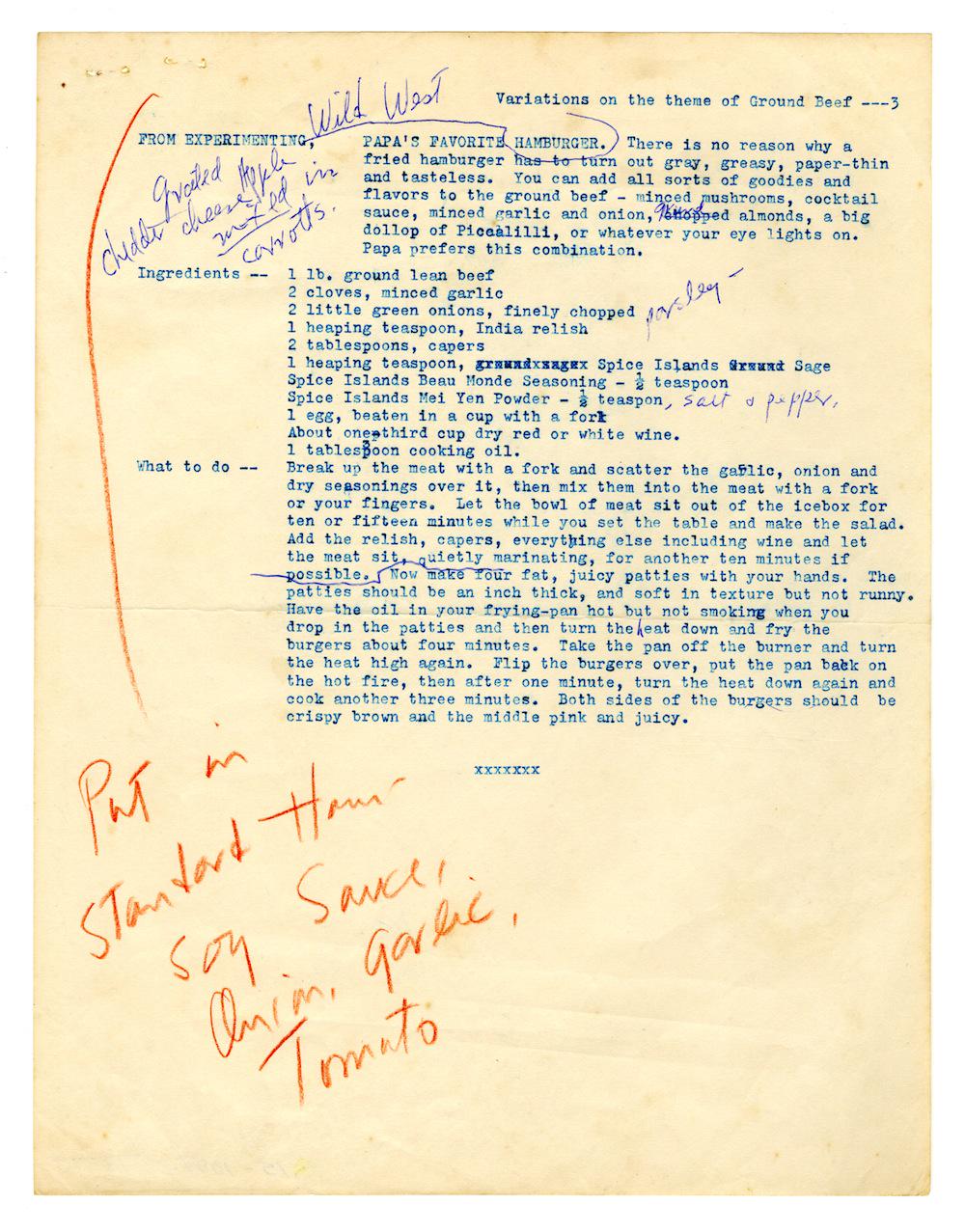
Ernest Hemingway’s Wild West Hamburger

Ernest Hemingway’s favorite burger:

FROM EXPERIMENTING,

PAPA’S FAVORITE HAMBURGER. There is no reason why a fried hamburger has to turn out gray, greasy, paper-thin and tasteless. You can add all sorts of goodies and flavors to the ground beef — minced mushrooms, cocktail sauce, minced garlic and onion, chopped almonds, a big dollop of piccadilli, or whatever your eye lights on. Papa prefers this combination.

Ingredients —

1 lb. ground lean beef

2 cloves, minced garlic

2 little green onions, finely chopped

1 heaping teaspoon, India relish

2 tablespoons, capers

1 heaping teaspoon, Spice Islands sage

Spice Islands Beau Monde Seasoning — ½ teaspoon

Spice Islands Mei Yen Powder — ½ teaspoon **

1 egg, beaten in a cup with a fork

About one third cup dry red or white wine.

1 tablespoon cooking oil

What to do —

Break up the meat with a fork and scatter the garlic, onion and dry seasonings over it, then mix them into the meat with a fork or your fingers. Let the bowl of meat sit out of the icebox for ten or fifteen minutes while you set the table and make the salad. Add the relish, capers, everything else including wine and let the meat sit, quietly marinating, for another ten minutes if possible. Now make four fat, juicy patties with your hands. The patties should be an inch thick, and soft in texture but not runny. Have the oil in your frying-pan hot but not smoking when you drop in the patties and then turn the heat down and fry the burgers about four minutes. Take the pan off the burner and turn the heat high again. Flip the burgers over, put the pan back on the hot fire, then after one minute, turn the heat down again and cook another three minutes. Both sides of the burgers should be crispy brown and the middle pink and juicy.

More at The Paris Review; image via.

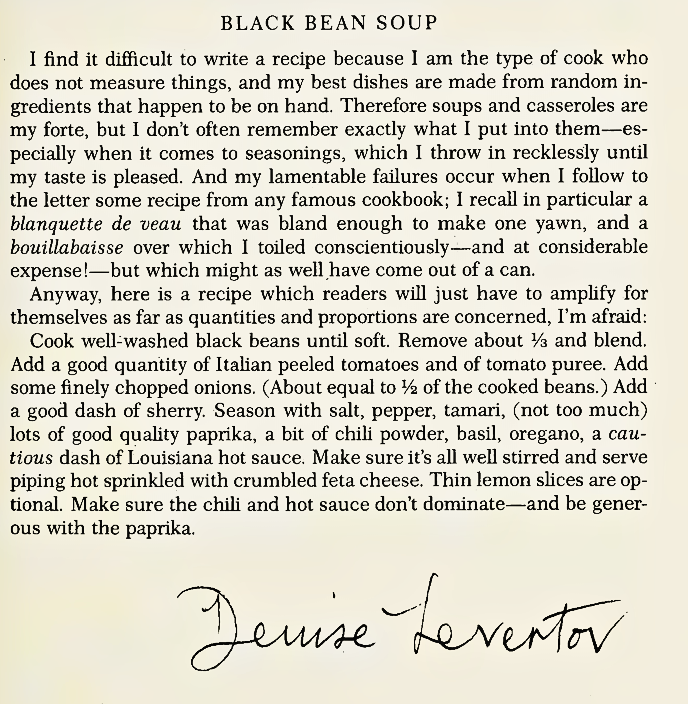
Denise Levertov’s Black Bean Soup

Denis Levertov’s recipe for black bean soup:

I find it difficult to write a recipe because I am the type of cook who does not measure things, and my best dishes are made from random ingredients that happen to be on hand. Therefore soups and casseroles are my forte, but I don’t often remember exactly what I put into them—especially when it comes to seasonings, which I throw in recklessly until my taste is pleased. And my lamentable failures occur when I follow to the letter some recipe from any famous cookbook; I recall in particular a blanquette de veau that was bland enough to make one yawn, and a bouillabaisse over which I toiled conscientiously–and at considerable expense!–but which might as well have come out of a can.

Anyway, here is a recipe which readers will just have to amplify for themselves as far as quantities and proportions are concerned, I’m afraid:

Cook well-washed black beans until soft. Remove about ⅛ and blend. Add a good quantity of Italian peeled tomatoes and of tomato puree.”Add some finely chopped onions. (About equal to ½ of the cooked beans.) Add a good dash of sherry. Season with salt, pepper, tamari, (not too much) lots of good quality paprika, a bit of chili powder, basil, oregano, a cautious dash of Louisiana hot sauce. Make sure it’s all well stirred and serve piping hot sprinkled with crumbled feta cheese. Thin lemon slices are optional. Make sure the chili and hot sauce don’t dominate—and be generous with the paprika.

From The Great American Writers’ Cookbook (ed. Dean Faulkner Wells, 1981).

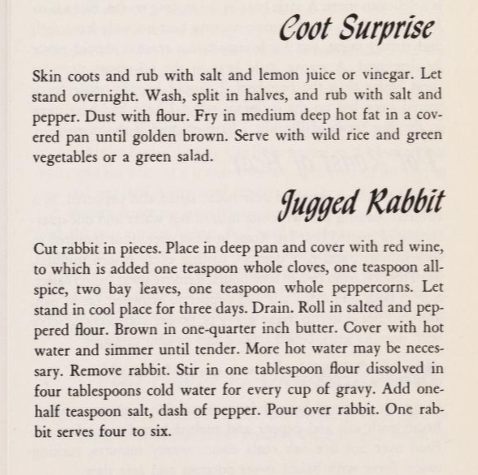
Marjorie Kinnan Rawlings’ Recipes for Coot Surprise, Jugged Rabbit, and Jellied Tongue

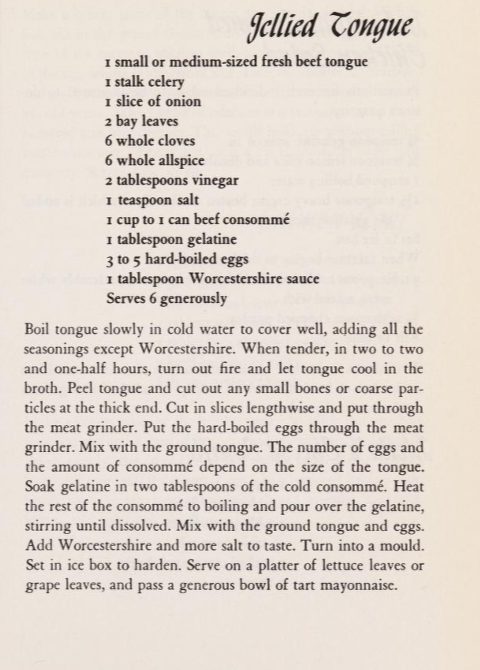
The following recipes are from Marjorie Kinnan Rawlings’ 1942 cookbook Cross Creek Cookery, which was published the same year as her seminal Florida memoir Cross Creek. If you ever find yourself in north central Florida, you might dine at The Yearling, where some of the dishes from Rawlings’ cookbook are still served.

Coot Surprise

Skin coots and rub with salt and lemon juice or vinegar. Let stand overnight. Wash, split in halves, and rub with salt and pepper. Dust with flour. Fry in medium deep hot fat in a covered pan until golden brown. Serve with wild rice and green vegetables or a green salad.


Jugged Rabbit

Cut rabbit in pieces. Place in deep pan and cover with red wine, to which is added one teaspoon whole cloves, one teaspoon all-spice, two bay leaves, one teaspoon whole peppercorns. Let stand in cool place for three days. Drain. Roll in salted and peppered four. Brown in one-quarter inch butter. Cover with hot water and simmer until tender. More hot water may be necessary. Remove rabbit. Stir in one tablespoon flour dissolved in four tablespoons cold water for every cup of gravy. Add one-half teaspoon salt, dash of pepper. Pour over rabbit. One rabbit serves four to six.

Jellied Tongue

1 small or medium-sized fresh beef tongue 1 stalk celery 

1 slice of onion

2 bay leaves

6 whole cloves

6 whole allspice

2 tablespoons vinegar

1 teaspoon salt

1 cup to 1 can beef consommé

1 tablespoon gelatine

3 to 5 hard-boiled eggs

1 tablespoon Worcestershire sauce

Serves 6 generously

Boil tongue slowly in cold water to cover well, adding all the seasonings except Worcestershire. When tender, in two to two and one-half hours, turn out fire and let tongue cool in the broth. Peel tongue and cut out any small bones or coarse particles at the thick end. Cut in slices lengthwise and put through the meat grinder. Put the hard-boiled eggs through the meat grinder. Mix with the ground tongue. The number of eggs and the amount of consommé depend on the size of the tongue. Soak gelatine in two tablespoons of the cold consommé. Heat the rest of the consommé to boiling and pour over the gelatine, stirring until dissolved. Mix with the ground tongue and eggs. Add Worcestershire and more salt to taste. Turn into a mould. Set in ice box to harden. Serve on a platter of lettuce leaves or grape leaves, and pass a generous bowl of tart mayonnaise.

Donald Barthelme’s Fine Homemade Soups

DONALD BARTHELME’S FINE HOMEMADE SOUPS

My fine homemade soups are interesting, economical, and tasty. To make them, one proceeds in the following way:

Fine Homemade Leek Soup

Take one package Knorr Leek Soupmix. Prepare as directed. Take two live leeks. Chop leeks into quarter-inch rounds. Throw into Soupmix.

Throw in ½ cup Tribuno Dry Vermouth. Throw in chopped parsley.

Throw in some amount of salt and a heavy bit of freshly-ground pepper.

Eat with good-quality French bread, dipped repeatedly in soup.

Fine Homemade Mushroom Soup

Take one package Knorr Mushroom Soupmix. Prepare as directed.

Take four large mushrooms. Slice. Throw into Soupmix. Throw in ⅛ cup Tribuno Dry Vermouth, parsley, salt, pepper. Stick bread as above into soup at intervals. Buttering bread enhances taste of the whole.

Fine Homemade Chicken Soup

Take Knorr Chicken Soupmix, prepare as directed, throw in leftover chicken, duck, or goose as available. Add enhancements as above.

Fine Homemade Oxtail Soup

Take Knorr Oxtail Soupmix, decant into same any leftover meat (sliced or diced) from the old refrigerator. Follow above strategies to the letter.

The result will make you happy. Knorr’s Oxtail is also good as a basic gravy-maker and constituent of a fine fake cassoulet about which we can talk at another time. Knorr is a very good Swiss outfit whose products can be found in both major and minor cities. The point here is not to be afraid of the potential soup but to approach it with the attitude that you know what’s best for it. And you do. The rawness of the vegetables refreshes the civilization of the Soupmixes. And there are opportunities for mercy-if your ox does not wish to part with his tail, for example, to dress up your fine Oxtail Soup, you can use commercial products from our great American supermarkets, which will be almost as good. These fine homemade recipes work! Use them with furious enthusiasm.

From The Great American Writers’ Cookbook (ed. Dean Faulkner Wells, 1981).

John Cage’s Homemade Bread

5 cups vegetable purée or gruel (see note)
5 cups stone-ground wholewheat flour
4 tablespoons fresh minced dill
1 teaspoon salt

1. Combine purée and flour in a large mixing bowl. Mix thoroughly. If the mixture is too liquid to knead add more flour. If too dry add more liquid.

2. Knead the mixture for 10 minutes. Turn into an 8½ -by–4½ -by–2½ breadpan.

3. Bake in a pre-heated 375 degree oven for 1 hour 15 minutes.

4. Turn out onto a rack and cool.

Note: Mr. Cage uses leftover cooked vegetables such as broccoli, kale, spinach, carrots, celery, celery root and squash, which he purées in a food processor with vegetable stock or water. The bread has the consistency of a dense German pumpernickel and goes well with smoked salmon.

John Cage’s homemade bread recipe was published as part of an 18 March 1981 New York Times feature.

Ntozake Shange’s turkey hash recipe

Hilda’s Turkey Hash

1 pound diced cooked turkey meat

(white & dark)

1 tablespoon cornstarch

3 tablespoons butter

2 medium onions, diced

Salt to taste, pepper too

1 red sweet pepper, diced

(A dash of corn liquor, optional)

1 full boiled potato, diced

In a heavy skillet, put your butter. Sauté your onions & red pepper. Add your turkey, once your onions are transparent. When the turkey’s sizzling, add your potato. Stir. If consistency is not to your liking, add the cornstarch to thicken, the corn liquor to thin. Test to see how much salt & pepper you want. & don’t forget your cayenne.

From Ntozake Shange’s novel Sassafrass, Cypress & Indigo.