Anne Tyler’s Hot Crab Sandwiches

Hot Crab Sandwiches

¼ cup homemade mayonnaise

1 tablespoon minced parsley

2 tablespoons sour cream

1 ½ teaspoons fresh lemon juice

¼ teaspoon garlic salt

½ lb. fresh jumbo lump crabmeat

4 English muffins, fork-split

Butter, room temperature

8 slices Swiss cheese

Sprinkling of paprika

Combine the first 5 ingredients. Then mix in the crab, using your hands. (Sorry, it’s the only respectful way to treat crab.) Spread the English muffins thinly with butter, cover with the Swiss cheese and top with the crab mixture. Dust with paprika.

Bake at 350° for 15 to 20 minutes, or till lightly browned on top. Serves 4.

From The New Great American Writers’ Cookbook (ed. Dean Faulkner Wells, 2003).

Larry Brown’s Squirrel and Biscuits and Gravy

Squirrel and Biscuits and Gravy

Go out into the woods, early or late, but preferably not in the middle of the day. Walk softly. You should have a gun of some sort, something like a 12-gauge shotgun with high brass #6s. Find a secluded hollow of leafy trees such as hickory, red oak, or white oak. Be quiet. Sit down. Don’t talk or smoke or move, even if your ass goes to sleep. You might have to wait for a long time, especially if you made a bunch of noise coming in.

If you see a squirrel far off, don’t go chasing after him because he’ll only run away and you’ll never see him again. They’re small, but they have good eyes. The best thing is to get there before daylight, when it’s still good and dark, and the squirrels are asleep in their nests, and be there waiting for them when they wake up and start feeding. You’ll be able to recognize this when the limbs start jumping and moving. Be patient. Wait for them to come to you. If one comes close enough, shoot it. But don’t get up and go get it. Just let it stay there, unless you’ve only wounded it and it starts trying to crawl off, at which point you’ll be forced to go in after it and polish it off with another shot, or maybe even a stick. One good whack over the head is usually enough, and it keeps meat mutilation to a minimum.

Don’t try to pick him up unless you’re sure he’s dead. Squirrels are small, sure, but remember that they cut those tough walnuts and hickory nuts open with their teeth, and think about what they could do to one of your fingers.

Okay. You’ve got your squirrel, he’s dead, and you’ve got him in your game bag and are headed back to the house with him. The next thing you’re going to need is somebody to help you dress him, unless you’ve been dressing them since you were fourteen and can do it by yourself.

The main idea is to get the hair off him without getting hair all over the meat because it’s almost impossible to pick it off.

When you’ve found a willing partner, and a sharp knife, hold the squirrel between you. Pinch up a bit of the skin on his back and hold it tight between you and your partner. Slice a little hole in there, straight down. Now work your fingers into that little hole and widen it, and pull against each other. If the squirrel’s not thirty years old and white around the muzzle with age, the skin should part. Just keep pulling on it until it strips off all the way around except for a tough little piece of skin that’ll be on the belly. You’ll have to cut through that little strip with your knife. Then work the skin on back, off the hips and the shoulders, then stop a minute. Work each of the legs out like taking a tight glove off, and cut off the feet, the tail, and the head. Cut him open from stem to stern and take out all the insides. Wash him good under the faucet, and then take him inside. He’ll be dripping bloody water. Expect that.

Now, depending on what kind of load you hit him with and how close he was and whether you had to shoot him again or not, he’s going to have X amount of lead pellets driven into the meat and believe me, it’s not going to be any fun to bite down on one of those babies with your new porcelain crown, and if you break it you’re going to have to pay Hal Haney some more money. I know. I was once over in Georgia doing a gig and a lady I was staying with fed me some kind of brittle trail mix for breakfast and I wound up paying Hal a whole bunch of money to fix my tooth after it broke. So try to dig those little lead pellets out of there as best you can.

Don’t get in any hurry. This squirrel’s nowhere ready to eat yet. Those lead pellets will have caused some bloody spots in the meat, and there’s only one way to get them out: salty water. Put him in a pan and cover him with cold water. Sprinkle a good bit of salt over each bloody spot and then put him in the refrigerator and let him stay overnight. Pour off that bloody water the next day, rinse him in some fresh water, and then you’ll be ready to cut him up.

Cut off the front legs first. Cut the rib cage off just behind the last ribs and toss it. Nothing but bone on it. Not fit to eat. But the middle back part, right behind that, has a lot of meat on it, so cut that off from the back legs, and cut the pelvic bone between the back legs in two. That gives you five pieces. It’s just like dressing a rabbit.

Now if a squirrel is old, he’s going to be tough. Little young squirrels that you can put in your pocket can go straight into the frying pan. But if his muzzle was kind of white, or he had some white hairs on his legs, he’s old, and he’s going to have to be parboiled. You don’t want to eat a stringy squirrel, not after you’ve already gone to all this trouble, bought your license, driven out to Wally World for shells, etc.

You need to parboil a tough squirrel for a couple of hours. Put him in there and just let him cook for a while. Stick a fork in there once in a while. You’ll be able to tell when he’s tender.

It is morally wrong to fry a squirrel in anything besides a big black iron skillet. Put you a little vegetable oil in there and let it warm up. You’re gonna want to cook him at a low heat. Get you a pan of flour and sprinkle some salt and black pepper in there. Put the squirrel pieces in there and roll them around for a while. Turn on the oven. Fix you a drink. See if you can find some good music on the radio.

Cook the squirrel until it browns, turning often. It should work up a nice crispy brown crust. Get some biscuits out of the refrigerator and put them in the oven to cook about the same time you’re ready to start making gravy.

Take the squirrel out of the skillet and drain it on some paper towels. Turn the heat up a little under the skillet and sprinkle a little of that flour from your pan in there and just kind of stir it around with a fork. It’ll be kind of thin and soupy at first and won’t look like gravy at all, but it is actually gravy in its embryonic stage. If it’s way thin, put a little more flour in there. When it starts turning brown, go over to the sink and draw you a big glass of cold water.

How brown you want your gravy is up to you. Some people don’t know what the hell they’re doing and let it burn and get too brown and that ruins it. You want it just a nice pale brown. When it gets like that, dump that cold water in there on it and observe the transformation. I don’t know what the scientific explanation for it is or what kind of a physical thing happens in the skillet, but it’s something I guess about cold water hitting hot embryonic gravy. It’ll get real thin all of a sudden and then almost immediately it’ll start to thicken. Just keep stirring it. Add a little more water to it until you get it just like you want it.

At this point you’ve got two options: you can pile that squirrel back into the skillet with that gravy and clap a lid over it and let it simmer on low heat for about 30 minutes, or you can haul those biscuits that are ready by now out of the oven and fall to just like it is. Either way, your mouth’ll be happy.

From The New Great American Writers’ Cookbook (ed. Dean Faulkner Wells, 2003).

Walker Percy’s Salt Steak

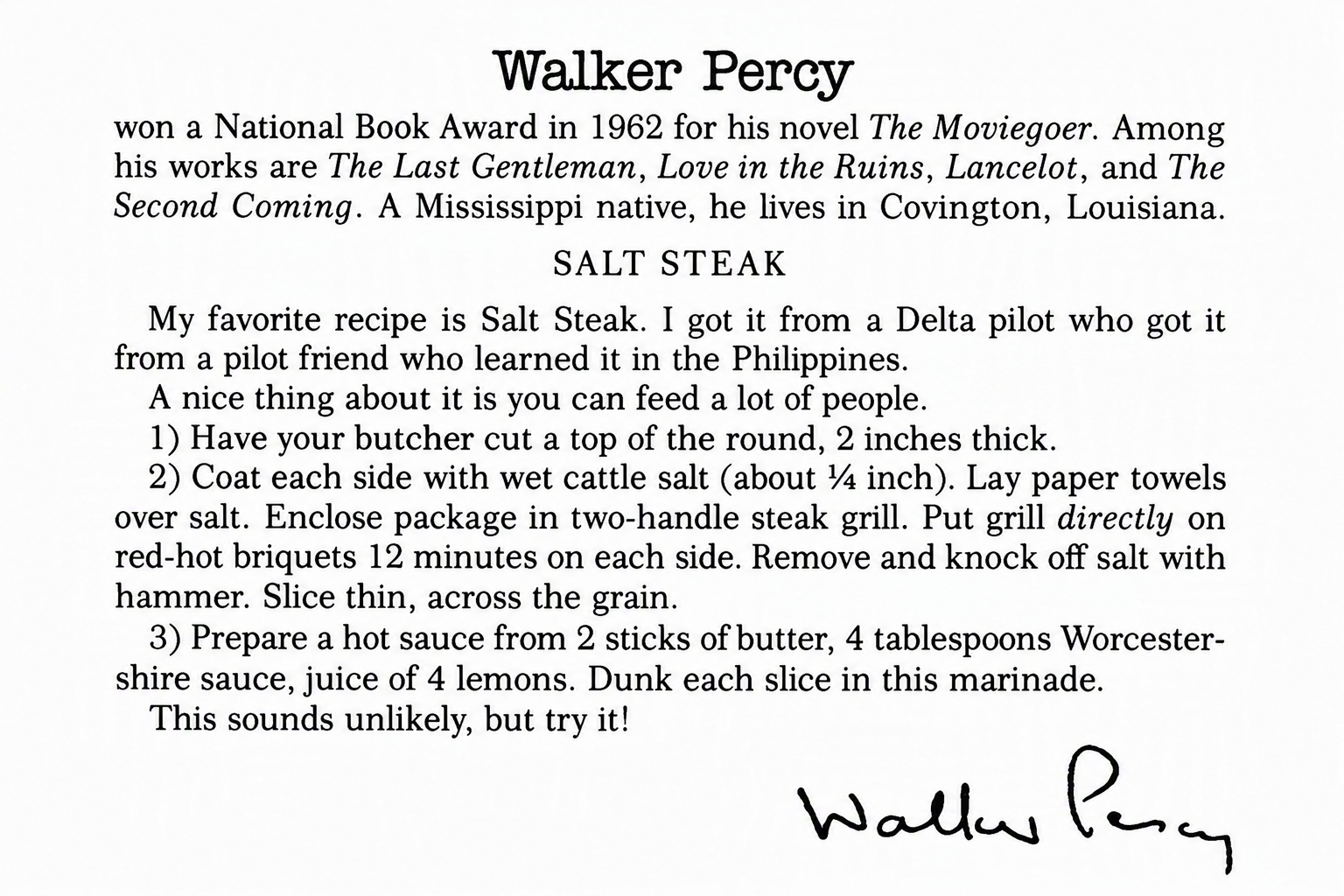
My favorite recipe is Salt Steak. I got it from a Delta pilot who got it from a pilot friend who learned it in the Philippines.

A nice thing about it is you can feed a lot of people.

  1. Have your butcher cut a top of the round, 2 inches thick.
  2. Coat each side with wet cattle salt (about ¼ inch). Lay paper towels over salt. Enclose package in two-handle steak grill. Put grill directly on red-hot briquets 12 minutes on each side. Remove and knock off salt with hammer. Slice thin, across the grain.
  3. Prepare a hot sauce from 2 sticks of butter, 4 tablespoons Worcestershire sauce, juice of 4 lemons. Dunk each slice in this marinade.

This sounds unlikely, but try it!

From The Great American Writers’ Cookbook (ed. Dean Faulkner Wells, 1981).

Emily Dickinson’s Isinglass Chocolate Dessert

Chocolate Dessert

Please break an Ounce Isinglass in a Quart of fresh Milk, placing in boiling Water till quite dissolved, adding afterward four table spoons Chocolate shavings and two of Sugar, boiling together fifteen minutes and straining before turning into molds.—Letters of Emily Dickinson, II 376.

From Literary Eats: Emily Dickinson’s Gingerbread, Ernest Hemingway’s Picadillo, Eudora Welty’s Onion Pie and 400+ Other Recipes from American Authors Past and Present, a 2014 cookbook compiled by Gary Scharnhorst.

Raymond Chandler’s Gimlet

Gimlet

One of the founders, with Dashiell Hammett, of the so-called hard-boiled school of detective fiction, Raymond Chandler (1888–1959) offers a recipe for a gimlet in the voice of one of his characters in The Long Goodbye (1953).

A real gimlet is half gin and half Rose’s Lime Juice and nothing else. It beats martinis hollow.—Chandler, Later Novels and Other Writings (New York: Library of America, 1995), 432.

From Literary Eats: Emily Dickinson’s Gingerbread, Ernest Hemingway’s Picadillo, Eudora Welty’s Onion Pie and 400+ Other Recipes from American Authors Past and Present, a 2014 cookbook compiled by Gary Scharnhorst.

H.G. Wells’ Anchovy Toast

Anchovy Toast

KIPPS, THE STORY OF A SIMPLE SOUL (1905)

by H. G. Wells

And after Chitterlow had . . . given him some anchovy paste piping hot on buttered toast, which he preferred to all other remedies he had encountered, Kipps . . . prepared to face Mr. Shalford and the reckoning for this wild, unprecedented night—the first “night out” that ever he had taken.

Young Kipps has been apprenticed as a draper to Mr. Shalford of Folkstone. While learning the retail trade, he leads a dull life with no possibility of bettering himself or escaping from his place in the system. Then he meets Chitterlow. Having run into Kipps with his bicycle, Chitterlow takes him home and tries to make amends for causing the mishap. He offers him whiskey and befriends him. They talk. Kipps, pleased with the worldly appearance he is making with the would-be playwright, accepts more whiskey. Fortified by the quantities of drink in which they indulge, the two become great and important people, and even the shabby room takes on a glamorous appearance.

Kipps fails to leave on time and is locked out of his premises above the drapery emporium. He must spend the night out, with loss of his job as an inevitable consequence.

When he awakens in the morning with a hangover, Chitterlow has the remedy—anchovy on toast—to restore him to sobriety. Although Kipps has learned about the pleasant, carefree, and oblivious state produced by alcohol, he will never succumb to drunkenness. He agonizes over his dismissal and considers his life irrevocably ruined by Chitterlow but does not resort to the consolation that might be found in a retreat to a state of total intoxication. Kipps knows, knows instinctively, that he has had enough.

At the commercial establishment, he explains to a fellow worker the effect of anchovy toast, taken to rectify his physical condition. He was in bad shape, he admits, before his energizer: “Anchovy on hot buttered toast. It’s the very best pick-me-up there is.” Anchovy toast becomes part of a scene vital to the understanding of the hero’s inner traits. The scene shows Kipps as “one of those who always know when they have had enough.”

By chance, Chitterlow brings fortune into the life of Kipps when he tells him of a newspaper item he has seen searching for a missing heir. As matters turn out, Kipps is the illegitimate son of a man whose father prevented him from marrying. To make amends, the old man has left a very substantial legacy for his grandson. Now Kipps can abandon the life of drudgery and the bleak future for which he had seemed destined.

He returns home to New Romney to regale his aunt and uncle with the unbelievably good news. At the simple supper table, Kipps convinces them of the authenticity of his claims. He retires after a supper of Welsh rarebit and considers his new life.

That anchovy toast was an accepted method of curbing the ill effects of alcohol in Victorian times seems to be corroborated by the redoubtable Mrs. Beeton in her Book of Household Management of 1861. In a note following her recipe, she warns against adulteration of the anchovy delicacy and adds that anchovy paste spread on toast is eaten by gentlemen at wine parties, thus enabling them to “enjoy their port with redoubled gusto.”

In any case, anchovy toast goes well with wine and would make a fine hors d’oeuvre.


Anchovy Butter or Paste

INGREDIENTS.—2 dozen anchovies, ½ lb. of fresh butter.

Mode.—Wash the anchovies thoroughly; bone and dry them, and pound them in a mortar to a paste. Mix the butter gradually with them, and rub the whole through a sieve. Put it by in small pots for use, and carefully exclude the air with a bladder, as it soon changes the colour of anchovies, besides spoiling them.

Average cost for this quantity, 2s.

Anchovy Toast

INGREDIENTS.—Toast 2 or 3 slices of bread, or, if wanted very savoury, fry them in clarified butter, and spread on them the paste. Made mustard, or a few grains of cayenne, may be added to the paste before laying it on the toast.

[Recipe from Novel Cuisine: Recipes that Recreate the Culinary Highlights of Favorite Novels by Elaine Borish.]

Padgett Powell’s Cracker-Yucatan Ribs

Cracker-Yucatan Ribs

This is a heretical paraphrase of Diana Kennedy’s Cochinita Pibil recipe in her Cuisines of Mexico. Her recipe is for pork loin wrapped in banana leaves and cooked underground. It takes more nerve than I have to put a good piece of meat in a hole in the ground.

You are going to make a paste, or a loose sauce, whatever you prefer, of the following seasonings in either vinegar or orange juice or both. The original recipe calls for Seville oranges—any that are sour will do. I just go with white vinegar; I do not like the wine or other fancy tinctures.

¼ to ½ teaspoon allspice

¼ to ½ teaspoon cumin

1 teaspoon oregano

3 teaspoons salt

Garlic, handful of peeled cloves

2 dozen black peppercorns

Several dried red peppers

Paprika for color, mostly

Blend these with just enough vinegar to make a heavy sauce. The figures given are very loose guides and should be regarded so. Use any ratio of this to that you like, and you needn’t use all the ingredients. The essence here is conveyed, I believe, by the cumin, allspice, and salt. Marinate the slab of ribs—overnight is good, a couple of hours will do.

Ribs in black joints in Memphis may, but ribs do not to my mind need long, or particularly slow, cooking. And they can take some heat. A wood fire just hot enough to not burn them is good (with the ribs about a foot above the fire); about an hour will do, then gentle holding. You can wet the ribs with the paste/sauce as you turn them. You are basically trying to get the fat out of them, which you will never do, which is why they are good no matter what you put on them.

From The New Great American Writers’ Cookbook (ed. Dean Faulkner Wells, 2003).

Samuel Beckett’s Irish Stew

IRISH STEW

I peered into the pots. Irish stew. A nourishing and economical dish, if a little indigestible. All honour to the land it has brought before the world.

— Molloy

Clodagh King lives on Achill Island in County Mayo. She is an amazing cook and hostess and always looks impeccably glamorous despite the prevailing winds in that corner of Ireland. Heinrich Böll describes her in Irish Journal as the doctor’s wife with the pearly pink fingernails running a practice at the edge of Europe. Her recipe for Irish Stew is unrivalled, so we make no apologies for including Irish Stew, even though it is a common feature in all Irish cookbooks.

8 gigot lamb chops
3½ pt (1¾ l) water
salt and black pepper
2 bay leaves
2 sprigs thyme
2 sage leaves
2 sprigs parsley
4 large carrots
4 parsnips
1 large turnip
4 large onions
about 12 medium potatoes

Place the chops in a very large saucepan, add the water and season with salt and pepper. Tie the herbs in a bouquet garni and place in the saucepan. Bring to the boil very gently, then simmer while you prepare the vegetables. Chop the vegetables and cut the potatoes into halves. Put a layer of onions on top of the meat, then a layer of carrots, followed by the turnips and parsnips. Season each layer to taste. The top layer should be potatoes. Bring back to the boil and simmer gently for 1½ to 2 hours. This amount serves four ravenous or eight normal people.

From Veronica Jane O’Mara and Fionnuala O’Reilly’s 1993 collection A Trifle, a Coddle, a Fry: An Irish Literary Cookbook.

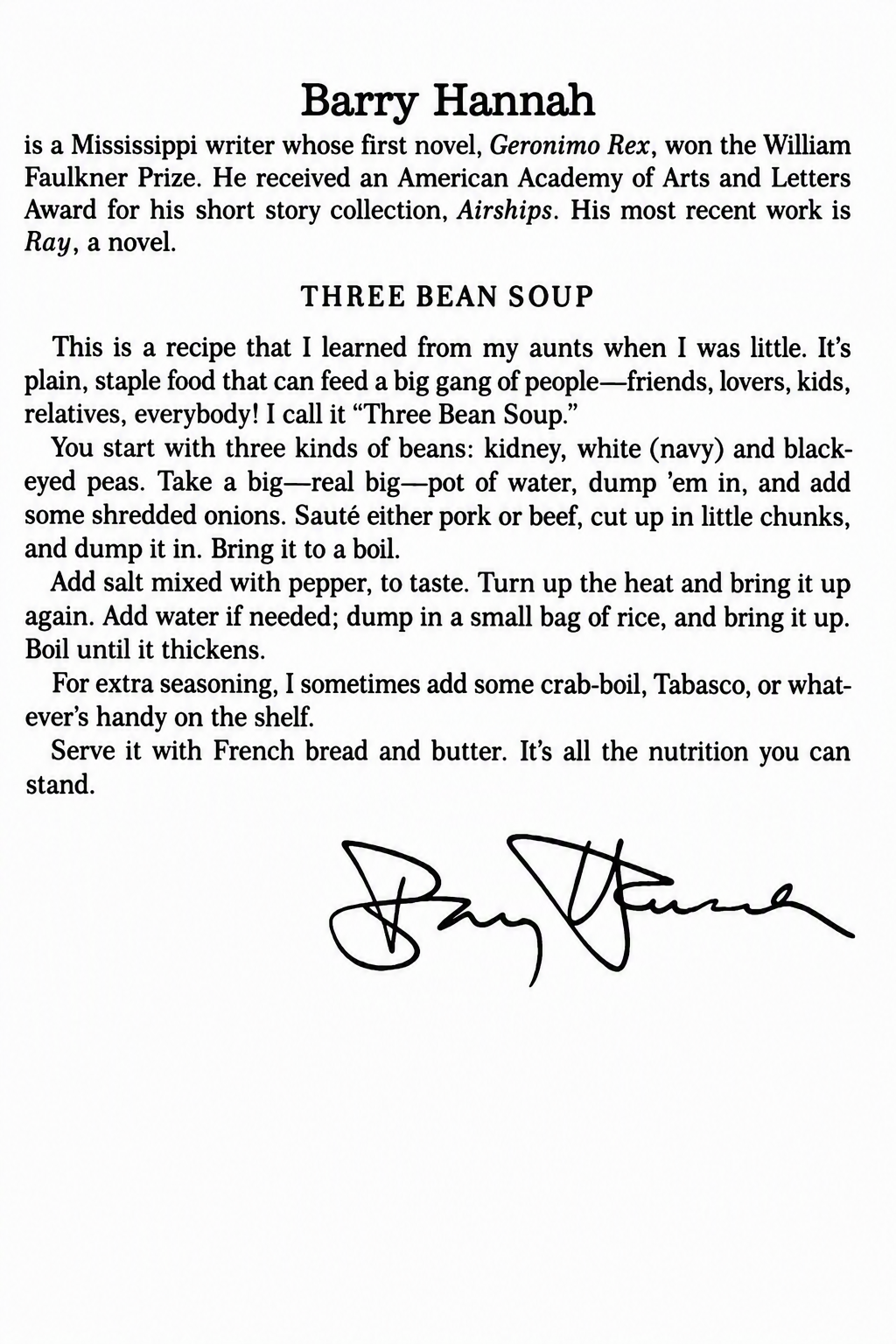
Barry Hannah’s Three Bean Soup

Three Bean Soup

This is a recipe that I learned from my aunts when I was little. It’s plain, staple food that can feed a big gang of people—friends, lovers, kids, relatives, everybody! I call it “Three Bean Soup.”

You start with three kinds of beans: kidney, white (navy) and black-eyed peas. Take a big—real big—pot of water, dump ’em in, and add some shredded onions. Sauté either pork or beef, cut up in little chunks, and dump it in. Bring it to a boil.

Add salt mixed with pepper, to taste. Turn up the heat and bring it up again. Add water if needed; dump in a small bag of rice, and bring it up. Boil until it thickens.

For extra seasoning, I sometimes add some crab-boil, Tabasco, or whatever’s handy on the shelf.

Serve it with French bread and butter. It’s all the nutrition you can stand.

From The Great American Writers’ Cookbook (ed. Dean Faulkner Wells, 1981).

Virginia Woolf’s Boeuf en Daube

Virginia Woolf’s Boeuf en Daube (from To the Lighthouse)

Everything depended upon things being served up the precise moment they were ready. The beef, the bay leaf, and the wine all must be done to a turn. To keep it waiting was out of the question. Yet of course tonight, of all nights, out they went, and they came in late, and things had to be sent out, things had to be kept hot; the Boeuf en Daube would be entirely spoilt.— Virginia Woolf, To the Lighthouse

BOEUF EN DAUBE

(Beef en Casserole)Ingredients

3 pounds chuck or stewing beef, cut into 2-inch cubes

1½ cups red wine

¼ cup cognac

2 tablespoons peanut oil

Salt, to taste

Freshly ground black pepper, to taste

½ teaspoon thyme

1 bay leaf

1 large onion, coarsely chopped

2 cloves garlic, crushed

2 cups carrots, scraped and thinly sliced

½ cup celery, coarsely chopped

½ pound lean bacon, sliced, each slice cut in half

Water

Flour, for dredging

2 cups mushrooms, thinly sliced

2½ cups Italian plum tomatoes, or fresh ripe tomatoes, cored, peeled, and chopped

2 cups beef stock, fresh or canned

Instructions

  1. Place the beef in a large mixing bowl and add the wine, cognac, oil, salt, pepper, thyme, bay leaf, onion, garlic, carrots, and celery. Cover and refrigerate for at least 3 hours, or longer.
  2. Preheat the oven to 350°F.
  3. Place the bacon in a saucepan and add just enough water to cover. Simmer for 5 minutes, then drain.
  1. Line a heatproof casserole with three or four pieces of bacon. Drain the beef, reserving the marinade.
  2. Dredge each cube of beef in flour and shake off the excess. Arrange a layer of beef in the casserole. Add a layer of the marinated vegetables, one-third of the tomatoes, and one-third of the mushrooms. Continue layering until all ingredients are used, ending with vegetables and bacon. Sprinkle with salt and pepper.
  3. Cover and bring to a boil on top of the stove. Place in the oven and bake for 15 minutes.
  4. Reduce the oven temperature to 300°F and continue cooking for 3 to 4 hours. Adjust the heat as necessary so the casserole barely simmers.
  5. Cook until the meat is fork-tender. Skim the fat from the surface and serve with rice or noodles.

Yield: 6 servings.

The recipe is from A Cookbook for Booksellers, a 1965 oddity by Craig Claiborne. The volume was published by The New York Times and given to booksellers as a promotional item.

George Bernhard Shaw’s Pinhead Oatmeal Porridge

GEORGE BERNARD SHAW

PINHEAD OATMEAL PORRIDGE

Broadbent: By the way, you told me I couldn’t have porridge for breakfast; but Mr Doyle has some.

Hodson: Yes, sir. Very sorry, sir. They call it stirabout, sir, that’s how it was. They know no better, sir.

John Bull’s Other Island

As you might have gathered by now, Shaw insists on having his opinion heard, on or off the soap-box, and is always prompt to provide appropriate advice, so we’ll let him take over:

Boil oatmeal porridge for 20 minutes; and if you think the result mere oatmeal and water, try boiling it for two hours. If you still think it as unpalatable as dry bread, treat it as you treat the bread; stir up a bounteous lump of butter in it, and do not forget the salt. In eating wheatmeal porridge, remember that there’s nothing so becomes a man as moderation and an admixture of stewed fruit.

1 cup pinhead oatmeal
3 cups cold water
pinch of salt

Place the ingredients in a heavy pot. Bring to the boil and simmer for approximately 20 minutes, until thick. This makes a nutty, chewy porridge, lovely with salt or honey and cream. (The instructions on some packets of pinhead oatmeal produce something that looks like Dickensian gruel; ignore them.)

We prefer the other sort of porridge, stone-ground oatflakes, which make a smoother porridge, which also has a good flavour.

1 cup stoneground oatflakes
3 cups cold water
pinch of salt

For this, use the same amount of water and a pinch of salt, but it cooks much faster, in about 10 minutes. Serve with demerara sugar and cream.

Serves two to four.

From Veronica Jane O’Mara and Fionnuala O’Reilly’s 1993 collection A Trifle, a Coddle, a Fry: An Irish Literary Cookbook.

William T. Vollmann’s Recipe for Caribou, Arctic Canada Style

Caribou, Arctic Canada Style

1. Kill a caribou, butcher it, and cut the meat into handy 5- or 10-pound chunks.

2. Freeze until needed.

3. Take a hunk of the raw frozen meat and put it on a piece of cardboard on the kitchen floor.

4. Kneel down and chop off a handful of flakes and splinters, using a nice sharp hatchet.

5. Dip in inukpo (seal fat, frozen to the consistency of jelly).

6. Eat.

From The New Great American Writers’ Cookbook (ed. Dean Faulkner Wells, 2003).

“Turkey Remains and How to Inter Them with Numerous Scarce Recipes” — F. Scott Fitzgerald

From F. Scott Fitzgerald’s Notebooks—

TURKEY REMAINS AND HOW TO INTER THEM WITH NUMEROUS SCARCE RECIPES
At this post holiday season the refrigerators of the nation are overstuffed with large masses of turkey, the sight of which is calculated to give an adult an attack of dizziness. It seems, therefore, an appropriate time to give the owners the benefit of my experience as an old gourmet, in using this surplus material. Some of the recipes have been in my family for generations. (This usually occurs when rigor mortis sets in.) They were collected over years, from old cook books, yellowed diaries of the Pilgrim Fathers, mail order catalogues, golfbags and trash cans. Not one but has been tried and proven—there are headstones all over America to testify to the fact.
Very well then: Here goes:

1. Turkey Cocktail
To one large turkey add one gallon of vermouth and a demijohn of angostura bitters. Shake.

2. Turkey at la Francais.
Take a large ripe turkey, prepare as for basting and stuff with old watches and chains and monkey meat. Proceed as with cottage-pudding.

3. Turkey and Water
Take one turkey and one pan of water. Heat the latter to the boiling point and then put in the refrigerator When it has jelled drown the turkey in it. Eat. In preparing this recipe it is best to have a few ham sandwiches around in case things go wrong.

4. Turkey Mongole
Take three butts of salami and a large turkey skeleton from which the feathers and natural stuffing have been removed. Lay them out on the table and call up some Mongole in the neighborhood to tell you how to proceed from there.

5. Turkey Mousee
Seed a large prone turkey, being careful to remove the bones, flesh, fins, gravy, etc. Blow up with a bicycle pump. Mount in becoming style and hang in the front hall.

6. Stolen Turkey
Walk quickly from the market and if accosted remark with a laugh that it had just flown into your arms and you hadn’t noticed it. Then drop the turkey with the white of one egg-well, anyhow, beat it.

7. Turkey a la Creme.
Prepare the creme a day in advance, or even a year in advance. Deluge the turkey with it and cook for six days over a blast furnace. Wrap in fly paper and serve.

8. Turkey Hash
This is the delight of all connoisseurs of the holiday beast, but few understand how really to prepare it. Like a lobster it must be plunged alive into boiling water, until it becomes bright red or purple or something, and then before the color fades, placed quickly in a washing machine and allowed to stew in its own gore as it is whirled around.
Only then is it ready for hash. To hash, take a large sharp tool like a nail-file or if none is handy, a bayonet will serve the purpose—and then get at it! Hash it well! Bind the remains with dental floss and serve.
And now we come to the true aristocrat of turkey dishes:

9. Feathered Turkey.
To prepare this a turkey is necessary and a one pounder cannon to compell anyone to eat it. Broil the feathers and stuff with sage brush, old clothes, almost anything you can dig up. Then sit down and simmer. The feathers are to be eaten like artichokes (and this is not to be confused with the old Roman custom of tickling the throat).

10. Turkey at la Maryland
Take a plump turkey to a barber’s and have him shaved, or if a female bird, given a facial and a water wave. Then before killing him stuff with with old newspapers and put him to roost. He can then be served hot or raw, usually with a thick gravy of mineral oil and rubbing alcohol. (Note: This recipe was given me by an old black mammy.)

11. Turkey Remnant
This is one of the most useful recipes for, though not, “chic”, it tells what to do with the turkey after the holiday, and extract the most value from it.
Take the remants, or if they have been consumed, take the various plates on which the turkey or its parts have rested and stew them for two hours in milk of magnesia. Stuff with moth-balls.

12. Turkey with Whiskey Sauce.
This recipe is for a party of four. Obtain a gallon of whiskey, and allow it to age for several hours. Then serve, allowing one quart for each guest.
The next day the turkey should be added, little by little, constantly stirring and basting.

13. For Weddings or Funerals. Obtain a gross of small white boxes such as are used for bride’s cake. Cut the turkey into small squares, roast, stuff, kill, boil, bake and allow to skewer. Now we are ready to begin. Fill each box with a quantity of soup stock and pile in a handy place. As the liquid elapses, the prepared turkey is added until the guests arrive. The boxes delicately tied with white ribbons are then placed in the handbags of the ladies, or in the men’s side pockets.

There I guess that’s enough turkey to talk. I hope I’ll never see or hear of another until—well, until next year.

Forty Literary Recipes for Thanksgiving (Or Any Other Time)

Breakfast

James Joyce’s Burnt Kidney Breakfast

Thomas Pynchon’s Banana Breakfast

Zelda Fitzgerald’s Special Breakfast

Vladimir Nabokov’s Eggs à la Nabocoque

Soup

Donald Barthelme’s Fine Oxtail Soup and Lentil Soup

Gordon Lish’s Chicken Soup

Ian McEwan’s Fish Stew

Cormac McCarthy’s Turtle Soup

Charles Dickens’ Hare Soup

Walter M. Miller Jr.’s Gopher Tortoise Stew

Ishmael Reed’s Texas Gumbo

Sides

William Carlos Williams’ Fried Onion on Rye Bread with Beer

Sharon Olds’ Bread

John Cage’s Homemade Bread

Zora Neale Hurston’s Mulatto Rice

Italo Calvino’s Love Noodles

Ursula K. Le Guin’s Valley Succotash

Roberto Bolaño’s Brussels Sprouts with Lemon

Robert Crumb’s Macaroni Casserole

Mark Twain’s Ash Cake

Truman Capote’s Caviar-Smothered Baked Potatoes with 80-Proof Russian Vodka

Mains

Ernest Hemingway’s Wild West Hamburger

John Barth’s Chesapeake Bay Suite

Ntozake Shange’s Turkey Hash 

Gordon Lish’s Chopped Liver

Thomas Pynchon’s European Pizza

Marjorie Kinnan Rawlings’ Recipes for Coot Surprise, Jugged Rabbit, and Jellied Tongue

Herman Melville’s Whale Steaks

Donald Barthelme’s Meal of a Certain Elegance

Don DeLillo’s Chicken Parts

Libations

Thomas Pynchon’s Crocodile (A Traditional Anarchist Favorite)

George Orwell’s Nice Cup of Tea

Walker Percy’s Mint Julep

Willam Faulkner’s Hot Toddy

Dessert

Emily Dickinson’s Cocoanut Cake

Eudora Welty’s Jellied Apples

Samuel Beckett’s Assassination Custard

George Orwell’s Plum Cake and Christmas Pudding

Anita Loos’ Kitten’s Tongue

Elizabeth Bishop’s Brownies

Eudora Welty’s Jellied Apples

Pare and core one dozen apples of a variety which will jell successfully. Winesap and Jonathan are both good.

To each dozen apples moisten well two and one-half cups of sugar. Allow this to boil for about five minutes. Then immerse apples in this syrup, allowing plenty of room about each apple. Add the juice of one-half lemon, cover closely, and allow to cook slowly until apples appear somewhat clear. Close watching and frequent turning is necessary to prevent them from falling apart.

Remove from stove and fill centers with a mixture of chopped raisins, pecans, and crystallized ginger, the latter adding very much to the flavor of the finished dish. Sprinkle each apple with granulated sugar and baste several times with the thickening syrup, then place in a 350-degree oven to glaze without cover on vessel. Baste several times during this last process.

Eudora Welty’s recipe for jellied apples is from a pamphlet written for and distributed by the Mississippi Advertising Commission in 1936. Her recipes from that pamphlet are widely available online.

Mark Twain’s Ash Cake

Take a lot of water and add to it a lot of coarse Indian meal and about a quarter of a lot of salt. Mix well together, knead into the form of a “pone,” and let the pone stand awhile—not on its edge, but the other way. Rake away a place among the embers, lay it there, and cover it an inch deep with hot ashes. When it is done, remove it; blow off all the ashes but one layer; butter that one and eat.

N.B.—No household should ever be without this talisman. It has been noticed that tramps never return for another ash cake.

From Mark Twain’s A Tramp Abroad, 1880.

Here’s a contemporary blogger’s take on ash cakes; she uses flour, not cornmeal.

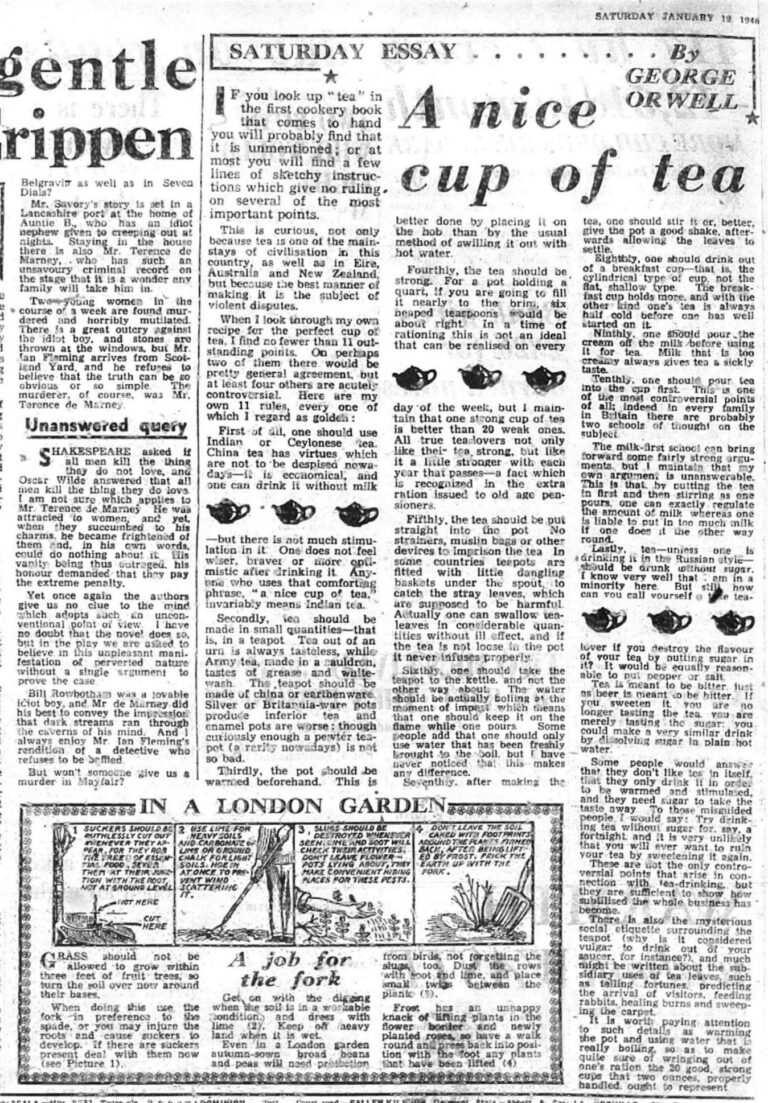
George Orwell’s Nice Cup of Tea

A Nice Cup of Tea
If you look up ‘tea’ in the first cookery book that comes to hand you will probably find that it is unmentioned; or at most you will find a few lines of sketchy instructions which give no ruling on several of the most important points.
This is curious, not only because tea is one of the main stays of civilisation in this country, as well as in Eire, Australia and New Zealand, but because the best manner of making it is the subject of violent disputes.
When I look through my own recipe for the perfect cup of tea, I find no fewer than eleven outstanding points. On perhaps two of them there would be pretty general agreement, but at least four others are acutely controversial. Here are my own eleven rules, every one of which I regard as golden:
First of all, one should use Indian or Ceylonese tea. China tea has virtues which are not to be despised nowadays — it is economical, and one can drink it without milk — but there is not much stimulation in it. One does not feel wiser, braver or more optimistic after drinking it. Anyone who has used that comforting phrase ‘a nice cup of tea’ invariably means Indian tea. Secondly, tea should be made in small quantities — that is, in a teapot. Tea out of an urn is always tasteless, while army tea, made in a cauldron, tastes of grease and whitewash. The teapot should be made of china or earthenware. Silver or Britanniaware teapots produce inferior tea and enamel pots are worse; though curiously enough a pewter teapot (a rarity nowadays) is not so bad.
Thirdly, the pot should be warmed beforehand. This is better done by placing it on the hob than by the usual method of swilling it out with hot water.
Fourthly, the tea should be strong. For a pot holding a quart, if you are going to fill it nearly to the brim, six heaped teaspoons would be about right. In a time of rationing, this is not an idea that can be realised on every day of the week, but I maintain that one strong cup of tea is better than twenty weak ones. All true tea lovers not only like their tea strong, but like it a little stronger with each year that passes — a fact which is recognised in the extra ration issued to old-age pensioners.
Fifthly, the tea should be put straight into the pot. No strainers, muslin bags or other devices to imprison the tea. In some countries teapots are fitted with little dangling baskets under the spout to catch the stray leaves, which are supposed to be harmful. Actually one can swallow tea-leaves in considerable quantities without ill effect, and if the tea is not loose in the pot it never infuses properly.
Sixthly, one should take the teapot to the kettle and not the other way about. The water should be actually boiling at the moment of impact, which means that one should keep it on the flame while one pours. Some people add that one should only use water that has been freshly brought to the boil, but I have never noticed that it makes any difference.
Seventhly, after making the tea, one should stir it, or better, give the pot a good shake, afterwards allowing the leaves to settle.
Eighthly, one should drink out of a good breakfast cup — that is, the cylindrical type of cup, not the flat, shallow type. The breakfast cup holds more, and with the other kind one’s tea is always half cold before one has well started on it.
Ninthly, one should pour the cream off the milk before using it for tea. Milk that is too creamy always gives tea a sickly taste.
Tenthly, one should pour tea into the cup first. This is one of the most controversial points of all; indeed in every family in Britain there are probably two schools of thought on the subject. The milk-first school can bring forward some fairly strong arguments, but I maintain that my own argument is unanswerable. This is that, by putting the tea in first and stirring as one pours, one can exactly regulate the amount of milk whereas one is liable to put in too much milk if one does it the other way round.
Lastly, tea — unless one is drinking it in the Russian style — should be drunk without sugar. I know very well that I am in a minority here. But still, how can you call yourself a true tea-lover if you destroy the flavour of your tea by putting sugar in it? It would be equally reasonable to put in pepper or salt. Tea is meant to be bitter, just as beer is meant to be bitter. If you sweeten it, you are no longer tasting the tea, you are merely tasting the sugar; you could make a very similar drink by dissolving sugar in plain hot water.
Some people would answer that they don’t like tea in itself, that they only drink it in order to be warmed and stimulated, and they need sugar to take the taste away. To those misguided people I would say: Try drinking tea without sugar for, say, a fortnight and it is very unlikely that you will ever want to ruin your tea by sweetening it again.
These are not the only controversial points to arise in connexion with tea drinking, but they are sufficient to show how subtilised the whole business has become. There is also the mysterious social etiquette surrounding the teapot (why is it considered vulgar to drink out of your saucer, for instance?) and much might be written about the subsidiary uses of tea leaves, such as telling fortunes, predicting the arrival of visitors, feeding rabbits, healing burns and sweeping the carpet. It is worth paying attention to such details as warming the pot and using water that is really boiling, so as to make quite sure of wringing out of one’s ration the twenty good, strong cups that two ounces, properly handled, ought to represent.

George Orwell’s recipe/method for a nice cup of tea was first published in the 12 Jan. 1946 issue of the Evening Standard. Image via the Orwell Society.