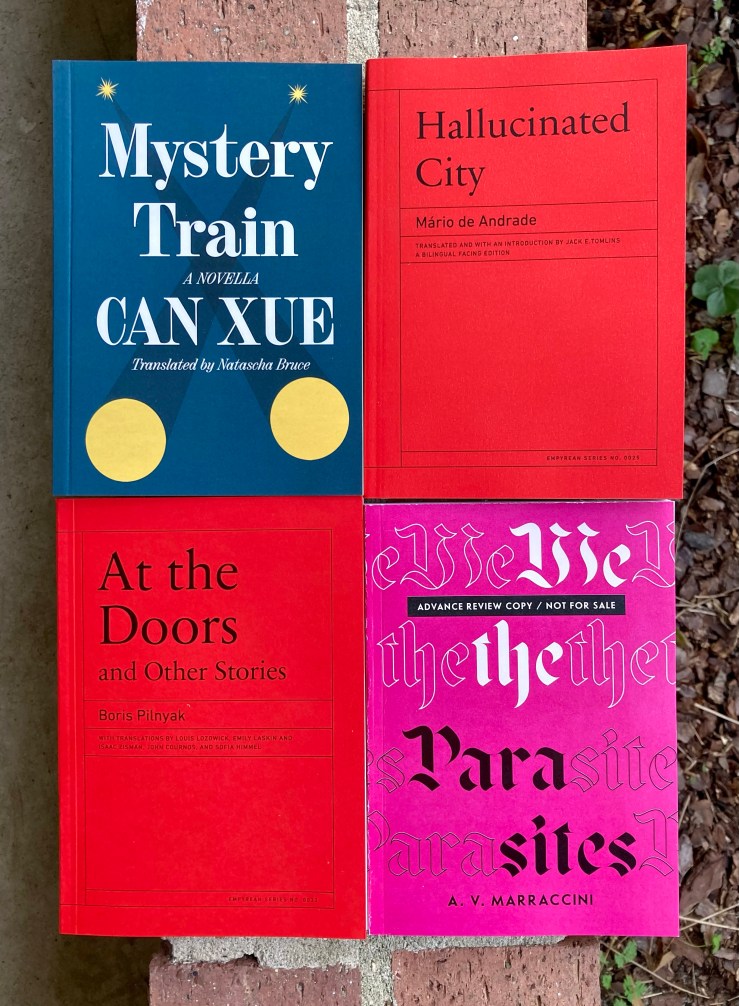
Four handsome fellas from Sublunary Editions.
I really enjoyed At the Doors and Other Stories by Boris Pilnyak (in translation by Emily Laskin, Isaac Zisman, Louis Lozowick, Sofia Himmel, and John Cournos). I dipped into the title story and just kept going. It reminded me a lot of “Mondaugen’s Story” in Pynchon’s V. While the other tales weren’t quite as strong, they were definitely weird. Great stuff.
I also read Mário de Andrade’s Hallucinated City (Jack E. Tomlins), and while these poems by the Brazilian modernist didn’t wholly zap me, there’s nonetheless a persuasive energy here.
Can Xue is maybe the “big name” in this fine little quadrant. Her novella Mystery Train is translated by Natascha Bruce, and it looks pretty fucked-up. Sublunary’s jacket copy:
A chicken-farm employee named Scratch, sent by his manager to buy feed, has boarded the right train. Hasn’t he? So what if the destination on the ticket is wrong, or if he’s locked in his compartment, or if the lights are off and it’s suddenly freezing cold? And surely the whispers of a pending accident are referring to some other event, long in the past. Right? Part allegory, part fever dream, Mystery Train leads the reader on an unsettling journey into a dark wilderness thick with intrigue, mysterious women… and wolves.
A. V. Marraccini’s We the Parasites also seems very promising. The jacket copy describes content—
Intertwining fig wasps, Updike, Genet, Twombly, Rilke, jewel heists, and a vividly rendered panoply of histories and myths from classical antiquity, it both tells a strange love story and makes a slantwise argument about reading with the body. We The Parasites reconfigures how longing changes and informs our relationship with art and literature, and asks what it means to want.
—but the small book’s rhetorical form seems even more intriguing.


 Biblioklept