Eudora Welty’s Jellied Apples

Pare and core one dozen apples of a variety which will jell successfully. Winesap and Jonathan are both good.

To each dozen apples moisten well two and one-half cups of sugar. Allow this to boil for about five minutes. Then immerse apples in this syrup, allowing plenty of room about each apple. Add the juice of one-half lemon, cover closely, and allow to cook slowly until apples appear somewhat clear. Close watching and frequent turning is necessary to prevent them from falling apart.

Remove from stove and fill centers with a mixture of chopped raisins, pecans, and crystallized ginger, the latter adding very much to the flavor of the finished dish. Sprinkle each apple with granulated sugar and baste several times with the thickening syrup, then place in a 350-degree oven to glaze without cover on vessel. Baste several times during this last process.

Eudora Welty’s recipe for jellied apples is from a pamphlet written for and distributed by the Mississippi Advertising Commission in 1936. Her recipes from that pamphlet are widely available online.

Mark Twain’s Ash Cake

Take a lot of water and add to it a lot of coarse Indian meal and about a quarter of a lot of salt. Mix well together, knead into the form of a “pone,” and let the pone stand awhile—not on its edge, but the other way. Rake away a place among the embers, lay it there, and cover it an inch deep with hot ashes. When it is done, remove it; blow off all the ashes but one layer; butter that one and eat.

N.B.—No household should ever be without this talisman. It has been noticed that tramps never return for another ash cake.

From Mark Twain’s A Tramp Abroad, 1880.

Here’s a contemporary blogger’s take on ash cakes; she uses flour, not cornmeal.

Walter M. Miller Jr.’s Gopher Tortoise Stew

Gopher Stew

A book of science fiction recipes should contain a few formulae for things to be cooked in a tin can in the forest after World War III. In the southeast, one such recipe might read simply: Catch, kill, and dress one 10-12 inch gopher, and boil meat until tender, adding any available herbs such as wild garlic and sabal palmetto hearts. The “gopher” of the recipe is not a rodent but a burrowing land tortoise, Gopherus polyphemus, common in this region and long a part of that swampland cuisine lately called “soul food.” In the summer and early fall, gophers are seen migrating across roads and through sandy clearings; when you approach, the animal’s only defense is to pull himself inside his shell and batten down the hatches. Because of the shell, a slow metabolism, and a subterranean abode, the gopher should have a better resistance to radiation than most hard-to-catch game. In the winter, you will find them underground, but dig with caution; the gopher sometimes shares his bole with a south-
eastern diamondback.

Calculate the position of the retracted head and kill either by putting a bullet through the shell just behind this point, or by breaking through the shell with hammer, hatchet, or pointed stone, and inserting a sharp knife to sever the neck. Chop all around the edges of the bottom shell plate, completely severing it from the top shell, insert a machete or long stiff butcher knife between the plate and the belly and slice the plate free. Dump the entrails, not bothering to look into the matter of reptilian giblets unless you’re really starving. By now you are feeling somewhat guilty because the headless beast keeps thrashing and waving its paws as it tries to crawl away: it’s not a mammal, so forget it. Reptilian meat is very persistent. Grasp the paws with a pair of pliers and stretch them out (against their will) while you cut around behind them and free the meat from the shell. A large gopher should yield about a quart of meat, including bone. Scrub the feet thoroughly, but do not attempt to skin or declaw, part of the backwoods charm of this dish is the sight of scaly reptilian feet floating with the onions and carrots in the tomatoey goop. Treat the meat with an ordinary papayin-based tenderizer, liquid or powder, and freeze it until you find another tortoise if one is not enough. (One does not ordinarily hunt the creatures, but encounters then while fishing, hunting, or walking in the woods.) Other types of turtle nay be substituted for gopher.

1 quart tortoise meat chunks
3-4 slices bacon
1. 1b. small peeled onions
4-5 carrots, sliced
4-5 small potatoes, if desired
8-9 pods of okra, sliced
3 large, red, ripe bell peppers (or large jar pimentos)
6 hot red peppers (meat only, discard seeds)
3 cloves garlic
1 small can tomato sauce
half glass of sherry, two bay leaves, several sprigs (or a teaspoon of dry) thyme, oregano, rosemary, salt and pepper

Fry out the bacon, then brown the gopher meat, trying not to let it jump out of the pan if recently killed (it’s less active if frozen). Mince the hot pepper meat, the garlic, one of the onions, and a small carrot, and add to the browning meat, along with the herbs. Add the tomato sauce and a little water, cover lightly, und Sumer until the meat is nearly tender. Add the sherry, herbs, and vegetables; cook until done. Okra is mucilaginous and has some thickening effect, but if there is too much liquid, thicken with a little brown roux or  preferably, with powdered sassafras leaves (or gumbo fillet).

Note: the fire in hot peppers is mostly in the seeds; if you use seeds and all, use only one pepper, not six.


Walter M. Miller’s recipe for “Gopher Stew” is collected in collected in Cooking Out of This World (ed. Anne McCaffrey, 1973).

Samuel Beckett’s Assassination Custard

When Samuel Beckett went to Paris in 1930 he discovered his true home, a place of liberation in both the personal and professional sense. He became a member of James Joyce’s inner circle, and was one of the many accoucheurs at the prolonged delivery of Finnegans Wake.

In the early hours of 7 January 1939, Beckett was returning home with friends from a café when he was accosted by a pimp called Prudent. When Beckett repelled the pimp’s advances he stuck a flick knife straight into Beckett’s chest, missing the heart by a mere whisker. His companions roared for help and were assisted by a passing piano student, Suzanne Deschevaux-Dumesnil, and Beckett was rushed to hospital. Joyce insisted on paying for a private room for him, and lent him his favourite reading lamp. Nora made one of her special custard puddings to nourish the invalid. The cool and efficient piano student eventually became Mrs Beckett.

5 egg yolks loz (30g) castor sugar
1 pt (600ml) single cream
2 tbsp brandy
Preheat oven to 160°C (325°F, Gas mark 3).

Grease a shallow ovenproof dish (about 900ml or 1½ pt capacity). Beat the egg yolks and castor sugar together. Heat the cream gently, do not boil, and stir in the brandy. Very gradually add the warmed cream to the egg mixture, beating constantly. Pour into the dish. Place the dish in a baking tin and pour sufficient hot water into the tin to come half-way up the dish. Bake for 45 minutes or until set.
Serves four.

From A Trifle, a Coddle, a Fry: An Irish Literary Cookbook by Veronica Jane O’Mara and Fionnuala O’Reilly.

John Barth’s Chesapeake Bay Recipes

FIVE CHESAPEAKE BAY RECIPES

Oysters Chesapeake
1. Tong oysters.
2. Shuck.
3. Eat.

Softshell Clams Chesapeake
1. Dig softshell clams.
2. Steam.
3. Eat.

Cherrystone Clams Chesapeake
See recipe for Softshell Clams Chesapeake

Blue Crabs Chesapeake
1. Net blue crabs.
2. Steam.
3. Eat.

Champagne Chesapeake
1. Pop champagne.
2. Toast.
3. Drink.

John Barth’s “Five Chesapeake Bay Recipes.”

From The Great American Writers’ Cookbook (ed. Dean Faulkner Wells, 1981).

Ernest Hemingway’s Wild West Hamburger

Ernest Hemingway’s favorite burger:

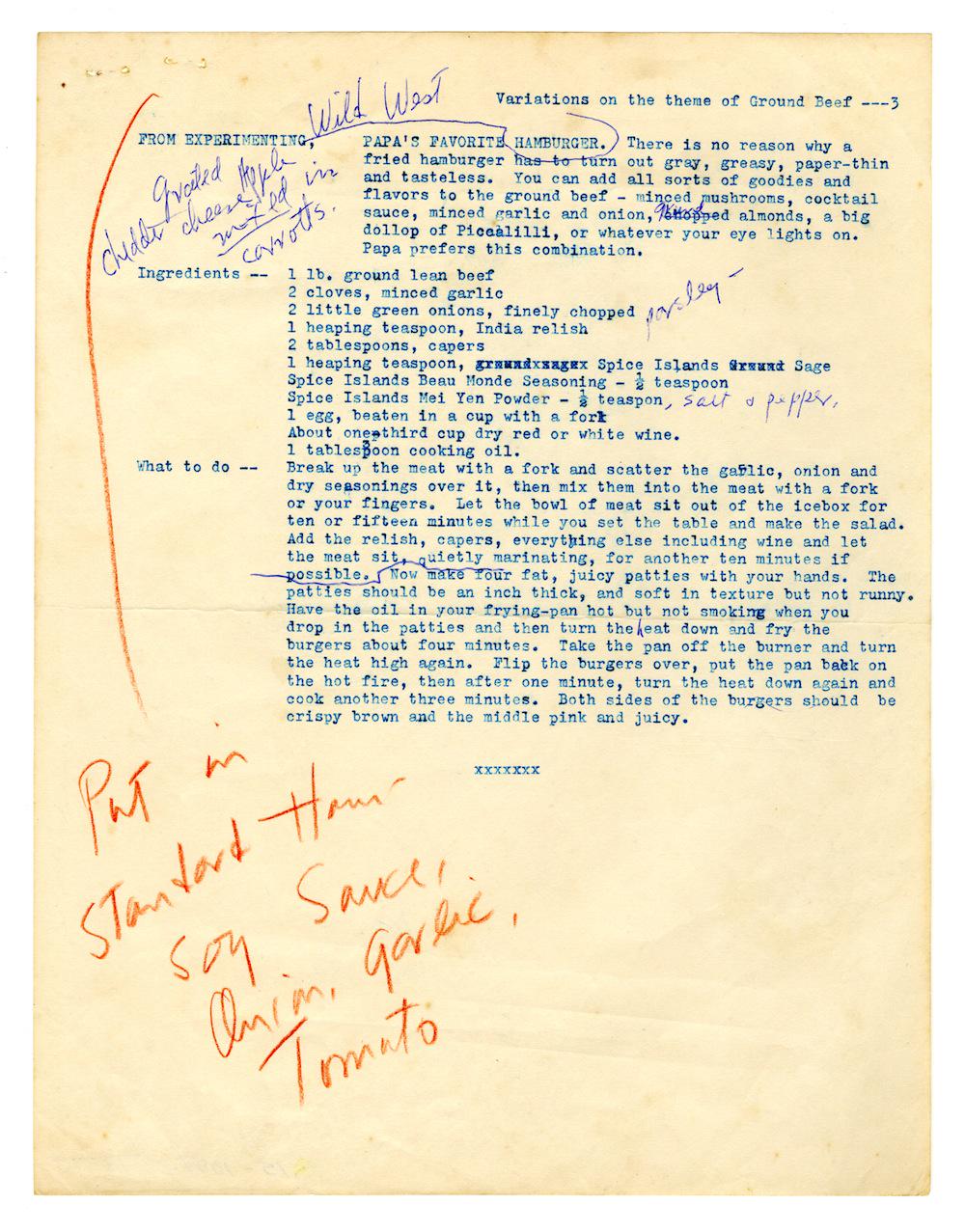
FROM EXPERIMENTING,

PAPA’S FAVORITE HAMBURGER. There is no reason why a fried hamburger has to turn out gray, greasy, paper-thin and tasteless. You can add all sorts of goodies and flavors to the ground beef — minced mushrooms, cocktail sauce, minced garlic and onion, chopped almonds, a big dollop of piccadilli, or whatever your eye lights on. Papa prefers this combination.

Ingredients —

1 lb. ground lean beef

2 cloves, minced garlic

2 little green onions, finely chopped

1 heaping teaspoon, India relish

2 tablespoons, capers

1 heaping teaspoon, Spice Islands sage

Spice Islands Beau Monde Seasoning — ½ teaspoon

Spice Islands Mei Yen Powder — ½ teaspoon **

1 egg, beaten in a cup with a fork

About one third cup dry red or white wine.

1 tablespoon cooking oil

What to do —

Break up the meat with a fork and scatter the garlic, onion and dry seasonings over it, then mix them into the meat with a fork or your fingers. Let the bowl of meat sit out of the icebox for ten or fifteen minutes while you set the table and make the salad. Add the relish, capers, everything else including wine and let the meat sit, quietly marinating, for another ten minutes if possible. Now make four fat, juicy patties with your hands. The patties should be an inch thick, and soft in texture but not runny. Have the oil in your frying-pan hot but not smoking when you drop in the patties and then turn the heat down and fry the burgers about four minutes. Take the pan off the burner and turn the heat high again. Flip the burgers over, put the pan back on the hot fire, then after one minute, turn the heat down again and cook another three minutes. Both sides of the burgers should be crispy brown and the middle pink and juicy.

More at The Paris Review; image via.

Nineteen Literary Recipes for Thanksgiving (Or Any Other Time)

Breakfast

Zelda Fitzgerald’s Special Breakfast

Vladimir Nabokov’s Eggs à la Nabocoque

Lunch

Thomas Pynchon’s European Pizza

Hunter S. Thompson’s Open-Face Cigarette-Special Hot-and-Cold Sandwich with Artichoke Appetizer

Soup

Ishmael Reed’s Texas Gumbo

Denise Levertov’s Black Bean Soup

Donald Barthelme’s Fine Homemade Soups

Sides

Ursula K. Le Guin’s Crab Nebula

John Cage’s Homemade Bread

Biblioklept’s Oven Rice

Mains

John Brunner’s Squid with Pine Nuts

Marjorie Kinnan Rawlings’ Recipes for Coot Surprise, Jugged Rabbit, and Jellied Tongue

Ernest Hemingway’s Campfire Trout

William Faulkner’s Cured Ham

Libations

Thomas Pynchon’s Crocodile (A Traditional Anarchist Favorite)

Walker Percy’s Mint Julep

Poul Anderson’s All My Own Invention

Dessert

Anita Loos’ Kitten’s Tongue

Elizabeth Bishop’s Brownies

Elizabeth Bishop’s Brownies

Elizabeth Bishop’s brownie recipe:

4 squares bitter chocolate (or about a cup of cocoa)
4 eggs
1/2 cup butter
2 1/2 cups white sugar
1 cup flour
2 teaspoons vanilla
2 cups chopped nuts

Melt the chocolate and butter together – or, if you use cocoa, melt along with half the sugar and a little water. Cool slightly and beat in eggs and rest of sugar.

Sift in flour, add vanilla and nuts and beat. The batter is fairly stiff – doesn’t run much. Spread about <——————> this thick in square pan.

Bake in a slow oven – about 45 minutes to an hr., depending on pan, thickness, etc. They should be dry on top, just pulling away from edges, but still rather damp in the middle. Cut in squares in pan and remove with spatula.

This makes chewy brownies – for a harder kind, use brown sugar and an extra egg – or half brown sugar – Can be made thicker and used hot with whipped cream on top for a desert [sic] –

Via the excellent blog Paper and Salt, whose author Nicole acquired it via Bishop’s at Vassar College.

Thomas Pynchon’s Recipe for the Crocodile, a Traditional Anarchist Cocktail

“I’ll be in the bar,” said Reef. Yzles-Bains was in fact one of the few places on the continent of Europe where a sober Anarchist could find a decent Crocodile—equal amounts of rum, absinthe, and the grape spirits known as trois-six—a traditional Anarchist favorite, which Loïc the bartender, a veteran of the Paris Commune, claimed to have been present at the invention of.

A cocktail recipe from Thomas Pynchon’s novel Against the Day. (More on trois-six here; good luck finding real absinthe).

Bonus recipe: Kit Traverse’s drink invention:

“‘Love in the Shadows of Pera,’ ” Kit said. “It’s just Creme de Menthe and beer.”

Anita Loos’ Recipe for Kitten’s Tongue

Anita Loos’ recipe for kitten’s tongue:

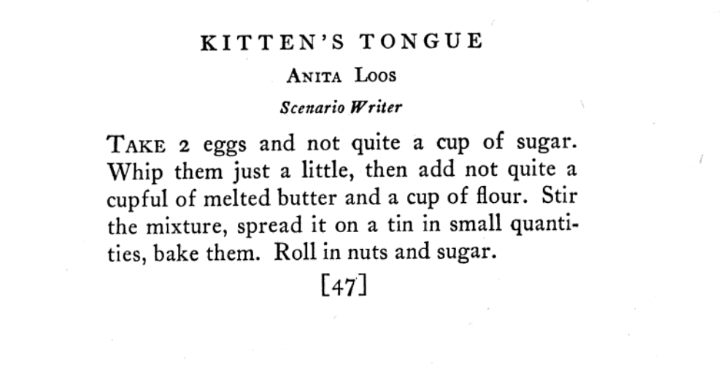
Take 2 eggs and not quite a cup of sugar. Whip them just a little, then add not quite a cupful of melted butter and a cup of flour. Stir the mixture, spread it on a tin in small quantities, bake them. Roll in nuts and sugar.

From Famous Recipes of Famous Women (ed. Florence Stratton, 1925).

Poul Anderson’s Cocktail All My Own Invention

Poul Anderson’s cocktail “All My Own Invention” is collected in collected in Cooking Out of This World (ed. Anne McCaffrey, 1973).

All My Own Invention

2 oz. dark rum, 2 oz. dry vermouth, 1 oz. fresh lemon juice, stirred over ice. Sneaky.

Walker Percy’s Cud’n Walker’s Uncle Will’s Favorite Mint Julep Receipt

As a postscript to his 1957 essay “Bourbon,” Walker Percy offers his favorite recipe for the drink:

Reader, just in case you don’t want to knock it back straight and would rather monkey around with perfectly good Bourbon, here’s my favorite recipe, “Cud’n Walker’s Uncle Will’s Favorite Mint Julep Receipt.”

You need excellent Bourbon whiskey; rye or Scotch will not do. Put half an inch of sugar in the bottom of the glass and merely dampen it with water. Next, very quickly—and here is the trick in the procedure—crush your ice, actually powder it, preferably in a towel with a wooden mallet, so quickly that it remains dry, and, slipping two sprigs of fresh mint against the inside of the glass, cram the ice in right to the brim, packing it with your hand. Finally, fill the glass, which apparently has no room left for anything else, with Bourbon, the older the better, and grate a bit of nutmeg on the top. The glass will frost immediately. Then settle back in your chair for half an hour of cumulative bliss.

Uncle Will shows up a few times in Signposts in a Strange Land, a collection of essays that includes “Bourbon” along with 1965’s “Uncle Will,” which offers this nugget:

Early each afternoon he made himself a pitcher of vodka martinis—no one had ever heard of such a drink in Mississippi in the 1930s—and set up shop in the pantry, listened and talked to any and all comers.

Also from “Bourbon”:

Bourbon does for me what the piece of cake did for Proust.

1926: As a child watching my father in Birmingham, in the exurbs, living next to number-6 fairway of the New Country Club, him disdaining both the bathtub gin and white lightning of the time, aging his own Bourbon in a charcoal keg, on his hands and knees in the basement sucking on a siphon, a matter of gravity requiring cheek pressed against cement floor, the siphon getting going, the decanter ready, the first hot spurt into his mouth not spat out.

1933: My uncle’s sun parlor in the Mississippi Delta and toddies on a Sunday afternoon, the prolonged and meditative tinkle of silver spoon against crystal to dissolve the sugar; talk, tinkle, talk; the talk mostly political: “Roosevelt is doing a good job; no, the son of a bitch is betraying his class.”

1934: Drinking at a Delta dance, the boys in bi-swing jackets and tab collars, tough-talking and profane and also scared of the girls and therefore safe in the men’s room. Somebody passes around bootleg Bourbon in a Coke bottle. It’s awful. Tears start from eyes, faces turn red. “Hot damn, that’s good!”

1935: Drinking at a football game in college. UNC versus Duke. One has a blind date. One is lucky. She is beautiful. Her clothes are the color of the fall leaves and her face turns up like a flower. But what to say to her, let alone what to do, and whether she is “nice” or “hot”—a distinction made in those days. But what to say? Take a drink, by now from a proper concave hip flask (a long way from the Delta Coke bottle) with a hinged top. Will she have a drink? No. But it’s all right. The taste of the Bourbon(Cream of Kentucky) and the smell of her fuse with the brilliant Carolina fall and the sounds of the crowd and the hit of the linemen in a single synesthesia.

1941: Drinking mint juleps, famed Southern Bourbon drink, though in the Deep South not really drunk much. In fact, they are drunk so seldom that when, say, on Derby Day somebody gives a julep party, people drink them like cocktails, forgetting that a good julep holds at least five ounces of Bourbon. Men fall facedown unconscious, women wander in the woods disconsolate and amnesiac, full of thoughts of Kahlil Gibran and the limber lost.

Would you believe the first mint julep I had I was sitting not on a columned porch but in the Boo Snooker bar of the New Yorker Hotel with a Bellevue nurse in 1941? The nurse, a nice upstate girl, head floor nurse, brisk, swift, good-looking; Bellevue nurses, the best in the world and this one the best of Bellevue, at least the best-looking. The julep, an atrocity, a heavy syrupy Bourbon and water in a small glass clotted with ice. But good!

Biblioklept’s Oven Rice

I’ve been sharing literary recipes on Biblioklept, mostly around Thanksgiving and Christmas, since I first started the blog back in 2009. The first entry was Zora Neale Hurston’s mulatto rice.

I’ve enjoyed taking note of recipes (or approximations of recipes) in the books I’ve read and sharing them here, as well as recipes authored by authors (printed originally in cookbooks or elsewhere). I’ve rehashed the recipes each Thanksgiving (here’s last year’s entry), but this Thanksgiving I thought I’d search for new stuff—hence the flurry of recipes on the blog the past few days. In the same spirit, I figured I’d share a simple staple in our household: a recipe for oven rice.

Really, this isn’t so much a recipe as it is a technique. My aunt taught me how to cook rice in the oven over twenty years ago and I haven’t looked back. I’ve employed this technique to cook all kinds of rice: long grain and short grain; jasmine, brown, wild, basmati, sushi and so on. It even works for middlins (but not grits). I’ve cooked this rice in smaller and larger batches, used different stocks, added vegetables, used a variety of oils and fats; I’ve cooked the rice in at least five different ovens. It always turns out perfect.

Here is what you need:

An enameled cast iron Dutch oven.

An oven and a cook top.

A cup of rice.

Two cups of stock or water. I almost always use stock that I make on Sundays.

Oil or fat; I usually use olive oil or schmalz if I have it.

Salt.

Here is how you make the rice:

Preheat the oven to 350°F.

Preheat your stock or water if it is cold. The liquid need not be aboil or anything, but it can’t hit the pan cold.

Coat the bottom of the Dutch oven with oil, turn the cook top eye to high, throw in your rice and add salt (more salt than you think you need).

Stir the rice until it’s coated with oil and salt and cook it until it’s nearly translucent—but you’re not making a pilaf here, please.

Add your liquid (really, the liquid should be a stock, which is easy to make from any bones or scraps you have about).

Bring the rice to not quite boiling and make sure it doesn’t stick to the bottom of your pan. But don’t overagitate it. If need be, remove the pan from the eye in the event you’ve misjudged how long it takes your oven to heat to 350°F. You’re not cooking the rice on the stove top; you simply want the liquid to be close to the same temperature as the oven.

Cover the rice and put it in the oven, setting a thirty minute timer or simply attending to the time yourself.

Now is the perfect time to read a short story and drink a glass of white wine, as you’ve already prepped a suitable match for this lovely oven rice, yes? Butter beans and chorizo with the onions you caramelized on Monday? Roasted garlic and peppers? Field peas cooked with a leftover smoked chicken thigh? Even a quick spinach wilt with a few tomato slices or an egg on top will do.

But you’ve taken care of that; read your story, drink your wine.

Remove the rice from the oven after thirty minutes. It will stay nice and hot in the enameled cast iron dish for an hour or more. If you’ve neglected to prepare butter beans or field peas or spinach—or even a can of sardines and hot sauce from your pantry—you can eat this rice with butter and salt and lots of pepper. And maybe you’ll have enough peace to read another story while you eat.



Hunter S. Thompson’s Open Face Cigarette Special Hot and Cold Sandwich with Artichoke Appetizer

I’m pretty sure there should be some hyphens in the title of Hunter S. Thompson’s recipe for “open face cigarette special hot and cold sandwich with artichoke appetizer.”  From The Great American Writers’ Cookbook (ed. Dean Faulkner Wells, 1981).

OPEN FACE CIGARETTE SPECIAL HOT AND COLD SANDWICH WITH ARTICHOKE APPETIZER

Ingredients

1 Artichoke

1 stalk of celery

1 onion

1 tomato

one quarter lb. butter

1 container cottage cheese

1 can Ortega whole green chilis

1 lemon

mayonnaise

vinegar

4 strips of bacon

1 slice dill rye bread

La Victoria green taco sauce

Directions

Fill a large pot three quarters full with water and add celery and half of the onion. Bring to a boil.

Add artichoke, cover and boil for 45 minutes. While you are waiting for the artichoke to cook you can prepare the sauce for it and the sandwich.

Sauce:

Mix 3 heaping tablespoons of mayonnaise with one table spoon of Dijon mustard. Add a splash of vinegar and a squeeze of lemon.

Cigarette Special

Cook bacon and put aside.

Butter the slice of rye bread generously and toast until the bread is light brown and the butter is sizzling.

Spread cottage cheese exactly one quarter inch thick on the toast.

Cut Ortega whole green chilis into 4 one quarter inch strips and place lengthwise on top of cottage cheese.

Add bacon to sandwich.

Cut 3 or 4 thin slices of tomato and place on top of bacon.

Cut 2 or 3 very thin slices of onion and put those on top of the tomatoes.

Then spread another one quarter inch thick layer of cottage cheese.

Salt and pepper and garnish with La Victoria green taco sauce.

Then cover the open face sandwich with Reynolds Wrap, leaving the bottom of the toast uncovered. Timing is crucial at this point. The artichoke should be well-boiled and ready to eat and all sandwich ingredients prepared for the final mix before the bread is toasted for the first time.

The sandwich must be lashed together and toasted (twice) in less than 5 minutes, or the toast will get limp and soggy.

When you have finished eating your artichoke appetizer and are ready to eat the Cigarette Special, place the sandwich back into the toaster oven and toast for about one minute. Remove Reynolds Wrap and you will now have a hot buttered toast cold cottage cheese cigarette special.

The procedure by steps:

Drink good whiskey while boiling artichoke and frying bacon.

Prepare sandwich ingredients.

Eat artichoke leaves

Mix sandwich and toast.

Eat artichoke heart, with good beer.

Eat sandwich.

Drink coffee and good whiskey, with sharp chocolate.

Zelda Fitzgerald’s Bacon n’ Eggs

Zelda Fitzgerald’s “recipe” for breakfast:

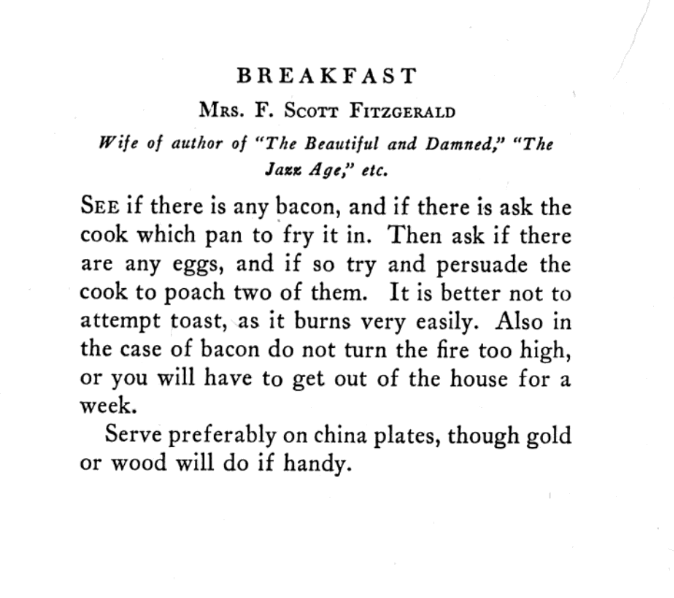
See if there is any bacon, and if there is ask the cook which pan to fry it in. Then ask if there are any eggs, and if so try and persuade the cook to poach two of them. It is better not to attempt toast, as it burns very easily. Also in the case of bacon do not turn the fire too high, or you will have to get out of the house for a week. Serve preferably on china plates, though gold or wood will do if handy.

From Famous Recipes of Famous Women (ed. Florence Stratton, 1925)

John Brunner’s Squid with Pine Nuts

John Brunner’s recipe for squid with pine nuts:

1 1b. baby squid

1 large onion

1 oz. pine nuts (pinon nuts)

2 oz. butter

1 clove garlic

salt and pepper

2 sherry-glasses dry sherry

water

Chop the onion and garlic fine, brown in the butter. Clean squid, cut into rings, add to pan and add nuts. Season lightly. Stir over low heat until everything is coated with the butter. Add the sherry. Simmer for 2-3 minutes. Add water to barely cover. Simmer until squid is tender-approximately 20 minutes, but this depends on the age of the squid: the older, the longer. Serve hot. Keep the breadsticks coming.

Try and finish off the white wine at the same time the last bit of squid disappears. (It will. I’ve seen people who were convinced they didn’t like the stuff come back for seconds of this dish, then ask optimistically for thirds-too late.)

Then we get down to the really serious item on the agenda, a member of that family of classic peasant dishes which runs from Normandy to Yugoslavia and can probably be found in recognizable form in the New World, too. What they amount to, basically, is a means of making stored beans taste wonderful when that’s all you’ve got for a large family. Any number of changes can be rung on the fundamental principle.

Brunner’s recipe is collected in Cooking Out of This World (ed. Anne McCaffrey, 1973)

Denise Levertov’s Black Bean Soup

Denis Levertov’s recipe for black bean soup:

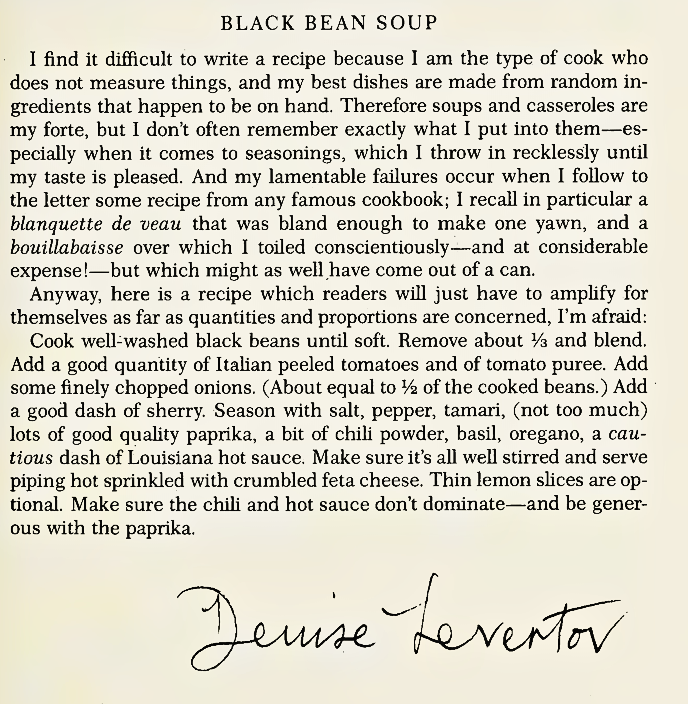
I find it difficult to write a recipe because I am the type of cook who does not measure things, and my best dishes are made from random ingredients that happen to be on hand. Therefore soups and casseroles are my forte, but I don’t often remember exactly what I put into them—especially when it comes to seasonings, which I throw in recklessly until my taste is pleased. And my lamentable failures occur when I follow to the letter some recipe from any famous cookbook; I recall in particular a blanquette de veau that was bland enough to make one yawn, and a bouillabaisse over which I toiled conscientiously–and at considerable expense!–but which might as well have come out of a can.

Anyway, here is a recipe which readers will just have to amplify for themselves as far as quantities and proportions are concerned, I’m afraid:

Cook well-washed black beans until soft. Remove about ⅛ and blend. Add a good quantity of Italian peeled tomatoes and of tomato puree.”Add some finely chopped onions. (About equal to ½ of the cooked beans.) Add a good dash of sherry. Season with salt, pepper, tamari, (not too much) lots of good quality paprika, a bit of chili powder, basil, oregano, a cautious dash of Louisiana hot sauce. Make sure it’s all well stirred and serve piping hot sprinkled with crumbled feta cheese. Thin lemon slices are optional. Make sure the chili and hot sauce don’t dominate—and be generous with the paprika.

From The Great American Writers’ Cookbook (ed. Dean Faulkner Wells, 1981).