Mass-market Monday | Guillermo Cabrera Infante’s Three Trapped Tigers

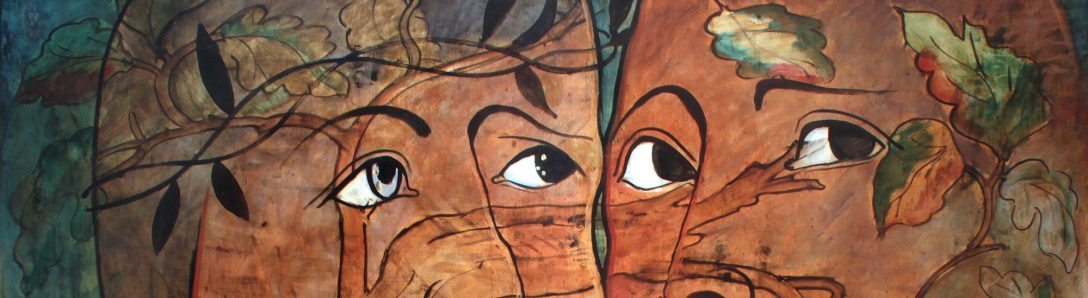
Three Trapped Tigers, G. Cabrera Infante. Translated by Donald Gardner and Suzanne Jill Levine with Guillermo Cabrera Infante. Avon Bard (1985). No cover artist or designer credited. 473 pages.

A busy buzzy book honking and howling and hooting, I am loving loving loving Three Trapped Tigers—it sings and shouts and hollers. The novel starts with a  polyglossic emcee announcing the parade of honorable horribles who will strut through the novel (if it is indeed a “novel”). Very funny, very engrossing, grand stuff, love it.

Here’s Salman Rushdie, reviewing the novel in the LRB back in 1981 (he’s just fumbled around answering “What is this crazy book actually about?”:

So much for the plot. (Warning: this review is about to go out of control.) What actually matters in Three Trapped Tigers is words, language, literature, words. Take the title. Originally, in the Cuban, they were three sad tigers, Tres tristes tigres, the beginning of a tongue-twister. For Cabrera, phonetics always come before meaning (correction: meaning is to be found in phonetic associations), and so the English title twists the sense in order to continue twisting the tongue. Very right and improper. Then there is the matter of the huge number of other writers whose influence must be acknowledged: Cabrera Infante calls them, reverently, Fuckner and Shame’s Choice. (He is less kind to Stephen Spent and Green Grams, who wrote, as of course you know, Travels with my Cant.) Which brings us to the novel’s most significant character, a sort of genius at torturing language called Bustrofedon, who scarcely appears in the story at all, of whom we first hear when he’s dying, but who largely dominates the thoughts of all the Silvestres and Arsenios and Codacs he leaves behind him. This Bustromaniac (who is keen on the bustrofication of words) gives us the Death of Trotsky as described by seven Cuban writers – a set of parodies whose point is that all the writers described are so pickled in Literature that they can’t take up their pens without trying to wow us with their erudition. Three Trapped Tigers, like Bustrofedon’s whole life, is dedicated to a full frontal assault on the notion of Literature as Art. It gives us nonsense verses, a black page, a page which says nothing but blen blen blen, a page which has to be read in the mirror: Sterne stuff. But it also gives us Bustrolists of ‘words that read differently in the mirror’: Live/evil, drab/bard, Dog/God; and the Confessions of a Cuban Opinion Eater; and How to kill an elephant: aboriginal method ... the reviewer is beginning to cackle hysterically at this point, and has decided to present his opinion in the form of puns, thus: ‘The Havana night may be dark and full of Zorro’s but Joyce cometh in the morning.’ Or: ‘Despite the myriad influences, Cabrera Infante certainly paddles his own Queneau.’
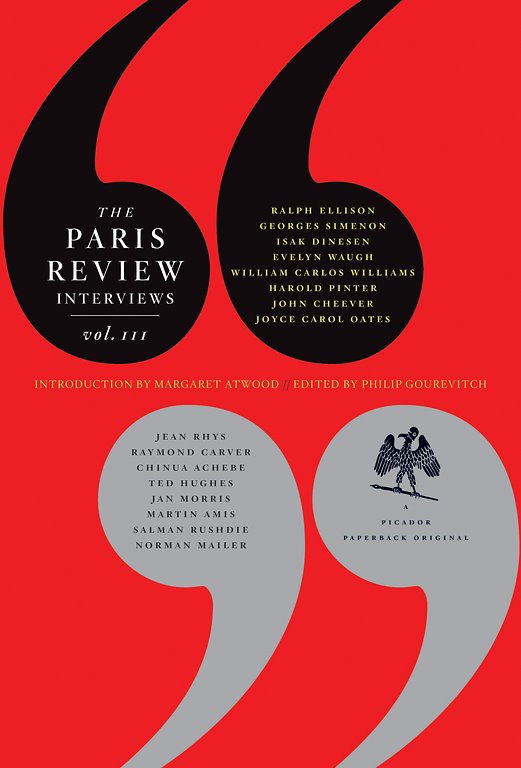
The Paris Review Interviews, Volume III

How much you enjoy the third collection The Paris Review Interviews will depend entirely on how much you enjoy reading intelligent and thoughtful writers discussing intelligent and thoughtful subjects. I happen to love reading author interviews–even interviews with authors I don’t particularly like–and hence, I enjoyed this book quite a bit.

Covering sixteen disparate authors and fifty-two tumultuous years, the interviews here are by turns insightful, hilarious, strange, and at times, infuriating. The first interview (the book is organized chronologically), a 1955 conversation with Ralph Ellison evokes all of these emotions. One can almost feel Ellison’s restraint as he patiently replies to asinine questions like, “Then you consider your novel a purely literary work as opposed to one in the tradition of social protest?” and, “But isn’t it going to be difficult for the Negro writer to escape provincialism when his literature is concerned with a minority?” If anything, these politicized charges prompt Ellison to some of the most salient observations about literature’s universalizing powers that I’ve ever read.

In his 1964 interview, poet William Carlos Williams also sheds quite a bit of light on his art and craft. Interestingly, his wife is also a major part of the interview, discussing at some length her own role in her husband’s writing. Beyond literature, craft, and writing, Williams also sets another early theme that unites the interviews collected here–dissing other writers. He calls T.S. Eliot a “conformist” determined to set poets back twenty years. Evelyn Waugh picks up on this theme in his 1963 interview. Of Faulkner: “I find Faulkner intolerably bad.” And Raymond Chandler: “I’m bored by all those slugs of whiskey. I don’t care for all the violence either.” Zing!

Don’t feel too bad for Chandler, though; he comes off funny and earthy and sad in his 1983 interview, especially when he discusses his alcoholism, and how and why he quit drinking. Apparently, teaching–and drinking–with John Cheever when the two were teaching at the Iowa Writer’s Workshop in 1973 had a major impact on Chandler’s decision to stop drinking.

John Cheever focuses mostly on the writing craft in his 1976 interview–not much talk of drinking here. He does, however, share this insight: “Plot implies narrative and a lot of crap. It is a calculated attempt to hold the reader’s interest at the sacrifice of moral conviction.” I’ve never liked Cheever’s writing, but he’s a great interview. In his 1994 interview, Achebe–an author whose fiction (and essays) I do like comes off as far more insightful and far less pretentious. On why creative writing classes exist: “I think it’s very important for writers who need something else to do, especially in these precarious times. Many writers can’t make a living. So to be able to teach how to write is a valuable to them. But I don’t really know about its value to the student.” Lovely. MFAs beware!

The interviews collected here are funny, smart, and very entertaining–whether its Achebe on general misunderstandings of his famous Conrad essay, Salman Rushdie on New Wave Cinema, or Joyce Carol Oates on Finnegans Wake, The Paris Review Interviews, Volume III is full of smart people talking about smart things–and what’s better than that? Highly recommended.

The Paris Review Interviews, Volume III is available October 28th, 2008 from Picador.