A few posts back, this blog turned some attention to what happens when writers become commodities sold by persona. Commodification results in a kind of lazy cultural shorthand that pre-empts the need to actually read the author and discuss their works: the author instead becomes a signifier of an abstracted ideal, a rubric of adjectives that the consumer can use to “identify” with their own life. It seems to me that no author has been more commodified than Ernest Hemingway. For example, check out The Ernest Hemingway Collection for a selection of clothes, home furnishings, and other chintzy crap. From their website:
“You can now share in his spirit as an adventurer, author and romantic. His legend can be brought to your home through this entire Ernest Hemingway Collection. Every item has been hand selected and approved to ensure authenticity. Enjoy this celebration of the man and the memory.”
Yes! You too can buy a certain kind of authenticity! But do throw pillows and bed spreads really convey a balance of macho resolve and artistic sensitivity just because a corporartion sticks Hemingway’s name on them? Who buys this stuff anyway? According to this article, it’s the “new male shoppers” that are interested in this kind of decor–and what do the “new male shoppers” read? They don’t have to read Hemingway, because distinguished literary journals such as Maxim and Men’s Vogue have already digested and sanctified it for them: Hemingway gets the stamp of approval–he was macho, a hunter and a drinker and a fighter–just one of the frat boys.
Years ago, at a party in Gainesville, I remember a guy bringing up Hemingway. I was on the outs with Hemingway at this point, so I prodded the guy—why did he like Hemingway? What about the work was so meaningful to him? More prompting yielded what I should have guessed: the guy drunkenly, laughingly admitted that he hadn’t read anything by Hemingway, it was just a stock answer that he gave to the question: “Who’s your favorite writer?”
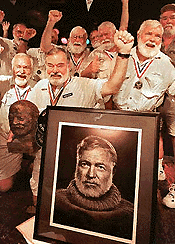
Who are the future stock answers? It seems like the hard-drinking ex-pat writers of the 30’s and 40’s had the right balance of persona and mystique to create their own mythos–but what about today’s greats? How will the future sell them?
 Biblioklept