I have heard Donald referred to as essentially a writer of the American 1960’s. It may be true that his alloy of irrealism and its opposite is more evocative of that fermentatious decade, when European formalism had its belated flowering in North American writing, than of the relatively conservative decades since. But his literary precursors antedate the century, not to mention its 60’s, and are mostly non-American. ”How come you write the way you do?” a Johns Hopkins apprentice writer once asked him. ”Because Samuel Beckett already wrote the way he did,” Barthelme replied. He then produced for the seminar his ”short list”: five books he recommended to the attention of aspiring American fiction writers. No doubt the list changed from time to time; just then it consisted of Rabelais’s ”Gargantua and Pantagruel,” Laurence Sterne’s ”Tristram Shandy,” the stories of Heinrich von Kleist, Flaubert’s ”Bouvard and Pecuchet” and Flann O’Brien’s ”At Swim-Two-Birds” – a fair sample of the kind of nonlinear narration, sportive form and cohabitation of radical fantasy with quotidian detail that mark his own fiction. He readily admired other, more ”traditional” writers, but it is from the likes of these that he felt his genealogical descent.
From John Barth’s 1989 eulogy for Donald Barthelme, first published in The New York Times.
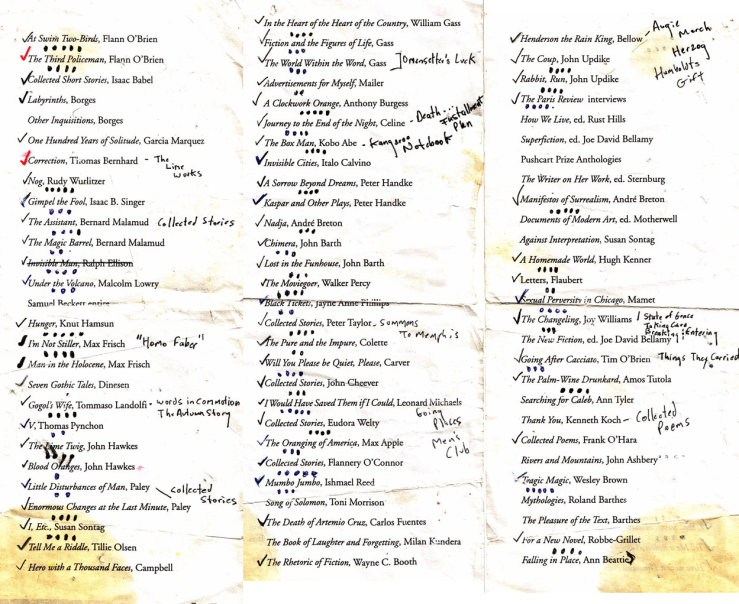
Barthelme had a longer list too, of course:
 Biblioklept