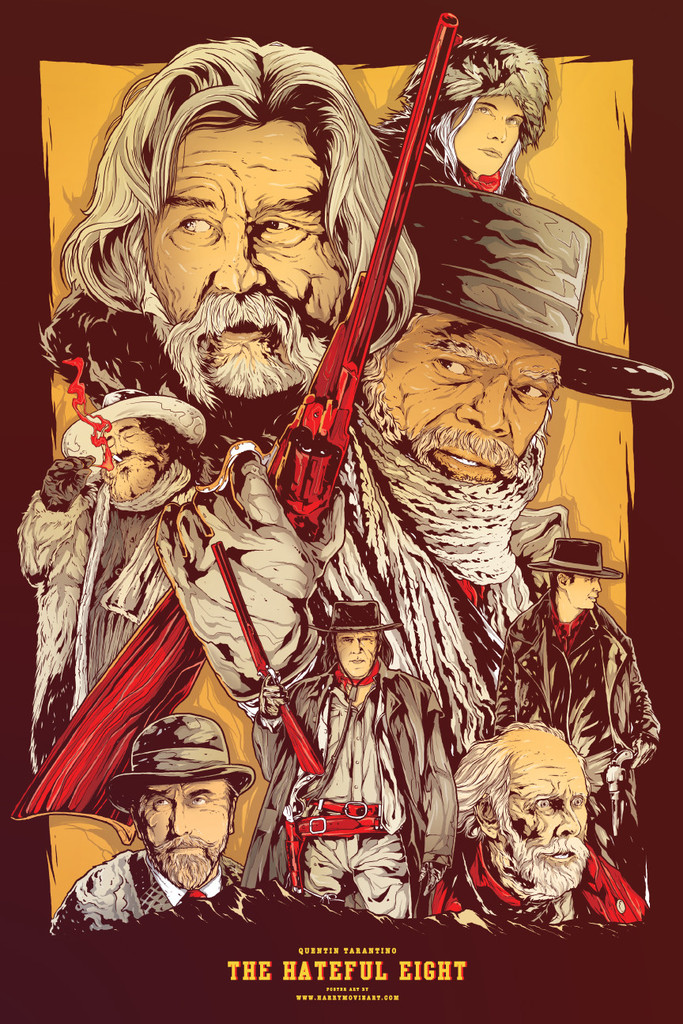
I don’t like films where nothing good happens, my wife told me years ago. I can’t remember the film that occasioned this remark, and I don’t find myself beholden to her rubric, but I still find myself applying it to films now and then. Especially after watching Quentin Tarantino’s The Hateful Eight.
Does anything good happen in The Hateful Eight?
(This is not the right question to ask about a film, but—).
This question isn’t the same as, say, Is any part of The Hateful Eight good?—because so many of the elements are good—excellent even—Ennio Morricone’s score, Robert Richardson’s cinematography, Yohei Taneda’s set design.
And the acting is great, or sorta great, or it’s hard to tell, maybe. Let’s say the performances are great. I mean, it’s Tarantino, so the acting is always at least one level removed from reality—even in Sam Jackson, the realest dude, the dude who carries the film as former Union officer, Major Marquis Warren. Sam Jackson is Tarantino’s main man, his star of hyperreality, and his performance is electric here.
But for hyperreality, it’s Jennifer Jason Leigh who stands out in The Hateful Eight. Her portrayal of prisoner Daisy Domergue is refined Looney Tunes slapstick. Cartoon soul. Watching Walton Goggins (vile racist ex-Confederate marauder Chris Mannix) or Kurt Russell (bounty hunter John Ruth)—both of whom get lots and lots of lines and screen time—one can’t help but realize one is seeing an actor acting—or, more Tarantinoesque—a character acting.
But Jennifer Jason Leigh, remanded to a punching bag for much of the film—or even stranger, a chained work-wife to Kurt Russell’s John Wayne parody (via Kurt Russell’s John Wayne parody as Jack Burton in Big Trouble in Little Trouble)—JJL imbues her Daisy Domergue with a wily pathos that surpasses both the script she’s made to read and her Seussian name.
Not that JJL’s Daisy Domergue’s isn’t vile, nasty, deeply racist, and hateful…but her hatefulness points towards something, I dunno, complex. Real. True. (I should mention now Laura Bogart’s essay “Hipster Misogyny: The Betrayal of The Hateful Eight,” which I think offers an intriguing read on the film. Bogart seems to argue that JJL’s DD is not complex enough, or not given enough complexity, which, hey, okay, fair enough—but I think also that Bogart was disturbed by the film’s conclusion—which I was too, disturbed).
But: Does anything good happen in The Hateful Eight?
What do I mean here by good? Should I just admit I don’t know “good,” but rather feel “good”? Okay. I don’t know good through definition, but rather by example. Fuzzy precis. Good: Perhaps a moment of redemption, but like, say, an earned one, a real one, one not forced through a Hollywood formula. Good might be kernel of hope—a real moment of hope, not just an up established for a foreshadowed down. Or maybe by good I just mean something aesthetically true.
Tarantino’s best films—the Kill Bill films, Pulp Fiction, Jackie Brown, and Reservoir Dogs—point to something good in their conclusions—and by conclusions I mean both literal endings and thesis statements. I’m not sure if I find this same “goodness” evident in the conclusion of The Hateful Eight, or, if it is there, it’s awfully ambiguous.
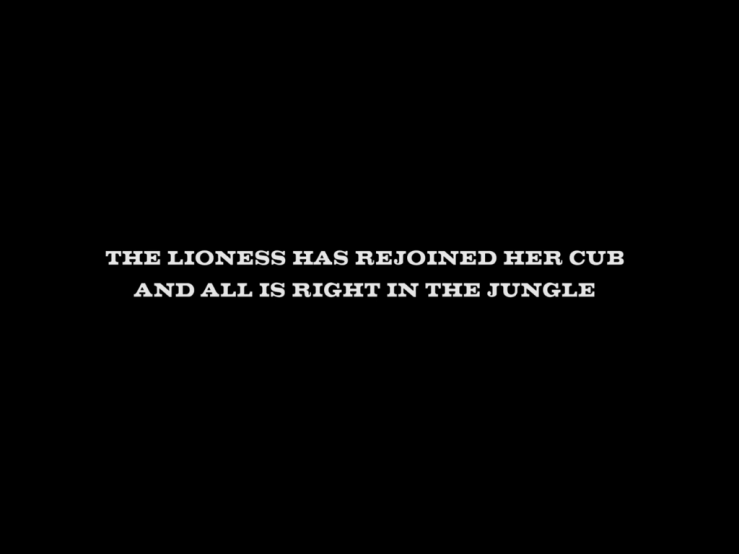
The conclusion of The Hateful Eight is the not-exact opposite of the end of my favorite Tarantino conclusion, the end of Kill Bill 2:
And The Hateful Eight’s conclusion is the not-exact opposite of the ending of Jackie Brown’s bittersweet take on redemption, loss, and escape—American lives that earn second acts.
And The Hateful Eight’s conclusion is the not-exact opposite of the ending Pulp Fiction, a film that resurrects Vincent Vega and sees Sam Jackson’s Jules Winnfield suspend wrathful violence and judgment on Tim Roth’s Ringo (or Pumpkin. Or whatever his name was).
And what about those films that didn’t make my silly little list of “Best Tarantino” — Inglorious Basterds (which is one of my faves, actually, just to watch for like, pure entertainment), Django Unchained, and Death Proof (which actually belongs on that best-of list, maybe, or at least the final sequence)? Shoshanna Dreyfus using film as weapon to end the Nazis? Django’s righteous rampage against slavery? Or the ecstatic violence of “the girls” destroying serial killer Stuntman Mike?
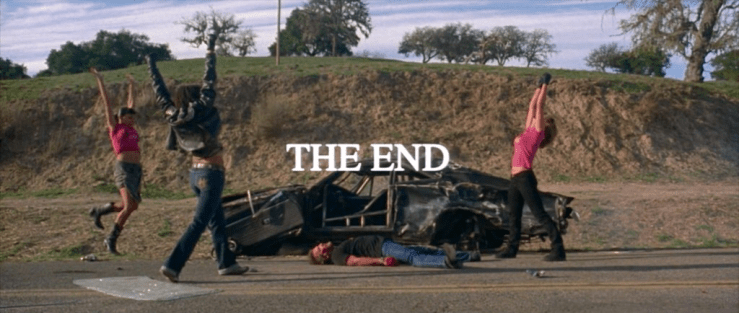
What most of QT’s conclusions share in common is that they somehow mediate the relationship between revenge and justice, and do so in a way that’s aesthetically convincing. The Hateful Eight also seeks to be a film about the relationship between revenge and justice. Its final moments attempt to aesthetically recapitulate much of American history into a morbid sequence of violence.
[Fair warning: There’s a discussion of the conclusion of The Hateful Eight coming up, including what some folks might call spoilers].
Continue reading “Does anything good happen in The Hateful Eight?”
 Biblioklept