The Anxiety of Influence

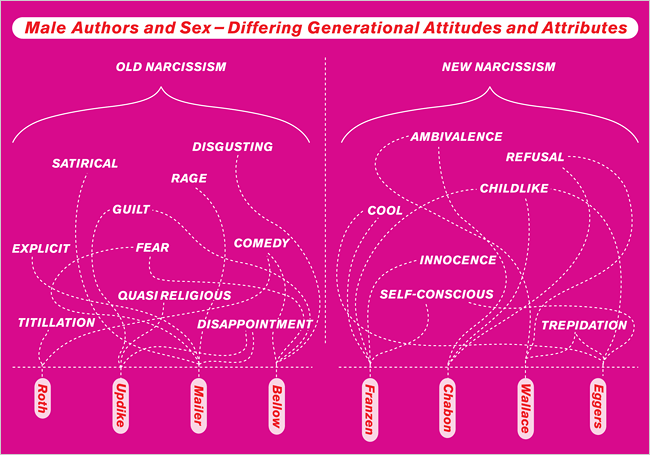
In her essay “The Naked and the Conflicted,” published in today’s New York Times, Katie Roiphe suggests that “we are awfully cavalier about the Great Male Novelists of the last century. It has become popular to denounce those authors, and more particularly to deride the sex scenes in their novels.” By the Great Male Novelists she is, of course, referring to Norman Mailer, John Updike, Philip Roth, and Saul Bellow. She continues: “Even the young male writers who, in the scope of their ambition, would appear to be the heirs apparent have repudiated the aggressive virility of their predecessors.” Roiphe picks a relatively slim sample of “young male writers” to prove her thesis, including David Foster Wallace, Michael Chabon, Dave Eggers, and Jonathan Franzen. Slim sample, but still, quite representative. Her big claim: “The younger writers are so self-­conscious, so steeped in a certain kind of liberal education, that their characters can’t condone even their own sexual impulses; they are, in short, too cool for sex.” Hmmm . . . Perhaps. Makes us think about how writers like Dennis Cooper, Wells Tower, Junot Díaz, or Stephen Elliott might fit into this scheme . . .

A Modern Euphemism Which Softens the Ugly Word Book-thief

A definition of “biblioklept,” from William S. Walsh’s strange and wonderful 1909 ‘cyclopedia, Handy-book of Literary Curiosities:

Biblioklept, a modern euphemism which softens the ugly word book-thief by shrouding it in the mystery of the Greek language. So the French say, not voleur, but chipeiir de livres. The true bibliomaniac cannot help feeling a tenderness for his pet fad, even when carried to regrettable excesses. Perhaps he has often felt his own fingers tingle in view of a rare de Grolier, a unique Elzevir, he knows the strength of the temptation, he estimates rightly his own weakness; perhaps, if he carries self-analysis to the unflattering point which it rarely reaches, save in the sincerest and finest spirits, he recognizes that his power of resistance is supplied not by virtue, but by fear,—fear of ilie police and of Mrs. Grundy. In his inner soul he admires the daring which risks all for the sake of a great passion. When a famous book-collector was exhibiting his treasures to the Duke of Sussex, Queen Victoria’s uncle, he apologized to his royal highness for having to unlock each case. ‘• Oh, quite right, quite right,” was the reassuring reply: “to tell the truth, I’m a terrible thief.” There are not many of us who are so honest. Nevertheless, the epidemic form which bibliokleptomania has assumed is recognized in the motto which school-boys affix to their books, warning honest friends not to steal them. ” Honest may, of course, be a fine bit of sarcasm. But one prefers to look upon it as indicating a subtle juvenile prescience that the most honest and the most friendly will steal books, as the most honest will cheat their dearest friends in a matter of horseflesh.

Continue reading “A Modern Euphemism Which Softens the Ugly Word Book-thief”