
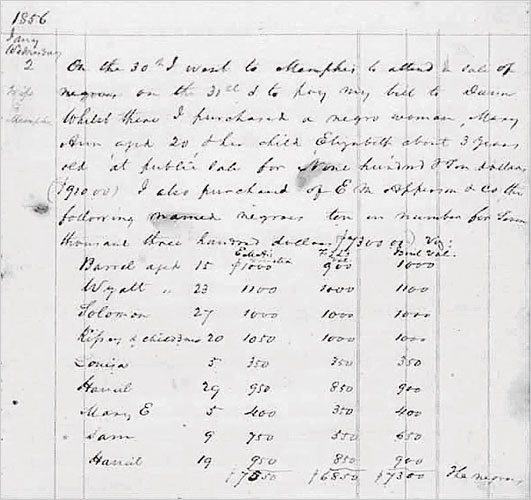
The New York Times reports that “what appears to be the document on which Faulkner modeled that ledger [detailing the genealogy that haunts Go Down, Moses] as well as the source for myriad names, incidents and details that populate his fictionalized Yoknapatawpha County has been discovered.” The article continues:
The original manuscript, a diary from the mid-1800s, was written by Francis Terry Leak, a wealthy plantation owner in Mississippi whose great-grandson Edgar Wiggin Francisco Jr. was a friend of Faulkner’s since childhood. Mr. Francisco’s son, Edgar Wiggin Francisco III, now 79, recalls the writer’s frequent visits to the family homestead in Holly Springs, Miss., throughout the 1930s, saying Faulkner was fascinated with the diary’s several volumes. Mr. Francisco said he saw them in Faulker’s hands and remembers that he “was always taking copious notes.”
History, particularly the strange, paradoxical, and taboo history of the plantation underwrites almost all of Faulkner’s significant fiction, so any historical document that served to inform his writing will be of particular note to enthusiasts and scholars alike.
 Biblioklept