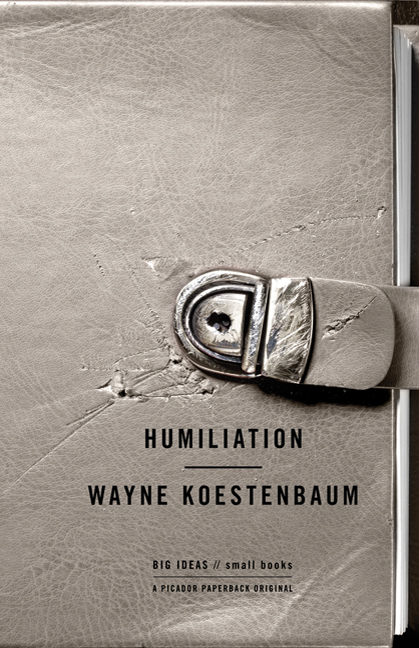
Wayne Koestenbaum’s Humiliation explores the ways that having a body (among other bodies, among a social body) might leave us humiliated or otherwise abject. To perform this exploration, Koestenbaum surveys a discursive range of subjects, including the humiliation of public figures, the sordid “private” lives of celebrities, the work of philosophers and cultural theorists, and the art, music, films, and writing of various artists and performers. The book’s central subject though is Koestenbaum himself, who shares his own humiliations in a way that surpasses ironic self-deprecation. The results are surprisingly moving, intelligent, and very funny. I’ll let Koestenbaum explain his project—
Not merely because I am tired, but because this subject, humiliation, is monstrous, and because it erodes the voice that tries to lay siege to its complexities, I will resign myself, in the fugues that follow, to set forth an open-ended series of paradoxes and juxtapositions. (I call these excursions “fugues” not only because I want the rhetorical license offered by invoking counterpoint but because a “fugue state” is a mentally unbalanced condition of dissociated wandering away from one’s own identity.) Some of my fugal juxtapositions are literal and logical, while others are figurative, meant merely to suggest the presence of undercurrents, sympathies, resonances shared between essentially unlike experiences. If there is any reward to be found in this exercise of juxtaposing contraries to detect the occasional gleam of likeness, that dividend lies in the apprehension of a singular prey: the detection of a whimpering beast inside each of us, a beast whose cries are micropitches, too faint for regular notation.
Koestenbaum composes these fugues, these thematized chapters of his book, in small blocks of text, numbered entries that range from single sentences to several pages. These are aphorisms, anecdotes, japes, jokes, riffs, prose poems, howls. The style recalls Nietzsche’s aphoristic work or Barthes’s short essays in Mythologies, although these comparisons seem inappropriately pretentious. In any case, Koestenbaum sets these short pieces against each other to achieve the fugue state he describes above, a willful wandering from topic to topic—all within the kingdom of humiliation.
So what is humiliation? Or, rather, how does Koestenbaum define humiliation? While the entire book addresses the subject, our author gives us a fairly succinct definition upfront—
Humiliation involves a triangle: (1) the victim, (2) the abuser, and (3) the witness. The humiliated person may also behold her own degradation, or may imagine someone else, in the future, watching it or hearing about it. The scene’s horror—its energy, its electricity—involves the presence of three. An infernal waltz.
Koestenbaum takes turns playing all three roles, both through personal, historical, and cultural memory, as well as through a profound imaginative capacity. It is worth remarking upon, or at least listing, some of his examples here: Joan of Arc, King Lear, Liza Minelli, Bill Clinton, Antonin Artaud, Jean Genet, Jean-Michael Basquiat, Larry Craig, American Idol, The Swan, Anita Bryant, Harriet Jacobs, Richard M. Nixon, various creeps trolling Craigslist for weird sex, the Marquis de Sade, Abu Ghraib, lynching postcards, Michael Jackson—and always Koestenbaum himself (as well as his family, his friends, his colleagues, his students . . . ). Koestenbaum shuffles through his subjects, looking at the various ways that they might fall into his triangle of humiliation, and even when he tries on the hat of the abuser, he modulates this position by keeping his subject’s agency within his critical purview. Indeed, one of the great warnings that Koestenbaum has to offer concerns what he labels “the Jim Crow gaze” — the propensity and capacity that each person holds within himself at all times to look at another human without recognition that that person is a human being, an agent of his or her own desires, emotions, and intellect. Koestenbaum readily admits his own failings, times he has turned the Jim Crow gaze on others, a look that goes past “othering” to actually desubjectify the gaze’s object. Koestenbaum’s project pays great dividends here; by moving discursively from a range of subjects (including himself), he reveals the limitations of first-person consciousness when coming into contact with the social, the cultural, the political, the historical. Put another way, Humiliation is one of the few works of cultural studies I’ve ever read to actively show why cultural studies matters. Here’s Koestenbaum again—
The humiliation of a derided performer on American Idol is immeasurably different from the humiliation of a Palestinian under Israeli occupation. One plight is chosen, the other is not. But isn’t there present, in both situations, an underlying coldheartedness, a rock-bottom refusal to believe the worthiness of the person whose reputation (or house, or land, or ego, or self-esteem) is stolen, trashed, occupied, razed? Isn’t there present, in both situations, an underlying will to deracinate and desubjectify this other person? And, most insidiously—isn’t there an insistence on considering this process of desubjectification (with my laughter I take away your humanity) an entertaining process, even a cathartic exercise, therapeutic and energizing, like calisthenics?
This willingness to connect American Idol to the Israeli-Palestinian conflict dramatically highlights the underlying psychological conditions lurking under the phenomenological apparatuses we see (or choose not to see) on a daily basis. And just as ridicule or schadenfreude may be posited as cathartic for the victimizer, Koestenbaum also finds that “the aftermath of humiliation can be paradoxically relaxing. Tranquilizing to have undergone humiliation and then emerge on the other side.” Perhaps it is toward some sense of release or tranquility then that Koestenbaum shares so much of his own humiliation with us—snubbings, embarrassments, accusations, disavowals, and, of course, his penis (he even apologizes for the “phallic” nature of the book).
Koestenbaum is willing to consider other penises too. Humiliation is very much a study of bodies in general: what it means to have a body, what it means for others to look at your body, how what your body looks like (its shape, its color, its gender, its parts, its excess, its lack) matters to others. Working from Julia Kristeva’s theory of the abject (see: Powers of Horror), Koestenbaum writes—
Humiliation involves physical process: fluids , solids, organs, cavities, orifices, outpouring, ingestions, excrescences, spillages. Humiliation demands a soiling. Even if the ordeal is merely mental, the body itself gets dragged into the mess.
Our most abject moments then are when we realize that our body is not the impermeable fortress of self that we might imagine, but rather a dripping mess with ill-defined borders. We are constantly leaking. Private shame always lurks, is always susceptible to public scrutiny. Koestenbaum again—
An object that should be private and unseen is suddenly visible . . . My unseen experience has been forcibly ejected—thrust outside. The judge hears my secrets. My inner rottenness lies exposed. My skin has been turned inside out. This fold (the self become a seam) is the structure of revulsion.
Yet going through these trials is part of forming an individual, subjective identity. “Humiliation, an educating experience, breeds identity,” writes Koestenbaum. Of course, this idea goes back to our oldest stories, yet it often remains unremarked (curiously, Koestenbaum does not write about Adam and Eve in Eden, that primal scene of triangular humiliation). And while Koestenbaum posits the educational (and even possibly therapeutic) dimensions of humiliation, he’s very clear about the deep pain repetitive, institutionalized humiliation can cause—
I presume that as moral individuals we should work toward minimizing humiliation, toward not inflicting it. We should practice an ethics of abstention. Vow: I abstain from deliberately humiliating others. When I find myself involved in this abhorrent practice, I will immediately desist and try to reverse the process and remedy the crime. And yet is a world without humiliation possible.? It’s disenchanting to write about a horrible situation. About this subject, I can’t rhapsodize.
I’m happy to rhapsodize about Humiliation more, but I fear that this review teeters on becoming overlong any word now. I’ve yet to remark on Humiliation’s humor, which is abundant, weird, occasionally dark, but always warm and deeply human. In the interest of time, perhaps you’ll trust the director John Waters, who provides the following blurb for the book: “This literary ‘topping from the bottom’ is the funniest, smartest, most heartbreaking yet powerful book I’ve read in a long time.” I agree completely with Waters, and looking over my review, I fear that I may have portrayed a very accessible, humorous, and loving book in terms that are too academic. Humiliation may be a work of philosophical inquiry, but it also functions as a sort of cultural memoir, and if it’s a narrative of pain and abjection, it also repeatedly offers solutions to this pain when it can, and consolation and sympathy when it cannot. Very highly recommended.
Humiliation, part of the BIG IDEAS // small books series, is new this month from Picador.

 Glen Duncan’s new novel The Last Werewolf is a book about a werewolf. That’s kind of a terrible way to begin a write-up, but let’s state the obvious: you probably know if you want to read a werewolf book or not. Duncan’s hero Jake Marlowe skews more noir (as his name suggests) than twinky Twilight—he’s a hard-drinking , chain-smoking, 200-year-old rascal who’s just learned that the only other living werewolf has just died (hence, he’s like, the last werewolf, man); compounding matters, he’s more than ready to die himself. A sinister cabal called the World Organisation for the Control of Occult Phenomena is after Jake, testing the limits of his suicide wish. Duncan’s prose is harsh, visceral, and occasionally a bit purple, but horror genre fans looking for more, uh, bite (jeez, sorry) from their books may wish to check out The Last Werewolf, new in hardback from
  Bright’s Passage is the début novel from songwriter/musician Josh Ritter. This slim novel tells the story Henry Bright, a man who returns to the hills of West Virginia after the trauma of World War I only to have his wife (who is also his first cousin) die in childbirth. Bright buries her body and sets fire to their cabin, which sparks a massive forest fire. Bright then takes his infant son and flees, both from the fire and his unstable father-in-law, “The Colonel,” a vet of America’s adventures in the Philippines who still wears his uniform. The Colonel and his crazy sons pursue Bright, who is guided on the lam by the angel who talks to him—yeah, an angel directs Bright; in fact it was the angel’s idea that Bright marry his cousin, burn down his cabin, and run . . . also, the angel swears that Bright’s son is going to be, like, the new Messiah. Also, Bright’s horse talks. Ritter moves the action between Bright’s flight, his ordeal in WWI, and his youth in simple, concrete, declarative prose. There are echoes here of Chris Adrian’s angel stories (
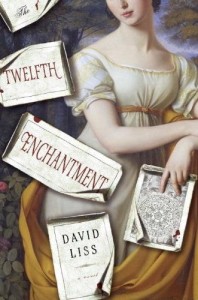 So we hit on the werewolves and angels, but what about those faeries? Honestly, that might have been a bit of a bait and switch, although David Liss’s new novel The Twelfth Enchantment does have faeries—but Romantic poets are slightly more prevalent in the book—only “Werewolves and Angels and Lord Byron and William Blake” sounds a bit clunky, doesn’t it? In any case, mea culpa. There are also Luddites and ghost dogs and alchemy and magic spells and all kinds of Gothic business going on in The Twelfth Enchantment, which gets a lot of mileage simply from its setting (the dawn of the Industrial Revolution), themes (the intersection of magick, alchemy, literature, and Gothic Romance), and characters (Byron, Blake, and Mary Crawford of Austen’s Mansfield Park). Our orphan heroine Lucy Derrick is in the clutches of her unsavory uncle who aims to marry her off until handsome, club-footed Lord Byron shows up at her house. He’s been hexed with a mystical curse and needs Lucy’s help; she soon finds herself snared in a web of dark intrigue, magic, and romance. The Twelfth Enchantment is a whimsical and lovingly crafted adventure story that will appeal to folks who dig literary mysteries (à la Jasper Fforde or pretty much any book that appropriates Jane Austen). The Twelfth Enchantment is new in hardback from
 Biblioklept