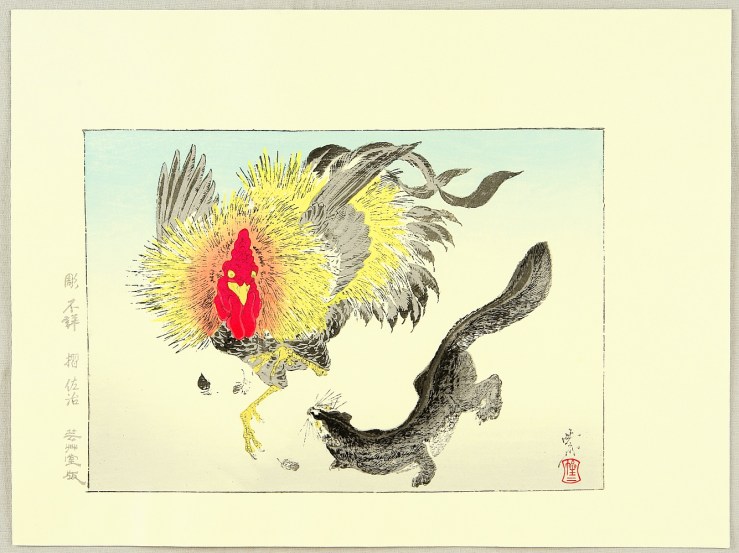
Weasel and Rooster — Kawanabe Kyōsai

48914g1

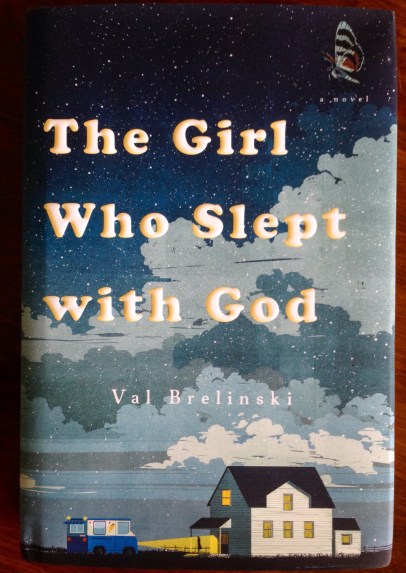
The Girl Who Slept with God (Book acquired, 7.24.2015)

IMG_7842

Val Brelinski’s novel The Girl Who Slept with God is new in hardback this week from Penguin Random House. Their blurb:

Set in Arco, Idaho, in 1970, Val Brelinski’s powerfully affecting first novel tells the story of three sisters: young Frances, gregarious and strong-willed Jory, and moral-minded Grace. Their father, Oren, is a respected member of the community and science professor at the local college. Yet their mother’s depression and Grace’s religious fervor threaten the seemingly perfect family, whose world is upended when Grace returns from a missionary trip to Mexico and discovers she’s pregnant with—she believes—the child of God.

Distraught, Oren sends Jory and Grace to an isolated home at the edge of the town. There, they prepare for the much-awaited arrival of the baby while building a makeshift family that includes an elderly eccentric neighbor and a tattooed social outcast who drives an ice cream truck.

What if we awake one day, all of us, and find ourselves utterly unable to read? (Nabokov’s Pale Fire)

We are absurdly accustomed to the miracle of a few written signs being able to contain immortal imagery, involutions of thought, new worlds with live people, speaking, weeping, laughing. We take it for granted so simply that in a sense, by the very act of brutish routine acceptance, we undo the work of the ages, the history of the gradual elaboration of poetical description and construction, from the treeman to Browning, from the caveman to Keats. What if we awake one day, all of us, and find ourselves utterly unable to read? I wish you to gasp not only at what you read but at the miracle of its being readable (so I used to tell my students). Although I am capable, through long dabbling in blue magic, of imitating any prose in the world (but singularly enough not verse – I am a miserable rhymester), I do not consider myself a true artist, save in one matter: I can do what only a true artist can do – pounce upon the forgotten butterfly of revelation, wean myself abruptly from the habit of things, see the web of the world, and the warp and the weft of that web.

From Vladimir Nabokov’s novel Pale Fire.

Corner of Studio Sink — Richard Diebenkorn