Blog about The Orange Eats Creeps, Grace Krilanovich’s Slutty Teenage Hobo Vampire Junkies novel

Hey, it’s Halloween, spooky times, dark times, right? So here’s a novel recommendation: Grace Krilanovich’s “Slutty Teenage Hobo Vampire Junkies” novel The Orange Eats Creeps.

Here is the first paragraph of The Orange Eats Creeps:

The sun is setting. The hobo vampires are waking up, their quest for crank and blood is just beginning. Over the course of the frigid night they will roam the area surrounding the train stop looking for warm bodies to suck, for cough syrup to fuel a night of debauched sexual encounters with fellow vampires and mortals alike. They distribute sexually transmitted diseases like the daily newspaper but they will never succumb, they will never die, just aging into decrepit losers inside a teenage shell. They have a sense of duty to their habit and their climax — twin addictions that inform their every move. They are lusty, sad creatures, these Slutty Teenage Hobo Vampire Junkies. They traverse the Pacific Northwest’s damp, shitty countryside, forests and big trees, the dusty fields and gravel pits clearing a path of desolation parallel to the rail lines of Oregon and Washington, the half-blown-out signs for supermarket chains in strip malls featuring exactly one nail place, one juice-slash-coffee place, and one freshmex-type grill chain restaurant. Here everything is coated in brown-grey paste like moss at the bottom of a crappy tree…

Krilanovich’s novel is coated in brown-grey paste, an accumulation of scum and cum and blood, a vampiric solution zapped by orange bolts of sex, pain, drugs, and rocknroll. It’s a riot grrrl novel, a psychobilly novel, a crustgoth novel. It’s a fragmented, ugly, revolting mess and I loved it. The Orange Eats Creeps is “A vortex of a novel,” as Steve Erickson puts it in his introduction, that will alternately suck in or repel readers.

The vortex of The Orange Eats Creeps recalls another black hole, Charles Burns’s Black Hole, also set in the Pacific Northwest, also crawling through subcultural punk detritus. Visually and thematically, there are also echoes of Kathryn Bigelow’s 1987 film Near Dark, Tim Hunter’s 1986 film River’s Edge, and Harmony Korine’s 1997 film Gummo. (And yeah, I’m sure a long essay could be worked out in the ways that this book grimes the gilt glam from Joel Schumacher’s 1987 film The Lost Boys.)

As a prose stylist, Krilanovich recalls Kathy Acker or William Burroughs, and the vomitiness and abject bodiness of it all is reminiscent of Julia Kristeva’s theory. Krilanovich’s style seems to have roots in punk rock, in zines, and cut-ups, in theft and weird Xerox collages. The novel is fragmentary, random. We’re trapped—trapped?—in the narrator’s ESP-consciousness, zipping through time and space, drugged out, immortal, wishing to nullify time and space, to achieve a comforting and insensate zero.

All the shooting galleries and basement punk shows and drugstore robberies and gallon buckets of cold coffee won’t be everyone’s cup of tea. Readers looking for a tightly-plotted vampire novel will find themselves frustrated. The lore here is a separate lore: foster families and parking lots and quick scores and quicker sex. The world is boxcars and group homes and 7-Elevens. But there’s plenty of weirdness: vampire boys, punk rock legends and would-be legends, a warlock, a serial killer called Dactyl, the Donner Party, and ESP, ESP, ESP. There’s a core quest: The narrator searches for her sister. Maybe the quest is a metaphor; hell, maybe vampirism itself is a metaphor in The Orange Eats Creeps. It doesn’t matter.

What matters is the aesthetic impression, a swirl of images, words, and motifs coagulating around the reader’s mind’s eye. The Orange Eats Creeps is a survey of consciousness in crisis—the crisis of late capitalism, with vampires making their way through a gig economy, addicted, transient, desperate, enthralled to a particularly Western weirdness. It doesn’t all work, but who cares? Good gross stuff.

“Concerning the Dead” — Zora Neale Hurston

img_2990

“Concerning the Dead”

by

Zora Neale Hurston

from Mules and Men


There are many superstitions concerning the dead.

All over the South and in the Bahamas the spirits of the dead have great power which is used chiefly to harm. it Will be noted how frequently graveyard dust is required in the practice of hoodoo, goofer dust as it is often called.

It is to be noted that in nearly all of the killing ceremonies the cemetery is used.

The Ewe-speaking peoples of the west coast of Africa all make offerings of food and drink ?particularly libations of palm wine and banana beer upon the graves of the ancestor. It is to be noted in America that the spirit is always given a pint of good whiskey. He is frequently also paid for his labor in cash.

It is well known that church members are buried with their feet to the east so that they will arise on that last day facing the rising sun. Sinners are buried facing the opposite direction. The theory is that sunlight will do them harm rather than good, as they will no doubt wish to hide their faces from an angry God.

Ghosts cannot cross water?so that if a hoodoo doctor wishes to sic a dead spirit upon a man who lives across water, he must first hold the mirror ceremony to fetch the victim from across the water.

People who die from the sick bed may walk any night, but

Friday night is the night of the people who died in the dark who were executed. These people have never been in the light.

They died with the black cap over the face. Thus, they are blind. On Friday nights they visit the folks who died from sick beds and they lead the blind ones wherever they wish to visit.

Ghosts feel hot and smell faintish. According to testimony all except those who died in the dark may visit their former homes every night at twelve o’clock. But they must be back in the cemetery at two o’clock sharp or they will be shut out by the watchman and must wander about for the rest of the night. That is why the living are frightened by seeing ghosts at times. Some spirit has lingered too long with the living person it still loves and has been shut out from home.

Pop Drummond of Fernandina, Fla., says they are not asleep at all. They “Sings and has church and has a happy time, but some are spiteful and show themselves to scare folks.” Their voices are high and thin. Some ghosts grow very fat if they get plenty to eat. They are very fond of honey. Some who have been to the holy place wear seven?starred crowns and arc very “suscautious” and sensible.

Dirt from sinners’ graves is supposed to be very powerful, but some hoodoo doctors will use only that from the graves of infants. They say that the sinner’s grave is powerful to kill, but his spirit is likely to get unruly and kill others for the pleasure of killing. It is too dangerous to commission.

The spirit newly released from the body is likely to be destructive. This is why a cloth is thrown over the face of a clock in the death chamber and the looking glass is covered over. The clock will never run again, nor will the mirror ever cast any more reflections if they are not covered so that the spirit cannot see them.

When it rains at a funeral it is said that God wishes to wash their tracks off the face of the earth, they were so displeasing to him.

If a murder victim is buried in a sitting position, the murderer will be speedily brought to justice. The victim sitting before the throne is able to demand that justice be done. If he is lying prone he cannot do this.

A fresh egg in the hand of a murder victim will prevent the murderer’s going far from the scene. The egg represents life, and so the dead victim is holding the life of the murderer in his hand.

Sometimes the dead are offended by acts of the living and slap the face of the living. When this happens, the head is slapped one?sided and the victim can never straighten his neck. Speak gently to ghosts, and do not abuse the children of the dead.

It is not good to answer the first time that your name is called. It may be a spirit and if you answer it, you will die shortly. They never call more than once at a time, so by waiting you will miss probable death.

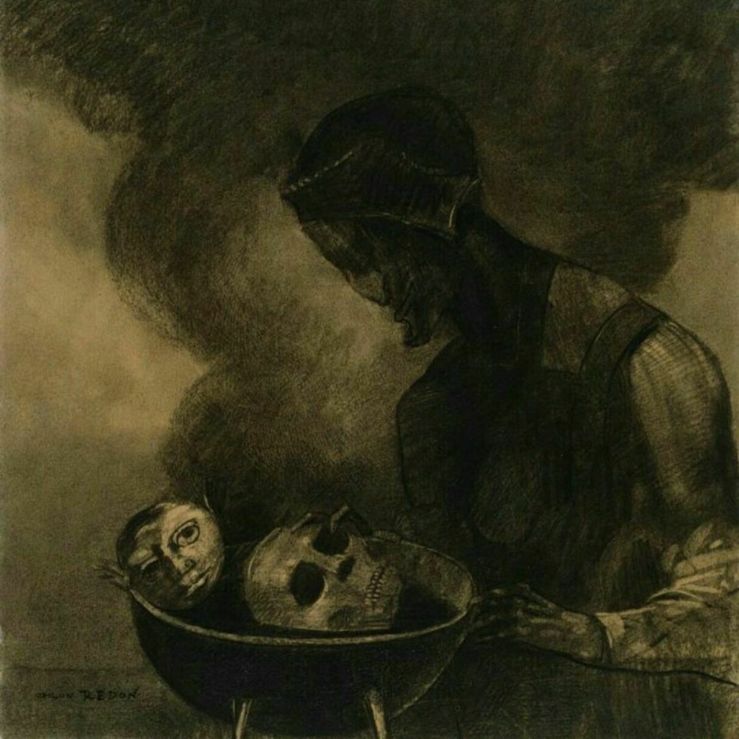
Cauldron of the Sorceress — Odilon Redon

Cauldron of the Sorceress, 1879 by Odilon Redon (1840-1916)