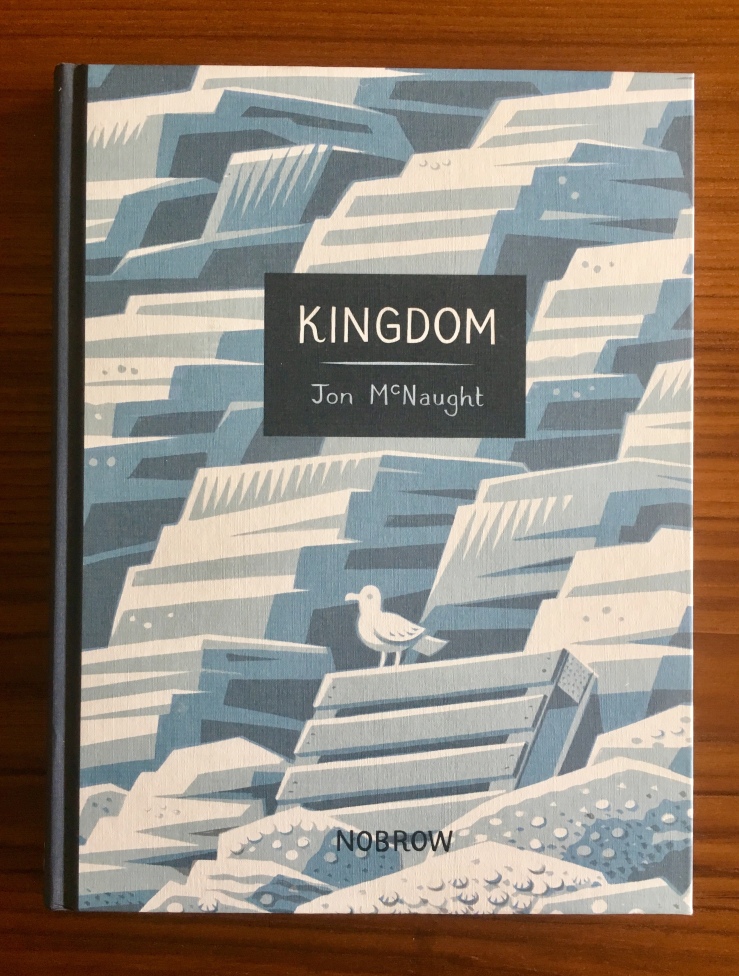
I got a physical copy of Jon McNaught’s latest graphic novel Kingdom last week. Here is publisher Nobrow’s blurb for the book, which will serve as a rough plot summary:
A family sets off for a long weekend at a caravan park on the British coast. We follow them through the familiar landscapes of a summer holiday: motorway service stations, windswept cliffs, dilapidated museums and tourist giftshops. In this atmospheric and contemplative work, Jon McNaught explores the rhythms of nature, the passing of time, and the beauty and boredom of a summer holiday.
A few weeks ago, I’d been sent a digital reader’s copy of Kingdom to review for The Comics Journal, so I’d already read it, but getting a physical copy was like reading it anew. Nobrow’s books are, in general, lovely. They look lovely, are large and colorful and printed on rich thick paper. They smell great too.
Reading Kingdom in print was a much more pleasurable aesthetic experience than reading it on an iPad. The story was the same, of course, but my eyes went across it differently, working with my fingers, lingering, moving backwards and forwards, shuffling pages. The feeling of the story came across stronger, somehow, than it did on a screen–McNaught’s themes of boredom, nature, and our ways of seeing nature resonated more when I could rub my hands on the pages themselves. I do not have a simple explanation for this. There’s an intangibility I’m pointing toward, but one that has to do with tangibility of course: reading as a tactile process.
I’m not a Luddite. I like ebooks, and I generally like to have an ebook of any novel that I’m reading so that I can read it late at night. (Digital copies also make quoting at length for reviews much easier). But I find that screens dampen or mute or hinder something of the aesthetic experience in reading highly-visual narratives, like comics and poetry.
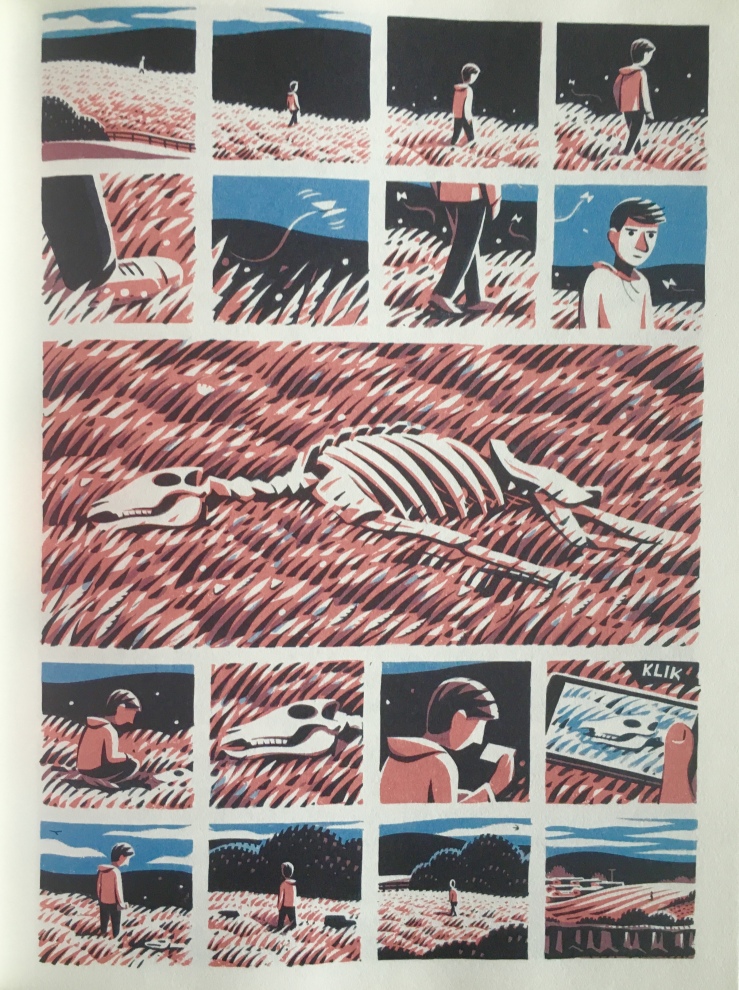
That last phrase, “comics and poetry”—I think that that’s what McNaught does by the way. His comics are visual poems, moods, feelings, evocations of time and space bounded not in words but in sounds, not in symbols and signs but in the objects themselves. The feeling of feeling of his comics is hard to pin down: tranquil and soothing with tinges of melancholy, gentle touches of pleasant boredom, waves of recognition: recognition of spirit, of impulse, of fellow feeling: etc. We see his characters seeing the world, being in the world, and seeing themselves seeing and being in the world. And we also see them mediating that world—on screens.
 I liked Kingdom the first time I read it on a screen. I loved it the second time I read it on paper. Full review soon at The Comics Journal.