Supermarket Ghost — Claudio Bravo 

bravo

Supermarket Ghost,1969 by Claudio Bravo (1936 — 2011)

Blog about Blog about 4

img_1220

On 1 Oct. 2018 on this foolish blog I foolishly wrote about my foolish “good intent to blog about something—books, film, art—every day or nearly every day.” I added, ” I’m not sure how it will go,” although I was a little bit sure about how it would go, which was, not great. Like, I knew that I would stumble in writing every day this month, which I have. October has snuck up (or sneaked up) on me like a thief or a serpent or a hobbit or a pick-your-simile—I even somehow missed taking my kid to her dentist appointment yesterday, and will almost surely get a bill from them over that. October sneaked/snuck up on me, and here we are 16 of 31 days in, and I have only managed 10 of these posts (including this one), which is like, 10 of 16, or 62.5%. (10/16 is also today’s date though, so like, uh, so like nothing).

Anyway.

I have been reading, and the initial blog I wrote about even included some specific goals, along with this picture, which semi-summarized those goals:

From bottom to top—

I did, as I promised I would, return (and not steal) the Ravel book, Irony and Sound, which was frankly over my head.

I have not returned to Hoffman’s Poe book, but I haven’t shelved it.

I’ve been reading the Gordon Lish interviews. Like, the book is good—it’s sort of almost like a book of Lish stories. I blogged about it a bit even.

I’ve absolutely loved reading William Gaddis’s third novel Carpenter’s Gothic. It’s turned out to be a perfect Halloween novel, too. I’ll finish the last of its seven chapters tonight—I would’ve finished last night, but I got sidetracked by some lines that reminded me of Leslie Fiedler’s 1960 analysis of American literature, Love and Death in the American Novel. Gaddis’s book in many ways performs a similar analysis to Fiedler’s—they both trace the weight of American guilt. As if anticipating Gaddis’s postmodern postGothic Gothic novel, Fiedler writes, a quarter century before Carpenter’s Gothic’s publication,

…in the United States, certain special guilts awaited projection in the gothic form. A dream of innocence had sent Europeans across the ocean to build a new society immune to the compounded evil of the past from which no one else in Europe could ever feel himself free. But the slaughter of the Indians, who would not yield their lands to the carriers of utopia, and the abominations of the slave trade, in which the black man, rum, and money were inextricably entwined in a knot of guilt, provided new evidence that evil did not remain with the world that had been left behind—but stayed alive in the human heart, which had come the long way to America only to confront the horrifying image of itself.

(I have stalled out on writing a stupid “Blog about” blog post these past few days because I have been cobbling together notes on something about Fiedler and Gaddis. But, like, really—I need to finish Gaddis’s book first).

No dent in the Pirandello.

I’ll return to David Bunch’s Moderan after finishing Carpenter’s Gothic. Bunch’s work is, so far, a perfectly-pitched pitch black satire of toxic (like nuclearly-toxic) masculinity. Horror-as-comedy, weird and undelightful.

I finished George Eliot’s Silas Marner pretty quickly in October, and enjoyed it. I’m glad I read Middlemarch first though. What Eliot next, reader?

So—what next? The picture at the top is the stack I’ve been stacking and unstacking and restacking. Gaddis and Fiedler feel like the thing I really want to write about—gender roles, Gothic promises, domesticity vs. adventure, the house vs. the frontier, the collapse of self into fragments of language, etc. I’m also loving Dreamverse, a collection of poems, art, and prose by Jindřich Štyrský’ that Twisted Spoon Press has put together.  Its insides look like this, at least in one place—

img_1162

I think the next novel I will read will be Angela Carter’s The Infernal Machines of Doctor Hoffman.

Dulle Griet (detail) — David Ryckaert III

Screenshot 2018-10-14 at 5.35.12 PM

Dulle Griet, 1658 by David Ryckaert III (1612-1661)

“Exceptions to the Instinctual” — Colin James

“Exceptions to the Instinctual”

by

Colin James

             The Draculaian fang
             is really only for grip.
             Mouth forms a salacious
             sucker draining the body
             of all its fluids.
             The heart an aperitif.
             Don’t listen to the others.
             That fool Van Helsing known
             to prance about his boudoir
             inappropriately attired in nothing
             other than thigh high boots,
             practicing his crucifixion rebuttal
             in front of a wall mirror.
             Someone substituted the hair
             from an ogre’s dong into
             his mother’s precious locket.
             The smell of which he would
             describe in despair as substantially
             stronger than a generation’s decline.

The Street of Hidden Presences — Remedios Varo

cat-164-la-calle-de-las-presencias-ocultas-1956

The Street of Hidden Presences, 1956 by Remedios Varo (1908-1963)

Hanging Wall — Gregory Thielker

04hangingwall-1807x1280

Hanging Wall, 2013 by Gregory Thielker (b. 1979)

Screenshot 2018-10-15 at 6.39.46 PMScreenshot 2018-10-15 at 6.39.32 PMScreenshot 2018-10-15 at 6.39.21 PM

Dulle Griet (detail) — David Ryckaert III

Screenshot 2018-10-14 at 5.31.00 PM

 Dulle Griet, 1658 by David Ryckaert III (1612-1661)

Pack of Hounds — Francisco Goitia

Screenshot 2018-10-14 at 4.14.55 PM

Pack of Hounds by Francisco Goitia (1882–1960)

Saul and the Witch of Endor (detail) — Benjamin West

Screenshot 2018-10-11 at 8.00.05 PM

Detail from Saul and the Witch of Endor, 1777 by Benjamin West (1738-1820)

Deer Skull (Georgia O’Keeffe) — Todd Webb

Screenshot 2018-10-11 at 7.46.11 PM

Deer Skull (Georgia O’Keeffe), 1961 by Todd Webb (1905-2000)

Blog about some books and some book covers and acquiring some books and not acquiring some books

img_1179

I went to the book store this afternoon to pick up a copy of the latest graphic novel in by Kazu Kibuishi’s Amulet series for my kids, and of course I browsed a while. Looking for a copy of Anne Carson’s Plainwater, I ended up finding Angela Carter’s 1972 novel Infernal Desire Machines of Doctor Hoffman. It’s a British edition, 1985, Penguin, with a lovely Boschian cover by James Marsh. Here’s a detail from the cover:

img_1180

I’ve wanted to pick up Carter’s novel since I read about it on a silly good dystopian fiction list last year, and I’m thrilled that I was able to get one with a Marsh cover. This particular cover, along with Marsh’s cover for The Bloody Chamber, are included in Phil Baines lovely book Penguin by Design.

Baines’s book doesn’t include any of Marsh’s fantastic covers of J.G. Ballard novels, opting instead to include Dave Pelham’s versions. I love both Pelham and Marsh’s Ballard covers, and would love to get my mitts on one at some point. I always browse for old mass market paperbacks of sci-fi authors I like — Philip K. Dick, Ursula K. LeGuin, the Strugatsky Brothers, J.G. Ballard — hoping to find an interesting cover, something inventive and fun, something from before their works were, under the cloak of awful respectability, given safe, boring literary covers. I didn’t find any Ballard editions with Marsh or Pelham covers, but I did come across this lovely pair of mass market paperback:

img_1176

They’re US Vintage versions, 1985, with covers by Chris Moore. There’s like a proto-Cherry 2000 thing going on here that I kinda love, but I already own these novels, and I don’t love the covers quite enough. So instead, this post. Here are the covers of my copies of Crash and Concrete Island:

img_1181

While Henry Sene Yee’s cover design for my copy of Concrete Island (using a photograph by Kevin Laubacher) isn’t terrible, it is a good example of what I mean by boring respectable literary covers. Still, this trade edition (Picador, 2001) is really readable—I mean, it’s easy to read. The pages are nice, the typeset is great, etc. (And the book is killer). I actually like the cover of my copy of Crash, a lot (design by Michael Ian Kaye and Melissa Hayden), but it’s also trying just a little too hard. (Again—very readable version from FS&G’s Noonday Press imprint, 1994).

While I had to pass today on the mass market copies of Crash and Concrete Island today—not because they would have set me back five bucks in store credit, but because I don’t need them, because I hope some kid goes in there and picks them up—while I had to pass on those lurid beauties, I did pick up a mass market 1967 copy of The Crystal World. Publisher Berkley Medallion didn’t bother to name the cover designer/artist, and I haven’t been able to track it down, but it is, I admit, a bit disappointing—an early pulp bid for literary respectability. At least I can be on the look out for a weirder one in the future.

Skull with Candle — Gerhard Richter

eb51e335dd696bebde2f9f2d1bad73a7

Skull with Candle, 1983 by Gerhard Richter (b. 1932)

Hide and Seek — Pavel Tchelitchew

stufftoblowyourmind-23-2014-01-hide-and-seek

Hide and Seek, 1945 by Pavel Tchelitchew (1898-1957)

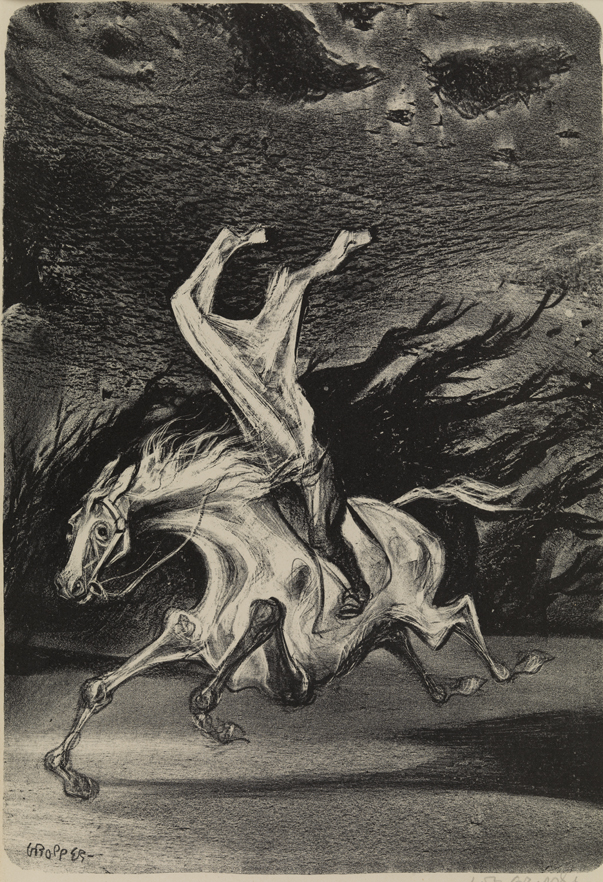
Headless Horseman — William Gropper

1956_55_9_l

Headless Horseman, 1953 by William Gropper (1897-1977)

Circe Punishes Glaucus by Transforming Scylla into a Monster (detail) — Eglon van der Neer

circe

Detail from Circe Punishes Glaucus by Transforming Scylla into a Monster, 1695 by Eglon van der Neer (1636–1703)

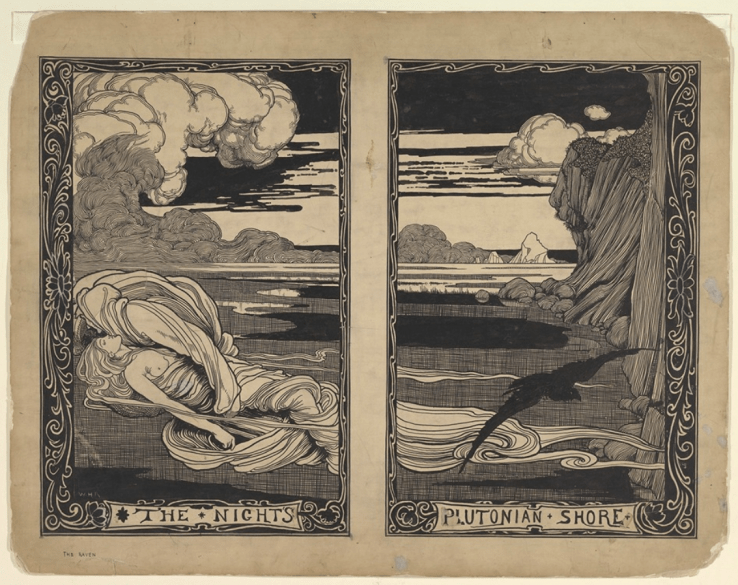
The Night’s Plutonian Shore — William Heath Robinson

Capture

The Night’s Plutonian Shore, 1909 by William Heath Robinson (1872-1944)

Saint Bernard Crushing a Demon (detail) — Marcello Venusti

Capture

 Saint Bernard Crushing a Demon, 1563 by Marcello Venusti (1512–1579)