The difference between writers and critics is that in order to function in their trade, writers must live in the world, and critics, to survive in the world, must live in literature.
That’s why writers in their own work need have nothing to do with criticism, no matter on what level.
In fact, since seminars and discussions move forward a lot more cheerily if a couple of bald statements are made, I’ll make one: You can lunge off into an interesting and true career as a writer even if you’ve read nothing but the Holy Bible and the New York Daily News, but that is an absolute minimum (read them slowly).
Literary criticism always ought to be of great interest to the historian, the moralist, the philosopher, which is sometimes me. Also to the reader—me again—the critic comes as a journalist. If it happens to be the right decade, he may even bring great news.
As a reader, I liked reading Wright Morris’s The Territory Ahead. But if I—the writer—should pay too much attention to him, I would have to think an awful lot about the Mississippi River. I’d have to get my mind off New York. I always think of New York. I often think of Chicago, San Francisco. Once in a while Atlanta. But I never think about the Mississippi, except to notice that its big, muddy foot is in New Orleans, from whence all New York singing comes. Documentaries aside, my notions of music came by plane.
The Indians in and around Cape Flattery, on the Pacific coast of British North America, retain the urine dance in an unusually repulsive form. As was learned from Mr. Kennard, U.S. Coast Survey, whom the writer had the pleasure of meeting in Washington, D.C., in 1886, the medicine men distil, from potatoes and other ingredients, a vile liquor, which has an irritating and exciting effect upon the kidneys and bladder. Each one who has partaken of this dish immediately urinates and passes the result to his next neighbor, who drinks. The effect is as above, and likewise a temporary insanity or delirium, during which all sorts of mad capers are carried on. The last man who quaffs the poison, distilled through the persons of five or six comrades, is so completely overcome that he falls in a dead stupor.
Precisely the same use of a poisonous fungus has been described among the natives of the Pacific coast of Siberia, according to the learned Dr. J. W. Kingsley (of Brome Hall, Scole, England). Such a rite is outlined by Schultze. “The Shamans of Siberia drink a decoction of toad-stools or the urine of those who have become narcotized by that plant.”—(Schultze, “Fetichism,” New York, 1885, p. 52.)
The Ur-Orgy of the natives of Siberia should be found fully described by explorers in the employ of the Russian Government. Application was accordingly made by the author to the Hon. Lambert Tree, the American Minister at the Court of St. Petersburgh, who evinced a warm interest in the work of unearthing from the Imperial archives all that bore upon the use of the mushroom as a urino-intoxicant. Unfortunately, the official term of Mr. Tree having expired, no information was obtained from him in time for incorporation in these pages.
Acknowledgment is due in this connection to Mr. Wurtz, the American Chargé d’Affaires at St. Petersburgh, as well as to his Excellency the Russian Minister of Public Instruction, for courteous interest manifested in the investigations made necessary by the amplification of the original pamphlet.
Conferences were also had with his Excellency the Chinese Minister and with Dr. H. T. Allen, Secretary of the Corean Legation, in Washington, but beyond developing the fact that in the minor medicine of those countries resort was still had to excrementitious curatives, the information deduced was meagre and unimportant.
Dependence was therefore necessarily placed upon the accounts of American or English explorers of undisputed authority.
George Kennan describes a wedding which he saw in one of the villages of Kamtchatka: “After the conclusion of the ceremony we removed to an adjacent tent, and were surprised as we came out into the open air to see three or four Koraks shouting and reeling in an advanced stage of intoxication,—celebrating, I suppose, the happy wedding which had just transpired. I knew that there was not a drop of alcoholic liquor in all Northern Kamtchatka, nor, so far as I knew, anything from which it could be made, and it was a mystery to me how they had succeeded in becoming so suddenly, thoroughly, hopelessly, undeniably drunk. Even Ross Browne’s beloved Washoe, with its ‘howling wilderness’ saloons, could not have turned out more creditable specimens of intoxicated humanity than those before us.
“The exciting agent, whatever it might be, was certainly as quick in its operation and as effective in its results as any ‘tanglefoot’ or ‘bottled lightning’ known to modern civilization.
“Upon inquiry, we learned to our astonishment that they had been eating a species of the plant vulgarly known as ‘toadstool.’ There is a peculiar fungus of this class in Siberia, known to the natives as ‘muk-a-moor,’ and as it possesses active intoxicating properties, it is used as a stimulant by nearly all the Siberian tribes.
“Taken in large doses, it is a violent narcotic poison, but in small doses it produces all the effects of alcoholic liquor.
“Its habitual use, however, completely shatters the nervous system, and its sale by Russian traders to the natives has consequently been made a penal offence by the Russian law. In spite of all prohibitions the trade is still secretly carried on, and I have seen twenty dollars’ worth of furs bought with a single fungus.
“The Koraks would gather it for themselves, but it requires the shelter of timber for its growth, and is not to be found on the barren steppes over which they wander; so that they are obliged for the most part to buy it at enormous prices from the Russian traders. It may sound strangely to American ears, but the invitation which a convivial Korak extends to his passing friend is not ‘Come in and have a drink,’ but ‘Won’t you come in and take a toadstool?’—not a very alluring proposal perhaps to a civilized toper, but one which has a magical effect upon a dissipated Korak. As the supply of these toadstools is by no means equal to the demand, Korak ingenuity has been greatly exercised in the endeavor to economize the precious stimulant and make it go as far as possible.
“Sometimes in the course of human events it becomes imperatively necessary that a whole band should get drunk together, and they have only one toadstool to do it with. For a description of the manner in which this band gets drunk collectively and individually upon one fungus, and keeps drunk for a week, the curious reader is referred to Goldsmith’s ‘A Citizen of the World,’ Letter 32. Continue reading ““Poisonous Mushrooms Used in Ur-Orgies” | From Captain John G. Bourke’s Scatalogic Rites of All Nations”→
William T. Vollmann has a new essay in Granta. “Drones and Decolonization” is reportage from the Russia-Ukraine war, but in typically Vollmannesque fashion the essay is also about a lot of other things (Joseph Roth, Isaac Babel, language and names, food, monuments, etc. — at one point Vollmann editorializes on his own habits to let his projects swell: “all Granta had commissioned was 5,000 words, and I would exceed expectations by submitting 40,000 words, which they would only be able to cut down so much”).
Here is the opening of the essay:
Some of her was Austria once, and part of her had been Poland. Starved and tortured by Stalinists into Soviet Republichood, then raped by Hitler’s Reich, she finally became some version of herself, but then V. Putin thought to annex her back into another empire: Re-Russify her! Give it to her good and hard, then beautify the corpse with a mask of iron!
Her de-Russifiers fought back, and not only with drones and artillery: Amputate the occupier’s monuments! Ban his writers, no matter how long ago they lived; rename his streets . . . ‘Little Father is no more,’ cried that Ukrainian, Russian, Polish or maybe Austro-Hungarian writer Joseph Roth. ‘Where is the czar? . . . What sort of world is this? A crooked world!’
I went to help her in my helpless way, with journalistic good intentions which sorrowed into love. From Berlin to Vienna I went, and then through the Czech Republic’s golden-red forests, which here and there burst into ultra-yellow blazes beneath an ever-darkening silver sky. I glimpsed long, gentle slopes of well-mown or -grazed green grass and I saw decrepit towns; then it was afternoon among Poland’s boarded-up brick buildings, with crew-cut young men lounging in packs while wearily beautiful old women dragged home heavy shopping bags. Passing through the town of Liszki I spied a church steeple graying in the twilight, and long after dark came the final border.
And I can’t help but share these lines from Vollmann’s conclusion (I do not think they constitute a so-called spoiler), which point out that our murder drones will one day come home to roost:
I knew that the American Empire in which I lived was approaching its imminent end, but I could not quite believe it. All those drones our corporations pimped out, when would they come to us to spread terror, agony and grief?
But in the white culture outside, in that creepy world full of precardiac Mustang drivers who scream insults at one another only when the windows are up; of large corporations where Niceguymanship is the standing order regardless of whose executive back one may be endeavoring to stab; of an enormous priest caste of shrinks who counsel moderation and compromise as the answer to all forms of hassle; among so much well-behaved unreality, it is next to impossible to understand how Watts may truly feel about violence. In terms of strict reality, violence may be a means to getting money, for example, no more dishonest than collecting exorbitant carrying charges from a customer on relief, as white merchants here still do. Far from a sickness, violence may be an attempt to communicate, or to be who you really are.
For conveying ideas, novels are among the least functional and most decorative of the blunt instruments. (Could this be a universal truth, some starry, operative mathematical principle? Most stars are decorative too, of course, their function merely to peg the universe in place like studs in upholstery, servicing the elegancies, strumming its physics like a man with a blue guitar, fleshing all the centripetals and centrifugals, stringing the planets like beads, some beautiful pump of placement, arranging night, moving the planetary furniture, and fixing the astronomical data, but less useful, finally, in the sense that a handful more here or a dollop less there could make as much of a never mind as corks or rhythm, less useful, finally, than mail or ice cream.) And if, a few times in a way, novels like Richard Henry Dana’s Two Years Before the Mast or Beecher Stowe’s Uncle Tom’s Cabin or Steinbeck’s Grapes of Wrath come along to legislate, or raise a consciousness or two, or rouse a rabble, to make, I mean, what history or the papers call a difference, why that’s decorative, too, I think, a lip service the system, touching the bases like a superstitious braille, pays art—like, oh, the claims made a few years back for the “We Are the World” folks when it was really the Catholic Relief Services already on site during the Ethiopian famine that did the heavy lifting.
Well it’s not the novelist’s fault. Not that they don’t deserve some of the blame, leaking encouragement like someone paying out line to fish, some of your have-cake-and-eat-its like a little miracle of the loaves. And there are still a few big mouths who stake claims for the ameliorative shamanism of—hark! this is interesting: not the book so much as the writer—the practice of fiction—the loyal, Nutso Art Jerk Groupie, like some devoted cultist, the last Deadhead, say, worrying like holy beads the shoelace on his wrist he thinks is a bracelet making confrontation with an Elvis Presley impersonator.
Isn’t it pretty to think so, though? To take oneself as seriously as one’s readers sometimes do? To believe, if only briefly, and if only by the light off the gloss of the brittlest mood swing, in the justice or even the palpability of one’s cause, to Don Quixote principle, any principle, and raise to the level of purpose what in the final analysis is only what given egos, fashionably or not, fashion or no, frozen in mere season’s hipped au courantness, perceive as beauty. Continue reading ““The Rest of the Novel” — Stanley Elkin”→
The teacher or lecturer is a danger. He very seldom recognizes his nature or his position. The lecturer is a man who must talk for an hour.
France may possibly have acquired the intellectual leadership of Europe when their academic period was cut down to forty minutes.
I also have lectured. The lecturer’s first problem is to have enough words to fill forty or sixty minutes. The professor is paid for his time, his results are almost impossible to estimate.
The man who really knows can tell all that is transmissible in a very few words. The economic problem of the teacher (of violin or of language or of anything else) is how to string it out so as to be paid for more lessons.
Be as honest as you like, but the danger is there even when one knows it. I have felt the chill even in this brief booklet. In pure good will, but because one must make a rough estimate, the publishers sent me a contract: 40,000 to 50,000 words. I may run over it, but it introduces a ‘factor’, a component of error, a distraction from the true problem.
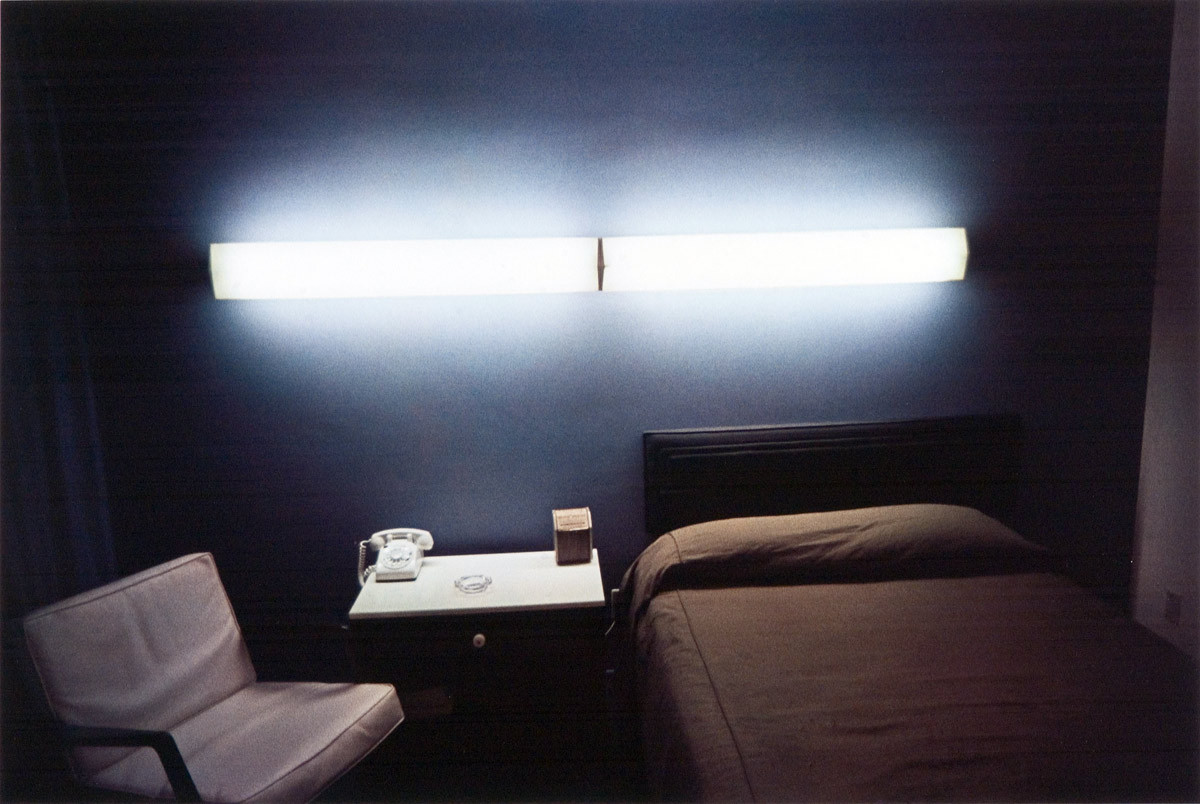
Untitled (Motel Room with Fluorescents), from The Los Alamos-Portfolio,1965-68 by William Eggleston (b. 1939)
“Motel #1”
by
Charles Portis
From his essay “Motel Life, Lower Reaches,” first published in Oxford American in 2003 and later collected in Escape Velocity.
Back when Roger Miller was King of the Road, in the 1960s, he sang of rooms to let (“no phone, no pool, no pets”) for four bits, or fifty cents. I can’t beat that price, but I did once in those days come across a cabin that went for three dollars. It was in the long, slender highway town of Truth or Consequences, New Mexico.
That cute and unwieldy name, by the way, was taken in 1950 from the name of a quiz/comedy radio show, and has stuck, against long odds. The show was okay, as I recall, a cut or two above the general run of broadcast ephemera, with some funny 1949 moments. But why re-name your town for it? And by now, a half-century later, you would think the townsfolk must surely have repented their whim and gone back to the old name, solid and descriptive, of Hot Springs. But no, and worse, the current New Mexico highway maps no longer offer both names, with the old one in parentheses, as an option, for the comfort of those travelers who wince and hesitate over saying, “Truth or Consequences.” Everyone must now say the whole awkward business.
I was driving across the state at the time, very fast. There were signs along the approaches to town advertising cheaper and cheaper motel rooms. The tone was shrill, desperate, that of an off-season price war. It was a buyer’s market. I began to note the rates and the little extras I could expect for my money. Always in a hurry then, once committed to a road, I stopped only for fuel, snake exhibits, and automobile museums, but I had to pause here, track down the cheapest of these cheap motels, and see it. I would confront the owner and call his bluff.
There were boasts of being AIR COOLED (not quite the same as being air-conditioned) and of PHONE IN EVERY ROOM, KITCHENETTES, LOW WEEKLY RATES, CHILDREN FREE, PETS OK, VIBRO BEDS, PLENTY OF HOT WATER, MINIATURE GOLF, KIDDIE POOL, FREE COFFEE, FREE TV, FREE SOUVNIERS. (Along Arkansas roads there are five or six ways of spelling souvenirs, and every single one of them is wrong. The sign painters in New Mexico do a little better with that tricky word, but not much better.) The signs said SALESMEN WELCOME and SNOWBIRDS WELCOME and TRUCKS WELCOME/BOBTAILS ONLY—meaning just the tractors themselves; their long semi-trailers would not be welcome. And there were the usual claims, often exaggerated, of having CLEAN ROOMS or NEW ROOMS or CLEAN NEW ROOMS or ALL NEW CLEAN MODERN ROOMS.
I decided not to consider the frills. How could you reckon in cash the delight value of a miniature golf course with its little plaster windmills, tiny waterfalls, and bearded elves perched impudently on plaster toadstools? I would go for price alone, the very lowest advertised price, which turned out to be three dollars. It was a come-on, I knew, a low-ball offer. Sorry, I would be told, but the last of those special rooms had just been taken; the only ones left would be the much nicer $6.50 suites. I would let the owner know what I thought of his sharp practice, but not really expecting him to writhe in shame.
The three-dollar place was an old “tourist court,” a horseshoe arrangement of ramshackle cabins, all joined together by narrow carports. The ports were designed to harbor, snugly, small Ford sedans of 1930s Clyde Barrow vintage, each one with a canvas water bag (“SATURATE BEFORE USING”) hanging from the front bumper, for the crossing of the Great American Desert.
But there were no cars here at all, and no one in the office. I gave the desk bell my customary one ding, not a loutish three or four. An old lady, clearly the owner, perhaps a widow, came up through parted curtains from her cluttered female nest in the rear. She was happy to see me. l asked about a three-dollar room, for one person, one night. She said yes, certainly, all her cabins went for three dollars, and there were vacancies. This, without bothering to crane her neck about and peer over my shoulder, by way of giving my car out there the once-over. Desk clerks do that when I ask for a single, to see if I am trying to conceal a family. These clerks are trained in their motel academies to watch for furtive movement in the back seats of cars, for the hairy domes of human heads, those of wives, tykes, and grannies left crouching low in idling Plymouths.
This old lady had come up in a gentler school. She was honest and her signs were honest and her lodgers were presumed to be more or less honest. She had caught me up short and rattled me. Who was bluffing now? I couldn’t just leave, nor, worse, give her three dollars and then leave, compounding the insult to her and her yellowish cabins. I paid up and stayed the night, her only guest.
My cabin had a swamp cooler, an evaporative cooling machine that is usually quite effective in that arid country. A true air conditioner (brutal compressor) uses much more electricity than a swamp cooler (small water pump, small fan). But then the cooler does consume water, and the economy of nature is such—no free lunch—that the thing works well only in a region where the humidity is low—under forty percent, say. Where water is scarce, that is, and thus expensive.
It was dry enough here, but my cooler was defective and did nothing more than stir the hot air a bit.
I looked the room over for redeeming touches. It wasn’t so bad, beaten down with use and everything gone brown with age, but honorably so, not disgusting, shabby but clean, a dry decay.
The bedding may have been original stock. That central crater in the mattress hadn’t been wallowed out overnight, but rather by a long series of jumbo salesmen, snorting and thrashing about in troubled sleep. A feeble guest would have trouble getting out of the mattress. He would cry out, feebly, for a helping hand, and nobody in earshot. The small lamp on the bedside table was good, much better for reading than the lighting systems in expensive motels, with their diffused gloom. Motel decorators, who obviously don’t read in bed, are all too fond of giant lampshades, a prevailing murk, and lamp switches that are hard to find and reach. The bath towels were clean but threadbare, and much too short to use as wraparound sarongs while shaving. The few visible insects were dead or torpid. There were no bathroom accretions of soft green or black matter. The lavatory mirror was freckled and had taken on a soft sepia tint. Mineral deposits clogged the shower head, making for a lopsided spraying pattern, but the H and C knobs had not been playfully reversed, nor did they turn the wrong way. There were sash windows you could actually raise, after giving them a few sharp blows with the heels of your hands, to break loose the ancient paint. Here again the feeble guest, seeking a breath of air, would struggle and whimper.
I had paid more and seen worse—murkier and more oppressive rooms, certainly, with that dense black motel murk hanging about in all the corners, impossible to dispel and conducive to so many suicides along our highways, I had seen worse rooms, if not thinner and shorter towels. There was plenty of hot water. I had the privacy of a cabin, and indeed not a single neighbor. What I had was a cottage, and a steal at three dollars.
Early the next morning the lady came tapping at my door. She had a pot of coffee for me on a tray with some buttered toast and a little china jug of honey. It was that unprecedented gesture, I think, and the grace note of the honey—no sealed packet of “Mixed Fruit” generic jelly—that made the place stick in my head so, and not the price at all. I like to think the old cabins lasted out the good old lady’s widowhood. It must have been a close-run finish. And it comes to me now, late, a faint voice, saying the price was really two dollars.

 Biblioklept