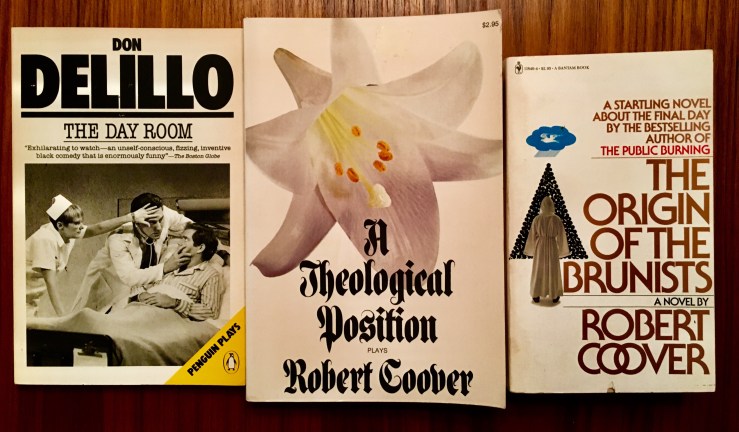
Two by Robert Coover and one by Don DeLillo (Books acquired—a few plays, unexpectedly—26 Jan. 2019)

img_2140

On Friday night we watched the first Hunger Games film with our daughter, who had finished the book this week. The movie isn’t that great, as I argued when I saw it seven years ago in the theater, but she seemed to like it, although she said she would have “done a lot of things differently.” She asked me to pick up the second book for her when I got a chance, and Not at the library, I want to own it, etc. So I figured that I’d use that as an excuse to browse my favorite used bookstore, so conveniently located 1.1 miles away (I swear I didn’t move into this neighborhood because of its proximity).

I went for a walk, got bitten rather viciously by a medium-sized dog, cleaned and dressed the wound, and went to browse books.

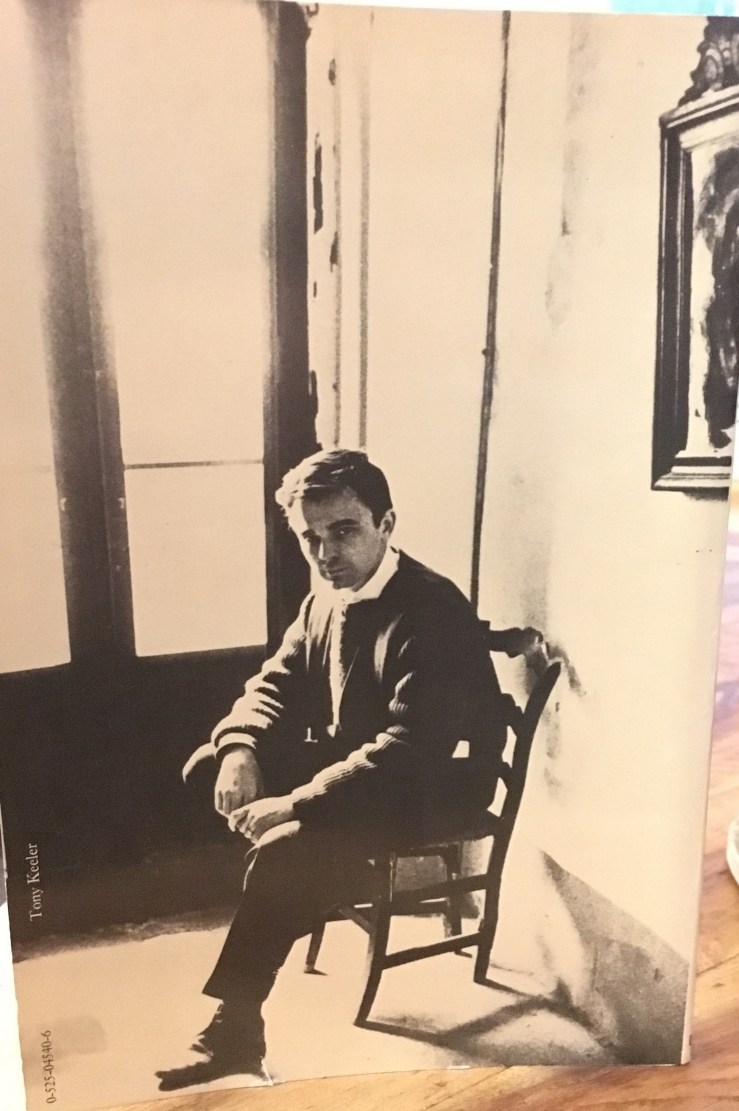
There are over two million books in this bookstore, a lot of them not really organized. While I usual mull around general fiction, literary criticism, art and art history, sci-fi, fantasy, and a section called “literary fiction,” I like to mix it up by going into areas I don’t know as well. Strolling through stack after stack in the drama section, an outward-turned collection of plays by Robert Coover caught my eye. I’d never heard of A Theological Position, but the cover and a few minutes browsing the four plays collected here—including one called Rip Awake, about Rip Van Winkle, which especially interested me—sealed the deal. That was before I turned the book over and saw this magnificent author photo, where a young Coover looks a bit like Jacques Derrida, in lieu of a tired blurb—
img_2142

A column over I spied a copy of Don DeLillo’s play The Day Room, 1986 joint I’d never heard of. The Penguin Plays edition with a black and white cover of a production recalled to me the four years of theater and drama I took in high school—we had plenty of these in the drama room, plays by Eugene O’Neil, Arthur Miller, Sam Shepard, etc. I was like the only one interested in these; it took me until the end of my sophomore year to realize that most of the drama kids were interested in fucking musicals and not literary drama. I probably belonged with the art kids but whatever.

I went and picked up the second Hunger Games book, and then browsed sci-fi a bit, hoping to find some more by the Strugatsky brothers or David Ohle’s Motorman, but not that day, friends! I also wanted to get a copy of Octavia Butler’s Parable of the Sower—and there were several—but they were all in these ridiculously well-kempt respectable and utterly literary cover editions that I can’t get down with. I’m sure I’ll find something I can live with sometime this year, but in the meantime, turning a corner, I found a massmarket paperback copy of Robert Coover’s novel The Origin of the Brunists, a novel I’ve been meaning to read for almost twenty years now. So.

 

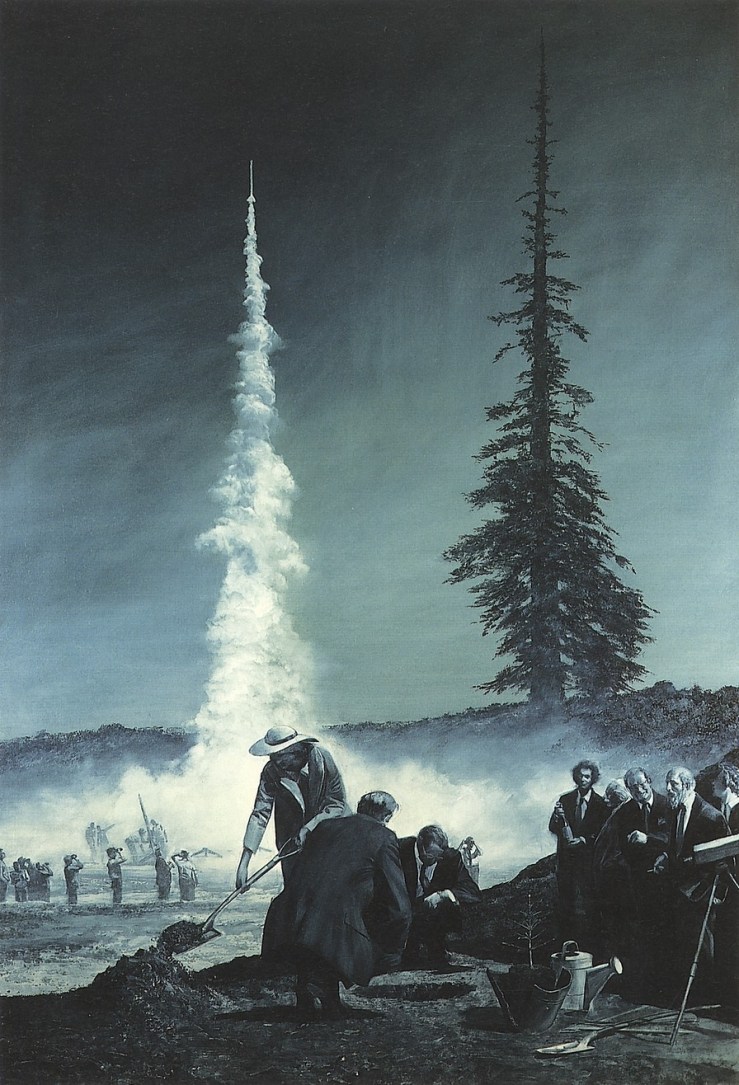
Almayer’s Folly — Rene Magritte

78831

Almayer’s Folly, 1951 by René Magritte (1898-1967)

“Kaspar!  Makan!”

The well-known shrill voice startled Almayer from his dream of splendid future into the unpleasant realities of the present hour.  An unpleasant voice too.  He had heard it for many years, and with every year he liked it less.  No matter; there would be an end to all this soon.

He shuffled uneasily, but took no further notice of the call.  Leaning with both his elbows on the balustrade of the verandah, he went on looking fixedly at the great river that flowed—indifferent and hurried—before his eyes.  He liked to look at it about the time of sunset; perhaps because at that time the sinking sun would spread a glowing gold tinge on the waters of the Pantai, and Almayer’s thoughts were often busy with gold; gold he had failed to secure; gold the others had secured—dishonestly, of course—or gold he meant to secure yet, through his own honest exertions, for himself and Nina.  He absorbed himself in his dream of wealth and power away from this coast where he had dwelt for so many years, forgetting the bitterness of toil and strife in the vision of a great and splendid reward.  They would live in Europe, he and his daughter.  They would be rich and respected.  Nobody would think of her mixed blood in the presence of her great beauty and of his immense wealth.  Witnessing her triumphs he would grow young again, he would forget the twenty-five years of heart-breaking struggle on this coast where he felt like a prisoner.  All this was nearly within his reach.  Let only Dain return!  And return soon he must—in his own interest, for his own share.  He was now more than a week late!  Perhaps he would return to-night.  Such were Almayer’s thoughts as, standing on the verandah of his new but already decaying house—that last failure of his life—he looked on the broad river.  There was no tinge of gold on it this evening, for it had been swollen by the rains, and rolled an angry and muddy flood under his inattentive eyes, carrying small drift-wood and big dead logs, and whole uprooted trees with branches and foliage, amongst which the water swirled and roared angrily.

One of those drifting trees grounded on the shelving shore, just by the house, and Almayer, neglecting his dream, watched it with languid interest.  The tree swung slowly round, amid the hiss and foam of the water, and soon getting free of the obstruction began to move down stream again, rolling slowly over, raising upwards a long, denuded branch, like a hand lifted in mute appeal to heaven against the river’s brutal and unnecessary violence.  Almayer’s interest in the fate of that tree increased rapidly.  He leaned over to see if it would clear the low point below.  It did; then he drew back, thinking that now its course was free down to the sea, and he envied the lot of that inanimate thing now growing small and indistinct in the deepening darkness.  As he lost sight of it altogether he began to wonder how far out to sea it would drift.  Would the current carry it north or south?  South, probably, till it drifted in sight of Celebes, as far as Macassar, perhaps!

–The opening paragraphs of Joseph Conrad’s 1895 novel Almayer’s Folly.