Sarah Palin, Vague Threats, and Why Banned Books Week Matters

We know Sarah Palin loves to read. In a great op/ed piece in today’s Washington Post, Ruth Marcus writes:

Asked in an interview for PBS’s Charlie Rose show last year (http://www.charlierose.com/guests/sarah-palin) about her favorite authors, Palin cited C.S. Lewis — “very, very deep” — and Dr. George Sheehan, a now-deceased writer for Runner’s World magazine whose columns Palin still keeps on hand.

“Very inspiring and very motivating,” she said. “He was an athlete and I think so much of what you learn in athletics about competition and healthy living that he was really able to encapsulate, has stayed with me all these years.”

Also, she got a Garfield desk calendar for Christmas 1987 that made a big impression.

Great stuff. Who doesn’t love to read? Books is where you gets knowledge. However, Palin is the sort of fundamentalist hardliner who thinks she knows what’s best for all of us to read–or not read. By now, you’ve probably heard of the pressure Palin exerted on the librarian of Wasilla. As mayor, Palin inquired how she might go about removing books from the library. Of course, according to most reports, including this one from The Anchorage Daily News earlier this month, “Palin didn’t mention specific books at that meeting.”

Huh. Hard to imagine that Palin didn’t get specific, right?

Palin then wrote the librarian in question a letter telling her she would be fired for lack of loyalty. Although public outcry prevented the firing, the librarian eventually moved away from Wasilla. Palin said at the time, and has maintained since then, that the question was “rhetorical”; she simply wanted to know how one would go about removing “objectionable” books.

Why would you ask how to remove books if you had no intention of removing them?

It’s too easy to dismiss Palin’s inquiries into censorship. Her moralistic will to ban what others read is really an attempt to control ideas, to control thoughts, to control bodies even–the ultimate goal of the far Christian right. It’s the middle of Banned Book’s Week, and it’s time to say “No” to the vacuous (a)moralizing of those like Palin who would presume to dictate what is and is not acceptable to be loaned in a public library. I don’t know about you, but I’m not going to let a woman who apparently believes that “dinosaurs and humans walked the Earth at the same time” tell me what to think or feel or read.

Banned Books Week calls attention to not only the great currency of ideas we have in literature, but to also points out that there are still those who seek to suppress ideas with which they don’t agree. Even as we celebrate these books, we must attack those who would ban them–especially those who work so surreptitiously.
The Adventures of Huckleberry Finn: One of Our Favorite Challenged Books

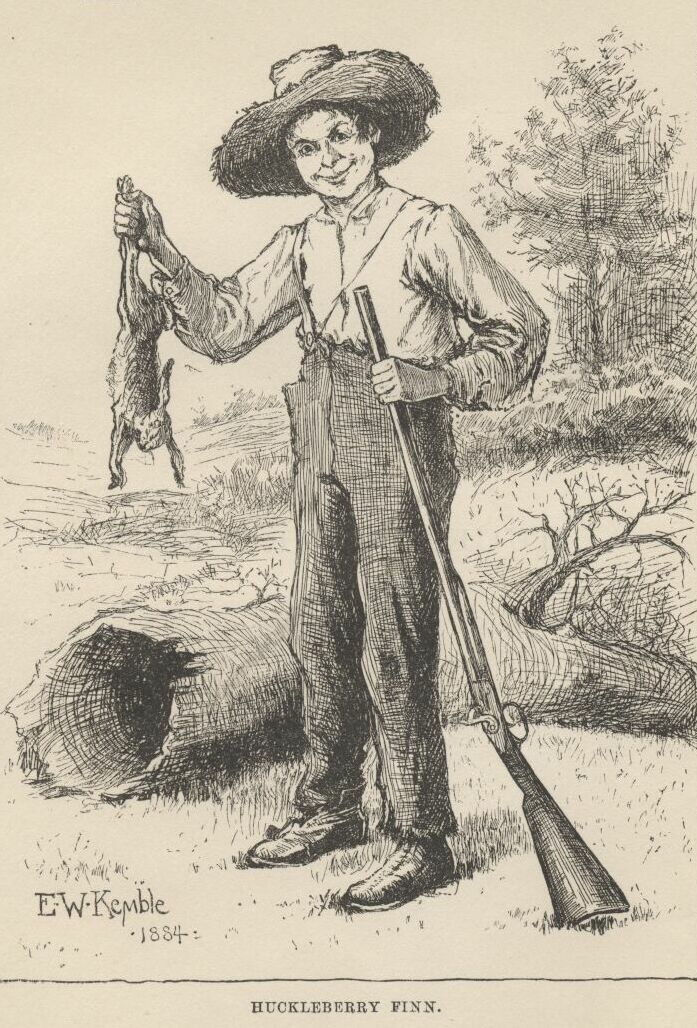
E.W. Kemble's frontispiece to the original 1884 edition
E.W. Kemble's frontispiece to the original illustrated edition

The Adventures of Huckleberry Finn by Mark Twain, undoubtedly one of the Great American Novels, ranks a healthy #5 on the ALA’s list the 100 Most Frequently Challenged Books. Young Huck’s casual colloquial use of the word “nigger” and the cruel hijinks Huck and Tom play on Jim at the novel’s end are two reasons that many have sought to suppress Twain’s masterpiece, including educator and critic John Wallace, who famously called it “the most grotesque example of racist trash ever given our children to read.” Wallace went so far as to suggest that “Any teacher caught trying to use that piece of trash with our children should be fired on the spot, for he or she is either racist, insensitive, naive, incompetent or all of the above.”

I guess I should’ve been fired on the spot, as I’ve used Huck Finn in my classroom a number of times, almost always in conjunction with excerpts from Olaudah Equiano’s Interesting Narrative, some Philis Wheatley poems, and a UN report on modern human trafficking. Context is everything.

While I can concede readily that Huck, the voice of the novel, says some pretty degrading things about Jim, often meant (on Twain’s part) to create humor for the reader, to expect Twain’s treatment of race to be what we in the 21st century want it to be is to not treat the material with any justice. And while Huck Finn may be insensitive at times, it handles the issues of race, slavery, class, and escape from the dominant social order with the complexity and thought that such weighty issues deserve. Ultimately, the novel performs a critique on the hypocrisy of a “Christian,” “democratic” society that thought it was okay to buy and sell people. This critique shows up right in the second page. Consider these lines (boldface mine):

The widow rung a bell for supper, and you had to come to time. When you got to the table you couldn’t go right to eating, but you had to wait for the widow to tuck down her head and grumble a little over the victuals, though there warn’t really anything the matter with them,—that is, nothing only everything was cooked by itself. In a barrel of odds and ends it is different; things get mixed up, and the juice kind of swaps around, and the things go better.

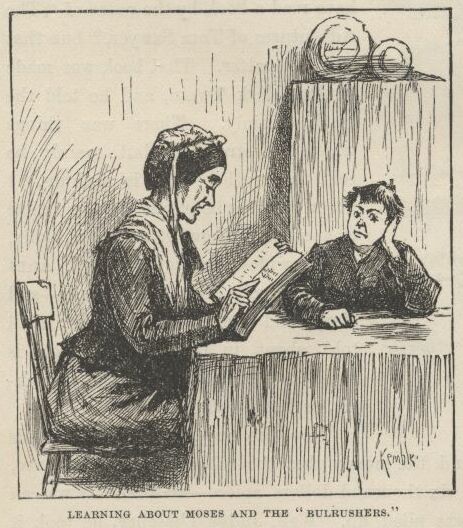
After supper she got out her book and learned me about Moses and the Bulrushers, and I was in a sweat to find out all about him; but by and by she let it out that Moses had been dead a considerable long time; so then I didn’t care no more about him, because I don’t take no stock in dead people.

Huck’s dream is of a delicious mix, a swapping of juices — integration. Additionally, his disregard for the dead Bible heroes reveals that the white Christian society’s obsession with the ancient past comes at the expense of contemporary value. Huck, an orphan, and Jim, separated from his family, will symbolically echo Moses in the bulrushes as they use the great Mississippi as a conduit for escape, for freedom. Huck (or Twain, really) here points out that it’s not enough to look at dead words on a page, on old dead lawgivers–we have to pay attention to the evils and wrongs and hypocrisies that live today.

Twain even tells us how to read his book from the outset:

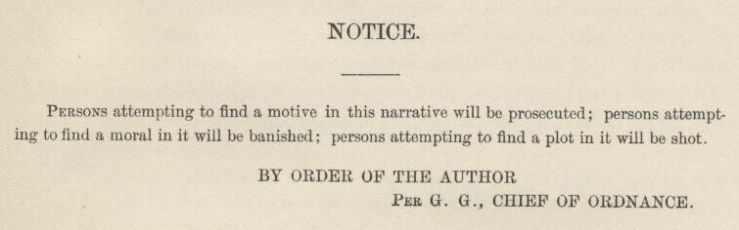
Now, it’s impossible to read a book–a good book–without finding its plot, searching for its moral, or caring about its characters, and Twain knows this. His “Notice” is tantamount to saying “don’t think about an elephant”–he uses irony to tell us we must find motive, moral, and plot here, and that we must do so through this lens of irony.

But of course, you have to read closely for all these things. I suppose it’s technically easier to call something trash, throw it in the garbage, and not have to devote time and energy to thinking about it. Who knows? You might learn something–and we wouldn’t want that, would we?

Banned Books Weeks Begins

From the American Library Association:

Banned Books Week: Celebrating the Freedom to Read is observed during the last week of September each year. Observed since 1982, this annual ALA event reminds Americans not to take this precious democratic freedom for granted. This year, 2008, marks BBW’s 27th anniversary (September 27 through October 4).

BBW celebrates the freedom to choose or the freedom to express one’s opinion even if that opinion might be considered unorthodox or unpopular and stresses the importance of ensuring the availability of those unorthodox or unpopular viewpoints to all who wish to read them. After all, intellectual freedom can exist only where these two essential conditions are met.

BBW is sponsored by the American Booksellers Association, American Booksellers Foundation for Free Expression, American Library Association, American Society of Journalists and Authors, Association of American Publishers, National Association of College Stores, and is endorsed by the Center for the Book in the Library of Congress.

Purchase BBW promotional items—such as the BBW Kit—through the ALA Store.

Explore Banned Books Week further through these resources: