“Let’s just say, on occasion, the police were involved and emergency rooms and courtrooms” — Raymond Carver Talks About Drinking

More from Raymond Carver’s 1983 Paris Review interview

INTERVIEWER

Could you talk a little more about the drinking? So many writers, even if they’re not alcoholics, drink so much.

CARVER

Probably not a whole lot more than any other group of professionals. You’d be surprised. Of course there’s a mythology that goes along with the drinking, but I was never into that. I was into the drinking itself. I suppose I began to drink heavily after I’d realized that the things I’d wanted most in life for myself and my writing, and my wife and children, were simply not going to happen. It’s strange. You never start out in life with the intention of becoming a bankrupt or an alcoholic or a cheat and a thief. Or a liar.

INTERVIEWER

And you were all those things?

CARVER

I was. I’m not any longer. Oh, I lie a little from time to time, like everyone else.

INTERVIEWER

How long since you quit drinking?

CARVER

June second, 1977. If you want the truth, I’m prouder of that, that I’ve quit drinking, than I am of anything in my life. I’m a recovered alcoholic. I’ll always be an alcoholic, but I’m no longer a practicing alcoholic.

INTERVIEWER

How bad did the drinking get?

CARVER

It’s very painful to think about some of the things that happened back then. I made a wasteland out of everything I touched. But I might add that towards the end of the drinking there wasn’t much left anyway. But specific things? Let’s just say, on occasion, the police were involved and emergency rooms and courtrooms.
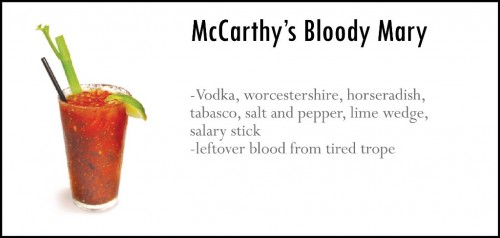
 

Cormac McCarthy’s Bloody Mary and Other Author Cocktails

At HTML, chief mixologist Jimmy Chen has concocted a satirical round of writer cocktails. Here’s “Cormac McCarthy’s Bloody Mary” (which calls for something called a “salary stick” — not sure what that is, but we suggest a celery stalk if you can’t find one)–

This is fun-mean–

And this is just mean-mean–


“Between Scotch and nothing, I’ll take Scotch” — William Faulkner on the Ideal Artistic Environment

The Paris Review’s 1956 interview with William Faulkner is amazing. An excerpt–

INTERVIEWER: Then what would be the best environment for a writer?

FAULKNER: Art is not concerned with environment either; it doesn’t care where it is. If you mean me, the best job that was ever offered to me was to become a landlord in a brothel. In my opinion it’s the perfect milieu for an artist to work in. It gives him perfect economic freedom; he’s free of fear and hunger; he has a roof over his head and nothing whatever to do except keep a few simple accounts and to go once every month and pay off the local police. The place is quiet during the morning hours, which is the best time of the day to work. There’s enough social life in the evening, if he wishes to participate, to keep him from being bored; it gives him a certain standing in his society; he has nothing to do because the madam keeps the books; all the inmates of the house are females and would defer to him and call him “sir.” All the bootleggers in the neighborhood would call him “sir.” And he could call the police by their first names.

So the only environment the artist needs is whatever peace, whatever solitude, and whatever pleasure he can get at not too high a cost. All the wrong environment will do is run his blood pressure up; he will spend more time being frustrated or outraged. My own experience has been that the tools I need for my trade are paper, tobacco, food, and a little whiskey.

INTERVIEWER: Bourbon, you mean?

FAULKNER: No, I ain’t that particular. Between Scotch and nothing, I’ll take Scotch.

Drinking Games for Readers

At Jezebel, a list of drinking games for readers. Some witty, some not so witty. Here’s the list:

Thomas Pynchon: Drink every time someone has a stupid name, like “Eigenvalue.”

David Foster Wallace: Drink every time a sentence has three or more conjunctions.

William Faulkner:
Every time a sentence goes on for more than a page, drink the entire bottle. Then make out with your sister.

Joyce Carol Oates: Drink every time there is a home invasion.

Jane Austen: Drink every time someone plays whist, goes riding, or gets married.

J.D. Salinger: Every time there is a symbol of lost innocence, drink a highball. Then spit it all over someone you love.

Emily Bronte: Drink every time you see the word “heath” (Heathcliff counts).

Gabriel García Márquez
: Drink every time someone’s name is “Aureliano.” (Note: this only works for A Hundred Years of Solitude)

Virginia Woolf: First, go buy some flowers. Then, if you have time left over, drink.

Sappho: Drink every time you can’t tell if something is hot or disgusting.

Ernest Hemingway: Drink every time Ernest Hemingway is boring and overrated. Man, I am so wasted right now.

Raymond Chandler: Drink every time someone drinks.

Dashiell Hammett:
Drink every time someone drinks.

Homer:
Drink every time someone drinks gross diluted wine.

Stephenie Meyer: Drink every time someone drinks blood.

Dylan Thomas: Drink until you are in a coma.

I think you can apply the rules for the Chandler and Hammett games to Bukowski if you wanted. Use Kingsley Amis’s signature cocktail the Lucky Jim if you wish. You might also be interested in David Foster Wallace’s drinking game “Hi Bob.”

“What Lies Beyond Violent Drunkeness” — Guy Debord on Drinking Booze

guydebord1jv7

In the following short chapter from his 1989 memoir Panegryic, Volume 1, Situationist mastermind Guy Debord writes a love letter to alcohol. He explains why he loves to drink, what he loves to drink, and where he loves to drink, and he does so with a scholar’s flair for quotation and an anarchic humor. Towards the end, he attacks the current state of mass-produced wines, liquors, and beers, complaining that regional flavors and varieties are being destroyed. Great stuff!

Wines, spirits and beers: the moments when some of them became essential and the moments when they returned have traced out the main course and meanders of days, weeks and years. Two or three other passions, which I will talk about, have almost continually taken up a lot of space in this life. But drinking has been the most constant and the most present. Among the small number of things that I have liked and known how to do well, what I have assuredly known how to do best is drink. Even though I have read a lot, I have drunk even more. I have written much less than most people who write; but I have drunk much more than most people who drink. I can count myself among those of whom Baltasar Gracián, thinking about an elite distinguishable only among the Germans — but here very unfair, to the detriment of the French, as I think I have shown — could say: “There are those who have got drunk only once, but it has lasted them a lifetime.” […]

Continue reading ““What Lies Beyond Violent Drunkeness” — Guy Debord on Drinking Booze”