“One Art” — Elizabeth Bishop

“One Art”

by

Elizabeth Bishop


The art of losing isn’t hard to master;
so many things seem filled with the intent
to be lost that their loss is no disaster.

Lose something every day. Accept the fluster
of lost door keys, the hour badly spent.
The art of losing isn’t hard to master.

Then practice losing farther, losing faster:
places, and names, and where it was you meant
to travel. None of these will bring disaster.

I lost my mother’s watch. And look! my last, or
next-to-last, of three loved houses went.
The art of losing isn’t hard to master.

I lost two cities, lovely ones. And, vaster,
some realms I owned, two rivers, a continent.
I miss them, but it wasn’t a disaster.

—Even losing you (the joking voice, a gesture
I love) I shan’t have lied. It’s evident
the art of losing’s not too hard to master
though it may look like (Write it!) like disaster.

Elizabeth Bishop’s Brownies

Elizabeth Bishop’s brownie recipe:

4 squares bitter chocolate (or about a cup of cocoa)
4 eggs
1/2 cup butter
2 1/2 cups white sugar
1 cup flour
2 teaspoons vanilla
2 cups chopped nuts

Melt the chocolate and butter together – or, if you use cocoa, melt along with half the sugar and a little water. Cool slightly and beat in eggs and rest of sugar.

Sift in flour, add vanilla and nuts and beat. The batter is fairly stiff – doesn’t run much. Spread about <——————> this thick in square pan.

Bake in a slow oven – about 45 minutes to an hr., depending on pan, thickness, etc. They should be dry on top, just pulling away from edges, but still rather damp in the middle. Cut in squares in pan and remove with spatula.

This makes chewy brownies – for a harder kind, use brown sugar and an extra egg – or half brown sugar – Can be made thicker and used hot with whipped cream on top for a desert [sic] –

Via the excellent blog Paper and Salt, whose author Nicole acquired it via Bishop’s at Vassar College.

“Marmosets,” a very short story by Clarice Lispector

“Marmosets”

by

Clarice Lispector

translated by Elizabeth Bishop


The first time we had a marmoset was just before New Year’s. We were without water and without a maid, people were lining up to buy meat, the hot weather had suddenly begun—when, dumfounded, I saw the present enter the house, already eating a banana, examining everything with great rapidity, and with a long tail. It looked like a monkey not yet grown; its potentialities were tremendous. It climbed up the drying clothes to the clothesline, where it swore like a sailor, and the banana-peelings fell where they would. I was exhausted already. Every time I forgot and absentmindedly went out on the back terrace, I gave a start: there was that happy man. My younger son knew, before I did, that I would get rid of this gorilla: “If I promise that sometime the monkey will get sick and die, will you let him stay? Or if you knew that sometime he’d fall out the window, somehow, and die down there?” My feelings would glance aside. The filthiness and blithe unconsciousness of the little monkey made me responsible for his fate, since he himself would not take any blame. A friend understood how bitterly I had resigned myself, what dark deeds were being nourished beneath my dreaminess, and rudely saved me: a delighted gang of little boys appeared from the hill and carried off the laughing man. The new year was devitalized but at least monkey-less.

A year later, at a time of happiness, suddenly there in Copacabana I saw the small crowd. I thought of my children, the joys they gave me, free, unconnected with the worries they also gave me, free, and I thought of a chain of joy: “Will the person receiving this pass it along to someone else,” one to another, like a spark along a train of powder. Then and there I bought the one who would be called Lisette.

She could almost fit in one hand. She was wearing a skirt, and earrings, necklace, and bracelet of glass beads. The air of an immigrant just disembarking in her native costume. Like an immigrant’s, too, her round eyes.

This one was a woman in miniature. She lived with us three days. She had such delicate bones. She was of such a sweetness. More than her eyes, her look was rounded. With every movement, the earrings shook; the skirt was always neat, the red necklace glinted. She slept a lot, but, as to eating, she was discreet and languid. Her rare caress was only a light bite that left no mark.

On the third day we were out on the back terrace admiring Lisette and the way she was ours. “A little too gentle,” I thought, missing the gorilla. And suddenly my heart said harshly: “But this isn’t sweetness. This is death.” The dryness of the message left me calm. I said to the children: “Lisette is dying.” Looking at her, I realized the stage of love we had already reached. I rolled her up in a napkin and went with the children to the nearest first-aid station, where the doctor couldn’t attend to her because he was performing an emergency operation on a dog. Another taxi—”Lisette thinks she’s out for a drive, mama”—another hospital. There they gave her oxygen.

And with the breath of life, a Lisette we hadn’t known was revealed. The eyes less round, more secretive, more laughing, and in the prognathous and ordinary face a certain ironic haughtiness. A little more oxygen and she wanted to speak so badly she couldn’t bear being a monkey; she was, and she would have had much to tell. More oxygen, and then an injection of salt solution; she reacted to the prick with an angry slap, her bracelet glittering. The male nurse smiled: “Lisette! Gently, my dear!”

The diagnosis: she wouldn’t live unless there was oxygen at hand, and even then it was unlikely. “Don’t buy monkeys in the street,” he scolded me; “sometimes they’re already sick.” No, one must buy dependable monkeys, and know where they came from, to ensure at least five years of love, and know what they had or hadn’t done, like getting married. I discussed it with the children a minute. Then I said to the nurse: “You seem to like Lisette very much. So if you let her stay a few days, near the oxygen, you can have her.” He was thinking. “Lisette is pretty!” I implored.

“She’s beautiful!” he agreed, thoughtfully. Then he sighed and said, “If I cure Lisette, she’s yours.” We went away with our empty napkin.

The next day they telephoned, and I informed the children that Lisette had died. The younger one asked me, “Do you think she died wearing her earrings?” I said yes. A week later the older one told me, “You look so much like Lisette!”

I replied, “I like you, too.”

“Seascape” — Elizabeth Bishop

“Seascape”

by

Elizabeth Bishop


This celestial seascape, with white herons got up as angels,
flying high as they want and as far as they want sidewise
in tiers and tiers of immaculate reflections;
the whole region, from the highest heron
down to the weightless mangrove island
with bright green leaves edged neatly with bird-droppings
like illumination in silver,
and down to the suggestively Gothic arches of the mangrove roots
and the beautiful pea-green back-pasture
where occasionally a fish jumps, like a wildflower
in an ornamental spray of spray;
this cartoon by Raphael for a tapestry for a Pope:
it does look like heaven.
But a skeletal lighthouse standing there
in black and white clerical dress,
who lives on his nerves, thinks he knows better.
He thinks that hell rages below his iron feet,
that that is why the shallow water is so warm,
and he knows that heaven is not like this.
Heaven is not like flying or swimming,
but has something to do with blackness and a strong glare
and when it gets dark he will remember something
strongly worded to say on the subject.

“The Fish” — Elizabeth Bishop

“The Fish”

by

Elizabeth Bishop


I caught a tremendous fish
and held him beside the boat
half out of water, with my hook
fast in a corner of his mouth.
He didn’t fight.
He hadn’t fought at all.
He hung a grunting weight,
battered and venerable
and homely. Here and there
his brown skin hung in strips
like ancient wallpaper,
and its pattern of darker brown
was like wallpaper:
shapes like full-blown roses
stained and lost through age.
He was speckled with barnacles,
fine rosettes of lime,
and infested
with tiny white sea-lice,
and underneath two or three
rags of green weed hung down.
While his gills were breathing in
the terrible oxygen
—the frightening gills,
fresh and crisp with blood,
that can cut so badly—
I thought of the coarse white flesh
packed in like feathers,
the big bones and the little bones,
the dramatic reds and blacks
of his shiny entrails,
and the pink swim-bladder
like a big peony.
I looked into his eyes
which were far larger than mine
but shallower, and yellowed,
the irises backed and packed
with tarnished tinfoil
seen through the lenses
of old scratched isinglass.
They shifted a little, but not
to return my stare.
—It was more like the tipping
of an object toward the light.
I admired his sullen face,
the mechanism of his jaw,
and then I saw
that from his lower lip
—if you could call it a lip—
grim, wet, and weaponlike,
hung five old pieces of fish-line,
or four and a wire leader
with the swivel still attached,
with all their five big hooks
grown firmly in his mouth.
A green line, frayed at the end
where he broke it, two heavier lines,
and a fine black thread
still crimped from the strain and snap
when it broke and he got away.
Like medals with their ribbons
frayed and wavering,
a five-haired beard of wisdom
trailing from his aching jaw.
I stared and stared
and victory filled up
the little rented boat,
from the pool of bilge
where oil had spread a rainbow
around the rusted engine
to the bailer rusted orange,
the sun-cracked thwarts,
the oarlocks on their strings,
the gunnels—until everything
was rainbow, rainbow, rainbow!
And I let the fish go.

“One Art” — Elizabeth Bishop

“One Art”

by Elizabeth Bishop

The art of losing isn’t hard to master;
so many things seem filled with the intent
to be lost that their loss is no disaster.

Lose something every day. Accept the fluster
of lost door keys, the hour badly spent.
The art of losing isn’t hard to master.

Then practice losing farther, losing faster:
places, and names, and where it was you meant 
to travel. None of these will bring disaster.

I lost my mother’s watch. And look! my last, or
next-to-last, of three loved houses went.
The art of losing isn’t hard to master.

I lost two cities, lovely ones. And, vaster,
some realms I owned, two rivers, a continent.
I miss them, but it wasn’t a disaster.


—Even losing you (the joking voice, a gesture
I love) I shan’t have lied.  It’s evident
the art of losing’s not too hard to master
though it may look like (Write it!) like disaster.

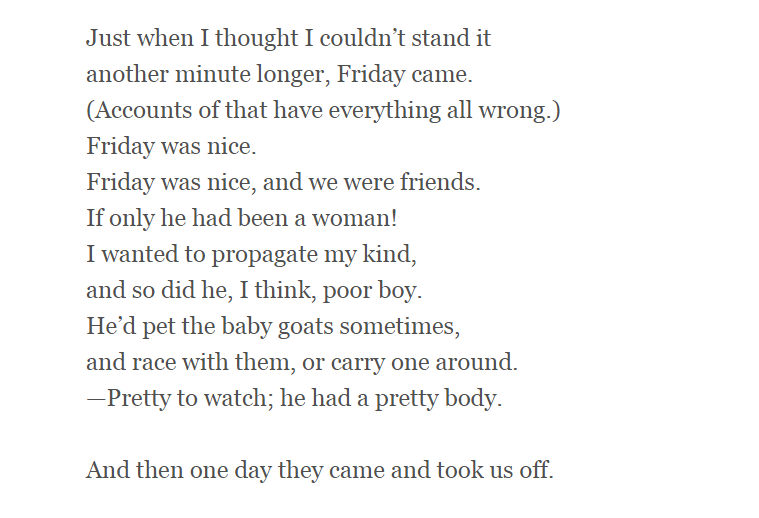
Just when I thought I couldn’t stand it another minute longer, Friday came.

ebFrom “Crusoe in England” by Elizabeth Bishop.
 

“Sonnet” — Elizabeth Bishop

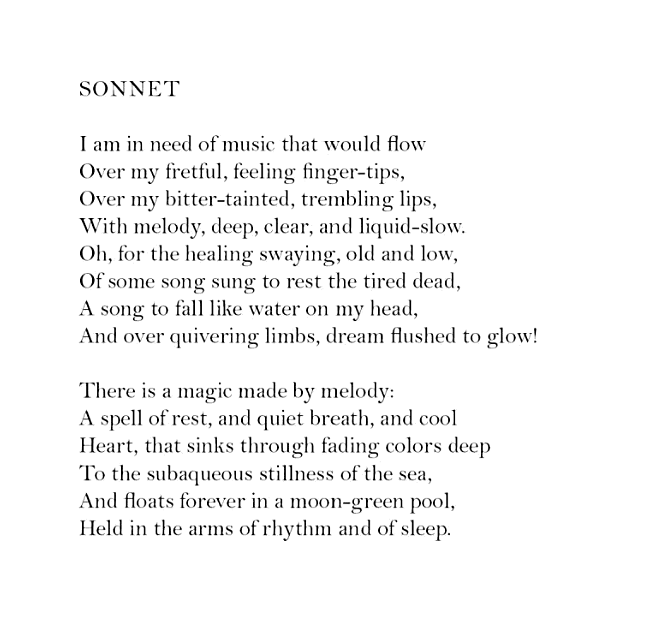
sonnet

“Florida” — Elizabeth Bishop

“Florida” by Elizabeth Bishop

The state with the prettiest name,
the state that floats in brackish water,
held together by mangrave roots
that bear while living oysters in clusters,
and when dead strew white swamps with skeletons,
dotted as if bombarded, with green hummocks
like ancient cannon-balls sprouting grass.
The state full of long S-shaped birds, blue and white,
and unseen hysterical birds who rush up the scale
every time in a tantrum.
Tanagers embarrassed by their flashiness,
and pelicans whose delight it is to clown;
who coast for fun on the strong tidal currents
in and out among the mangrove islands
and stand on the sand-bars drying their damp gold wings
on sun-lit evenings.
Enormous turtles, helpless and mild,
die and leave their barnacled shells on the beaches,
and their large white skulls with round eye-sockets
twice the size of a man’s.
The palm trees clatter in the stiff breeze
like the bills of the pelicans. The tropical rain comes down
to freshen the tide-looped strings of fading shells:
Job’s Tear, the Chinese Alphabet, the scarce Junonia,
parti-colored pectins and Ladies’ Ears,
arranged as on a gray rag of rotted calico,
the buried Indian Princess’s skirt;
with these the monotonous, endless, sagging coast-line
is delicately ornamented.

Thirty or more buzzards are drifting down, down, down,
over something they have spotted in the swamp,
in circles like stirred-up flakes of sediment
sinking through water.
Smoke from woods-fires filters fine blue solvents.
On stumps and dead trees the charring is like black velvet.
The mosquitoes
go hunting to the tune of their ferocious obbligatos.
After dark, the fireflies map the heavens in the marsh
until the moon rises.
Cold white, not bright, the moonlight is coarse-meshed,
and the careless, corrupt state is all black specks
too far apart, and ugly whites; the poorest
post-card of itself.
After dark, the pools seem to have slipped away.
The alligator, who has five distinct calls:
friendliness, love, mating, war, and a warning–
whimpers and speaks in the throat
of the Indian Princess.