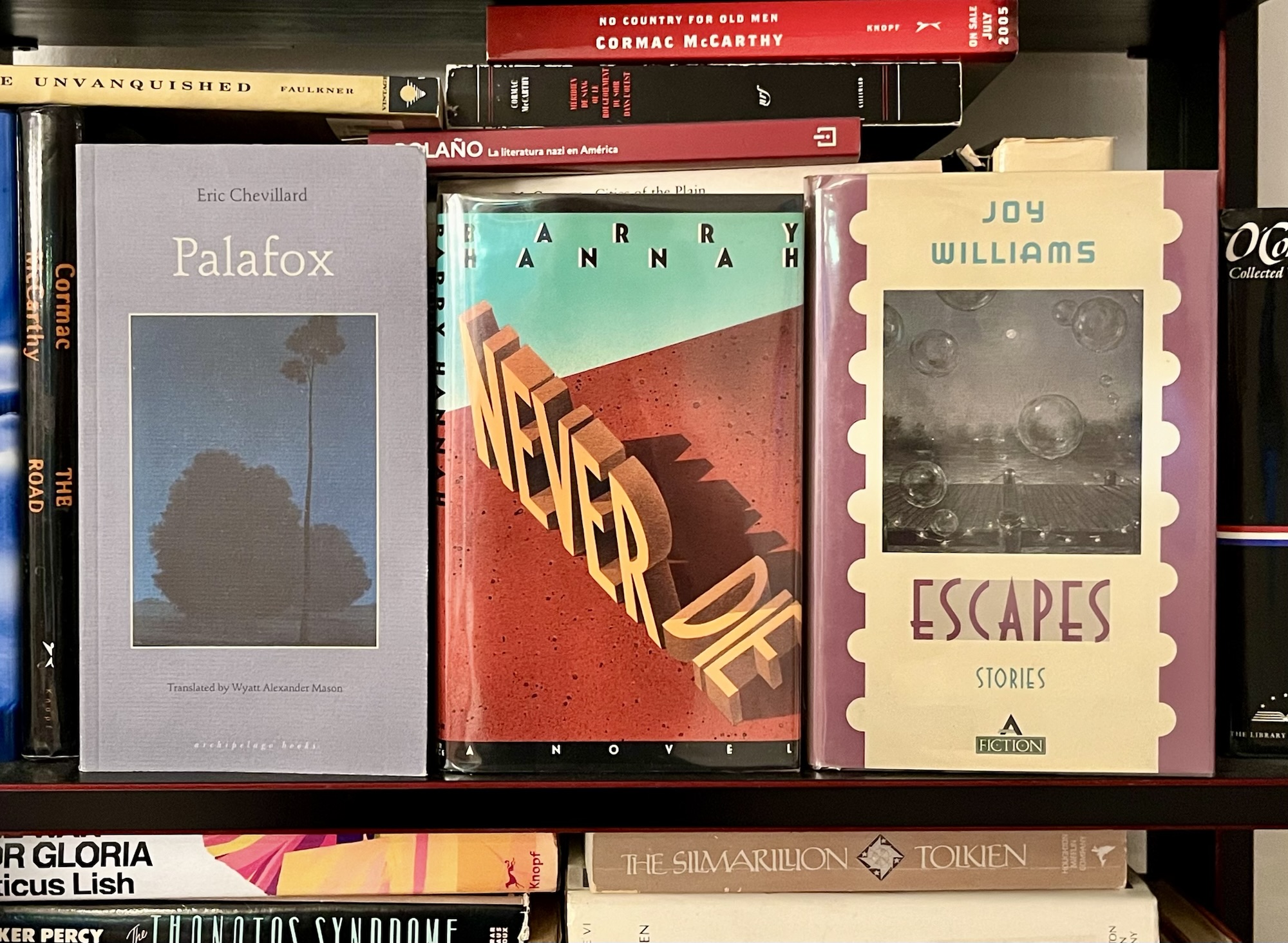
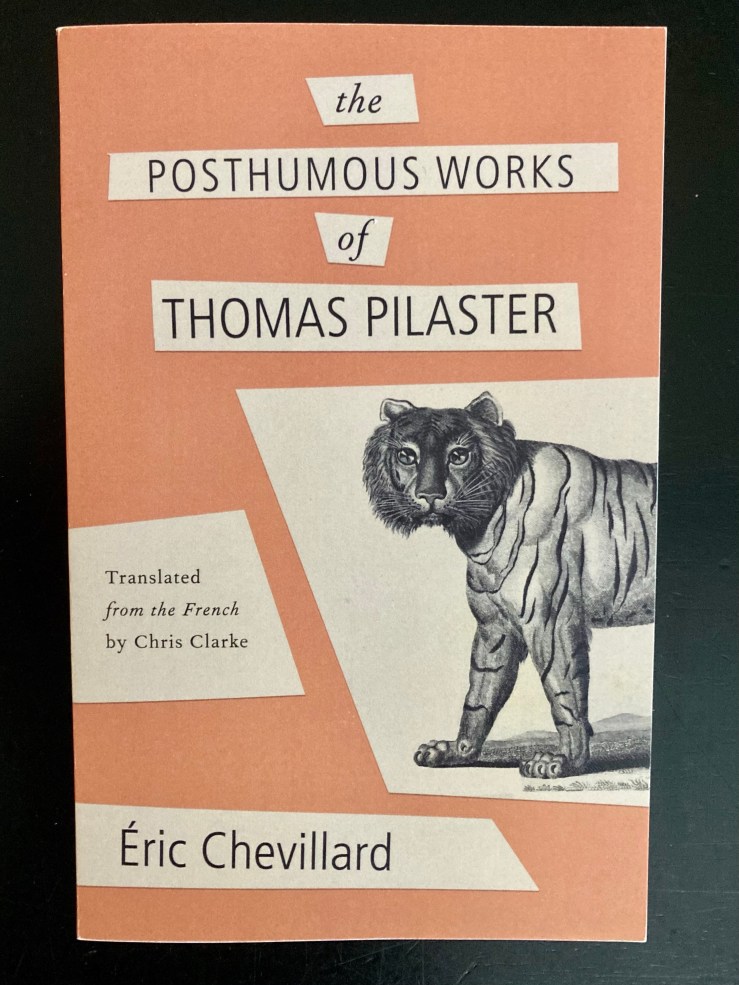
I dropped off a few books for trade credit and wound up with hardback first editions of Barry Hannah’s Never Die and Joy Williams’ 1990 collection Escapes. I also couldn’t pass up on Éric Chevillard’s Palafox in translation by Wyatt Mason. (I really dug Chris Clarke’s translation of Chevillard’s short novel The Posthumous Works of Thomas Pilaster.)
If you feel like feeling a little depressed and feeling a little amused in a way that creates a new, not-so-little feeling, you can read the title track of Joy Williams’ Escapes, “Escapes” (by Joy Williams) at Granta. From the story:
My mother was a drinker. Because my father left us, I assumed he was not a drinker, but this may not have been the case. My mother loved me and was always kind to me. We spent a great deal of time together, my mother and I. This was before I knew how to read. I suspected there was a trick to reading, but I did not know the trick. Written words were something between me and a place I could not go. My mother went back and forth to that place all the time, but couldn’t explain to me exactly what it was like there. I imagined it to be a different place.
As a very young child, my mother had seen the magician Houdini. Houdini had made an elephant disappear. He had also made an orange tree grow from a seed right on the stage. Bright oranges hung from the tree and he had picked them and thrown them out into the audience. People could eat the oranges or take them home, whatever they wanted.
How did he make the elephant disappear, I asked.
‘He disappeared in a puff of smoke,’ my mother said. ‘Houdini said that even the elephant didn’t know how it was done.’
Was it a baby elephant, I asked.
My mother sipped her drink. She said that Houdini was more than a magician, he was an escape artist. She said that he could escape from handcuffs and chains and ropes.
‘They put him in straitjackets and locked him in trunks and threw him in swimming pools and rivers and oceans and he escaped,’ my mother said. ‘He escaped from water-filled vaults. He escaped from coffins.’
I said that I wanted to see Houdini.
‘Oh, Houdini’s dead, Lizzie,’ my mother said. ‘He died a long time ago. A man punched him in the stomach three times and he died.’
Dead. I asked if he couldn’t get out of being dead.
‘He met his match there,’ my mother said.
 Biblioklept