
The first line of Joyce’s Finnegans Wake in comics form. Part II here (but, um, there’s like more to the book, of course), and check out the rest of Galumph’s comic book poetry (“Tales of Adventure & Girls–Stories to Make You Sad”).

The first line of Joyce’s Finnegans Wake in comics form. Part II here (but, um, there’s like more to the book, of course), and check out the rest of Galumph’s comic book poetry (“Tales of Adventure & Girls–Stories to Make You Sad”).
So today Biblioklept turns a healthy one year old. When I wrote that very first post about A Raisin in the Sun, I had no inkling of the vast riches on my horizon. Ahhh…simple youth. Them were the days, etc. etc. etc.
I’ll celebrate this momentous occasion by recounting my recent trip to my favorite used book sellers, where I loaded up on more than I can possibly read in 2007. Eidetic readers may recall my last book buying spree: I’m happy to report I read 5.5 out of 7 of the books bought on that trip (I’m only counting half of The Portable Faulkner): that’s almost 79%! Not bad. Because that’s what reading’s all about: percentages and stats. Like baseball.
The goods:
Finnegans Wake, James Joyce
I’ve been dipping into the select chapters of FW included in The Portable Joyce for a few years now. I’m currently enrolled in a Joyce seminar but we won’t be reading more than a sentence or two of the book. My professor described it as a “vortex, a black hole from which no one returns.” He said this with a smile and meant it in good humor but maybe he has a point. The book is possibly probably incomprehensible unless you’re someone like, say, Terrence McKenna or L. Moholy-Nagy (whose graphic organizer for FW appears below) or Joseph Campbell.
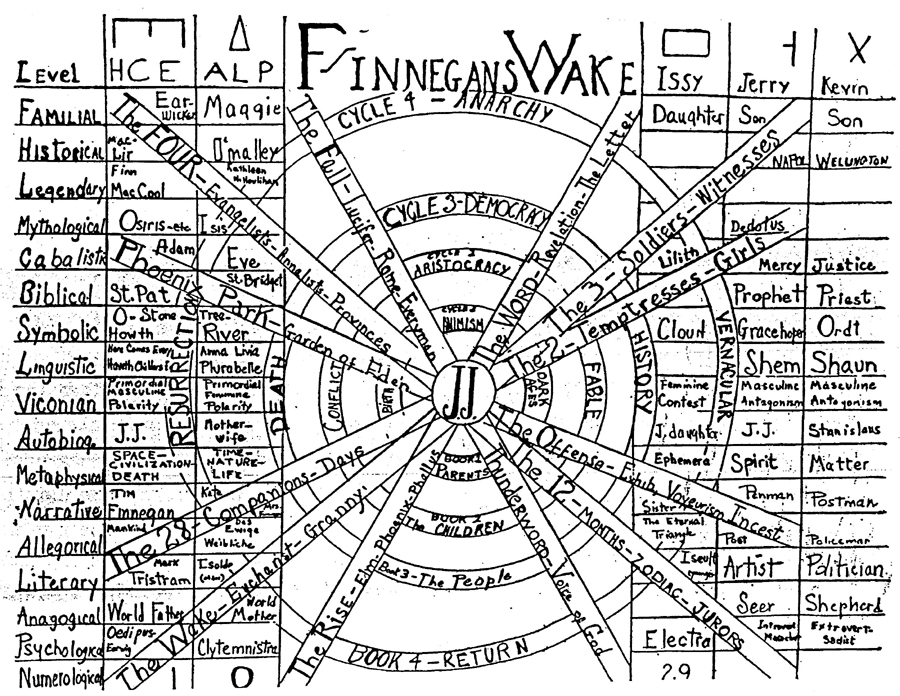
I recently listened to a series of lectures given by Joseph Campbell on Joyce; Campbell suggests that FW is the dream that happens after Molly and Leopold Bloom fall asleep at the end of Ulysses. Campbell also posits that Joyce has a final book planned that would finish the four book cycle that began with Portrait; he thinks that the book would be very simple and clear and probably short, and would be thematically based on the mother-as-ocean. Campbell’s lectures are brilliant, beautiful, human, and humorous, and best of all, they are enlightening. Besides explicating the book as a whole, he also guides his audience through select sentences of FW in ways that make you go “!!!” Brilliant stuff.
You and I both know that I will probably never read this book in its entirety. That’s okay. It’s a vortex of fun.
The Amazing Adventures of Kavalier and Clay, Michael Chabon

I almost bought this book in the central train station in Rome two summers ago; I bought Eugenides’s somewhat disappointing novel Middlesex instead, because my wife had more interest in it. I’ve actually started the book already (despite having a ton of Joyce and Joyce-related academic crap to read); it’s pretty good. I’ll probably finish it if I can keep up this pace.
Gun, With Occasional Music, Jonathan Lethem

It’s no secret that we’re big fans of Mr. Lethem around the ‘klept. This is supposed to be a mystery novel involving memory-annihilating drugs and thug kangaroos. My plan is to read this over the Thanksgiving break.
Vanished Splendors: A Memoir, Balthus (with Alan Vircondolet)

As with most of the books that I end up buying in labyrinthine used books stores, I found this by mistake. For some reason it was mixed in with children’s hardback picture books. Balthus is one of my favorite painters of all time, so of course I had to buy his memoir. The chapters are short, vague, and achronological, making this a book that you can just pick up and read at random (kinda like Finnegan’s Wake).
Nightfall: Country Lake, David Cunningham and Whistling Thorn, Helen Cowcher
If I wasn’t so lazy I’d go heat up the ole scanner and show you some of the beautiful images in these “children’s books.” I find that lots of children’s “picture” books tend to be condescending or just plain stupid, and finding good ones is not easy. I spent over 40 minutes plumbing through dusty boxes before coming across these two. David Cunningham’s gentle and dark-hued watercolor depictions of a lake at night are deep and soothing, as is the simple text that accompanies the illustrations. Cowcher’s Whistling Thorn details the evolution of acacia, giraffes, and rhinos. Lovely stuff.
Slow Century, Pavement (DVD)
I never look at the used DVDs; I have a Netflix account, library card, and a program called DVDShrink, so if I want to own a DVD it’s a pretty simple operation. Still, there are rare cases where I want the packaging, usually music films like Sonic Youth’s Corporate Ghost DVD. Like the Balthus book, I happened across this two-disc Pavement film among the children’s books. I’d seen it before: the hour long documentary is really good, and the videos are excellent. The concerts…well, I dunno. I’m not really into that kind of thing, unless Martin Scorsese and The Band are involved.
From said documentary: Pavement destroys Lollapalooza in West Virginia:
I think that’s it for this recent trip.
Now, I would be remiss if I didn’t include a book theft in our birthday edition, so here goes.
There really isn’t much to this story, and I’m actually deeply ashamed of this one. No irony, no joke. Most of the book thefts I discuss on this site are books that I’ve borrowed and never returned or books that I’ve purloined that no one was going to read anyway. This one is a straight-up theft from an indie book store. Ouch.
When I was a young stupid college freshman (note the defensive tone)–it was my first semester in fact–I had to go to a certain Gainesville book store to buy my course texts. They seemed outrageously overpriced and I was outraged, despite the stipend the state of Florida was giving me as part of my scholarship to buy books (I thought of this as beer money). In order to “get even” with these high prices, I not-so-subtly swiped a copy of Nabokov’s Laughter in the Dark: I simply picked it up after I’d paid for my course texts, walked out of the store with it, got on my bicycle, road home, and never read it. That was about ten years ago. Mea culpa. I’ve never done anything like that since, and, like I said, I feel bad about it now, so bad that every time I pick up the book to give it a shot, a small shudder of shame creeps through me and I put it down.
So there you go: new books and a book theft. Here’s to another year of cranky commentary with elitist overtones.
Dis for Daedalus, kid Icarus’s papa. From Joseph Shipley’s The Origin of English Words: A Discursive Dictionary of Indo-European Roots, a book that has given me more joy than is probably normal or healthy :
“del II: cut; carve; harm. GK daidalos: cut with art; Daedalus, the inventor who built the labyrinth for Minos, king of Crete, to confine the Minotaur. This monster—half man, half bull—was conceived by Minos’s wife Pasiphae with Poseidon’s sacred bull, which Minos had refused to return to Poseidon. Imprisoned, Daedalus made wings for himself and his son Icarus; they few away; but the son flew too near the sun, the wax fastening his wings melted, and he fell and drowned in what was thereafter called the Icarian Sea. Hence daedalian: skillful; Icarian: rash and ruinous” (Shipley 58).
D is also for Dedalus, Stephen, James Joyce’s semi-autobiographical stand-in in Portrait of an Artist as a Young Man. Stephen Dedalus also is prominent in the first couple of chapters of Ulysses, before Leopold Bloom’s journey through Dublin becomes the novel’s focus. Despite the heroic help of my college roommate’s Ritalin prescription, I never finished Ulysses, but I’m enrolled in a Joyce seminar commencing this fall (should be good). I did however read Portrait a number of times; I can’t think of a better example of an experimental writing style that evolves and adapts as its main character grows, learns, and rebels.
E is for Ebdus, Dylan, the hero of one of my all-time favorites, Jonathan Lethem’s The Fortress of Solitude. Like Portrait of the Artist as a Young Man, Fortress is a bildungsroman, a novel that details the development of its main character from childhood to maturity. To this end, each chapter of the first section of Fortress covers approximately a year in the life of young Dylan as he tries to make meaning out of his strange Brooklyn neighborhood and race-relations in the seventies.
E is also for Essrog, Lionel, the would-be detective who narrates Jonathan Lethem’s 1999 novel Motherless Brooklyn. Lionel Essrog is afflicted with Tourette’s syndrome, and his tics and yelps punctuate the novel with a weird and fascinating rhythm, a play of re-signification that would make Derrida proud. This is one of those Sunday afternoon books, the kind that you sit down to read with a glass (or four) of sangria and pretty much finish. Japanese monks, Brooklyn mobsters, hot dogs and papaya juice, plenty of verbal tics. And orphans. Lots and lots of orphans.
 Biblioklept