“Gorse Is Not People,” a short story by Janet Frame

“Gorse Is Not People”

by

Janet Frame


Do you remember your twenty-first birthday? The party, the cake, and cutting a slice of it to put under your pillow that night, to make you dream of your future beloved; the giant key; the singing:

I’m twenty-one today!

Twenty-one today!

I’ve got the key of the door!

Never been twenty-one before!

Trivial, obvious words. Yet when the party was over and you lay in bed remembering the glinting key and the shamrock taste of the small glass of wine, and perhaps the taste of a sneaked last kiss in the dark, then the song seemed not trivial or obvious but a poetic statement of a temporal wonder. You had, as they say, attained your majority. You could vote in the elections; you could leave home against your parents’ wishes; you could marry in defiance of all opposition. You had crossed a legal border into a free country, and you now walked equipped with a giant tinsel key, a cardboard key covered with threepenny spangles.

Or perhaps your twenty-first birthday did not happen that way. Perhaps there was no party, no cake, no wine, and no kiss? I would like to tell you about Naida’s twenty-first birthday.

Naida was a dwarf, which is not really a rare thing. I suppose in our lifetime we see many dwarves—first, perhaps, at the circus, where they are advertised as the tiniest people in the world and we pay to watch them moving about in their almost walnut-shell or matchbox beds. Sometimes we pass them in the street and stare hard for a moment, then pretend we haven’t seen them, until they have passed us and we look back, saying, “It must be strange, how strange it must be, such tiny folk, and us out of reach, like tall trees!” Continue reading ““Gorse Is Not People,” a short story by Janet Frame”
“Gavin Highly” — Janet Frame

Did it happen this way? The land lay like stone, and one night, all night long, rain pelted down on it the way people, they say, hammer hard on a stone to find blood. And in the morning the land was cut in two by a deep flow of creek, clotted with red weed—Gavin Highly’s creek.

But all this was a long time ago. I did not know back then that hearts could be laid out like land and cut in two by storms coming out of the sky, or that dreams could be thrown, as Gavin Highly threw the ashes of his fire or his oyster shells or his old tins and bottles or his scraps of food, deep into the dark flowing divided heart to be buried there. I did not know, and my brother did not know. We cared more about plums—ah, they were yellow and dusty blue and hung on trees, over Gavin Highly’s fence, and in the early autumn the sun burned on each plum till its tight yellow or blue dusty skin gave in and rolled up like a blind to let in more sun. The plums split and were ripe and we ate them and, if Gavin Highly caught us, all he said, in one breath, was “Hop-it-you.” I think he understood about plums.

Read the rest of Janet Frame’s story “Gavin Highly” at The New Yorker.

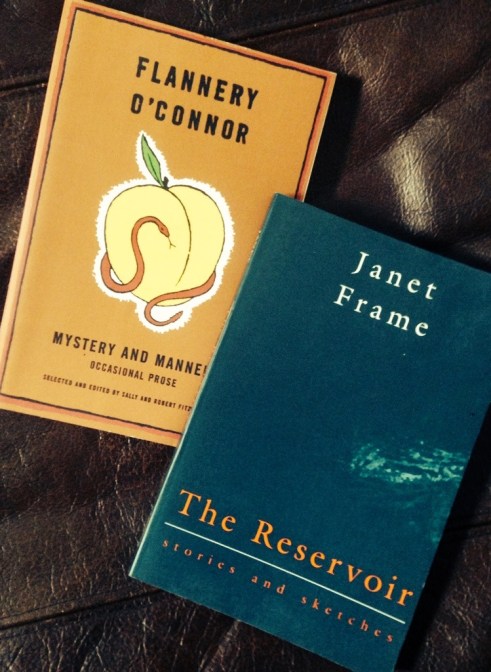
Flannery O’Connor/Janet Frame (Books Acquired, 6.27.2014)

20140628-161808-58688350.jpg

“A Night at the Opera” — Janet Frame

We acted the cliché. We melted with laughter. Not the prickly melt that comes from sitting on a hot stove but the cool relaxing melt, in defiance of chemistry, like dropping deep into a liquid feather bed. We did not know or remember the reason for laughing. There was a film, yes: a dumb sad man with hair like wheat and round eyes like paddling pools; another man with a mustache like a toy hearth brush; and many other people and things—blondes, irate managers, stepladders, whitewash, all the stuff of farce. And there was a darkened opera house growing cardboard trees and shining wooden moons.

I shall never know why we laughed so much. Perhaps other films had been as funny, but this one seemed to contain for us a total laughter, a storehouse of laughter, like a hive where we children, spindly-legged as bees, would forever bring our foragings of fun to mellow and replenish this almost unbelievably collapsing mirth.

Nor was it the kind of laughter that cheats by turning in the end to tears, or by needing reinforcement with imagery. It was, simply, like being thrown on a swing into the sky, and the swing staying there, as in one of those trick pictures we had seen so often and marvelled at—divers leaping back to the springboard, horses racing back to the starting barrier. It was like stepping off the swing and promenading the sky.

After the film, we managed somehow to walk home. The afternoon was ragged with leaves and the dreary, hungry untidiness of a child’s half past four. Faces and streets seemed wet and serious. The hem of sky, undone, hung down dirty and gray.

But the laughter stayed with us, crippling, floating, rolling, aching, dissolving.

“It must have been a comic picture,” our mother said, not knowing, not knowing, when she saw our faces.

Read the rest of Janet Frame’s short story “A Night at the Opera.”