Blog about John Crowley’s novel Beasts

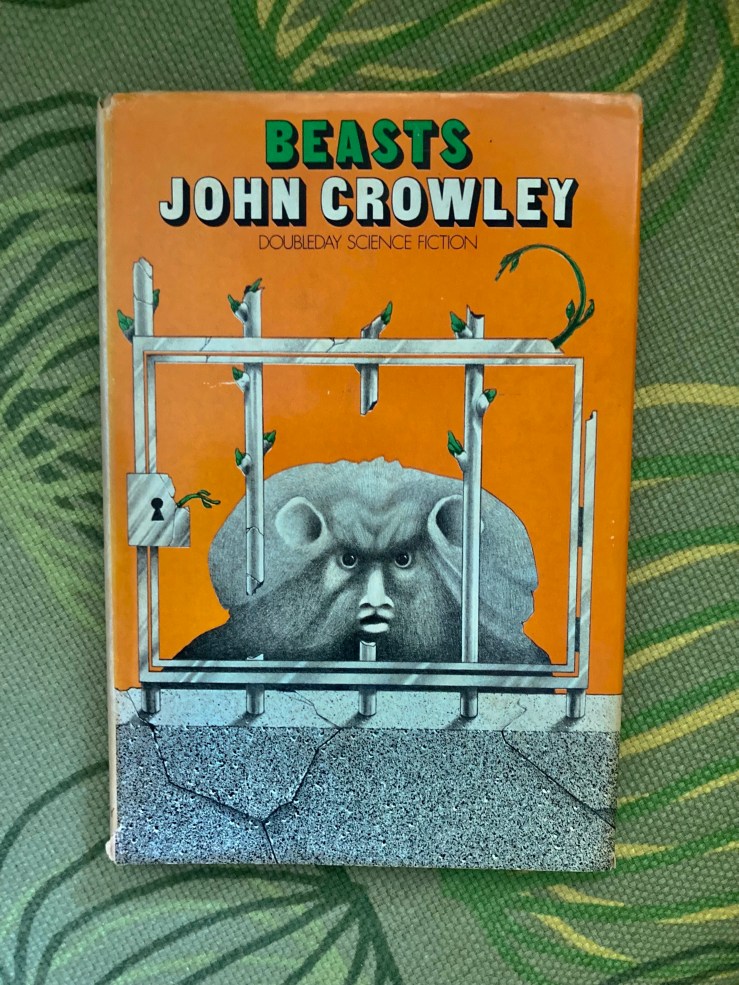
I finished John Crowley’s 1976 novel Beasts this morning. Loved it.

Beasts is not quite 200 pages, each of its nine chapters centering on a different character’s perspective. Crowley’s writing is rich and poetic here, as readers of his 1981 opus Little, Big might expect. In that novel, likely his most famous, Crowley conjures a vast, deep, detailed world; Little, Big is big big.

Beasts is little big: each of its nine chapters might be read as a short story in which we get a glimpse from one perspective at a balkanized, dystopian post-USA. A species of genetic hybrid called leos are corralled on reservations or outright hunted by the militant Union for Social Engineering; what remains of the Federal Government vies for control with various Autonomous zones; utopian cultists try to hide from the world; slavery has returned under the guise of contractual indentured servitude. A mutant fox, the trickster Reynard, plays kingmaker behind the scenes. The nine chapters refuse to explicitly connect the pieces of the world the present; that is the job of the reader. As Joachim Boaz puts it in his excellent, thorough review of the novel,

Beasts embodies a fascinating dialogue between nature and civilization, man and animal…  Do not expect a straightforward narrative for many chapters function more as mood pieces.  Each is part of a mosaic of images, characters, and philosophies that struggle to survive, or are altogether snuffed out, in a rapidly collapsing Old Order.

That imminent collapse is where Beasts leaves us, its final line a utopian promise: Shall we begin?

Cortazar/Crowley/Ford (Books acquired, 27 July 2023)

I went to the bookstore today looking for a copy of Katherine Burdekin’s dystopian 1937 novel Swastika Night. I was unsuccessful there, but while browsing the scifi and fantasy section, I came across three books that I couldn’t resist.

The first was an unread hardcover first edition of John M. Ford’s 1983 novel The Dragon Waiting. This book was only on my radar because Slate republished a 2019 article on Ford by Isaac Butler and a friend sent me the link (his message was simply “?”). From Butler’s article:

The Dragon Waiting is an unfolding cabinet of wonders. Over a decade before George R.R. Martin wrote A Song of Ice and Fire, Ford created an alternate-history retelling of the Wars of the Roses, filled with palace intrigue, dark magic, and more Shakespeare references than are dreamt of in our philosophy. The Dragon Waiting provokes that rare thrill that one gets from the work of Gene Wolfe, or John Crowley, or Ursula Le Guin. A dazzling intellect ensorcells the reader, entertaining with one hand, opening new doors with another.

Wolfe blurbed the back cover of the copy I bought, by the way.

Maybe Crowley was in my subconscious too; while searching for Swastika Night under the Cs (it was first published under the pseudonym “Murray Constantine”), I came across a cheap hardcover copy of Crowley’s 1976 novel Beasts. I’d read Little, Big years ago, enjoyed it, but gone no further. (There were no copies of Little, Big in Crowley’s placarded section, all though I did find three copies in the “General Fiction” section, away from the beautiful weird scifi fantasy ghetto.)

I’ve long been a sucker for the mass market Avon Bard Latin American writers series, so I couldn’t pass up the copy of Julio Cortazar’s Hopscotch (translated by Gregory Rabassa). It sat upon a miscellaneous, dusty stack of outcasts in the middle of the “D” aisle in the scifi fantasy ghetto, waiting for me.