
Frances Brody’s Dying in the Wool is a mystery from Minotaur/St. Martin’s. Their description:
Take one quiet Yorkshire village
Bridgestead is a peaceful spot: a babbling brook, rolling hills and a working mill at its heart. Pretty and remote, nothing exceptional happens…
Add a measure of mystery
Until the day that Master of the Mill Joshua Braithwaite goes missing in dramatic circumstances, never to be heard of again.
A sprinkling of scandal
Now Joshua’s daughter is getting married and wants one last attempt at finding her father. Has he run off with his mistress, or was he murdered for his mounting coffers?
And Kate Shackleton—amateur sleuth extraordinaire!
Kate Shackleton has always loved solving puzzles. So who better to get to the bottom of Joshua’s mysterious disappearance? But as Kate taps into the lives of the Bridgestead dwellers, she opens cracks that some would kill to keep closed…

Jane Vows Vengeance is the third (and final?) in a series by Michael Thomas Ford where Jane Austen is a vampire. I covered the first book here (and was perhaps way kinder to the book than its conglomeration of trends deserved) and the second here. Let me cannibalize text from both previous write ups (the second write up cannibalized the first!):
In the past few years we’ve seen a spate of books where public domain characters and historical figures feature in supernatural tales, usually written in an ironic, or at least parodic mode. It seems like a heavy percentage of these books are mixed up somehow with Jane Austen, whose legacy has become grist for a literary cottage industry, with a new “re-imagining” of Pride and Prejudice or Sense and Sensibility coming out every season. Last year, Michael Thomas Ford offered the public the mix of Jane Austen and vampires we had been so desperately clamoring for,Jane Bites Back. By way of a little more context (and pure laziness), I’ll quote Biblioklept’s review of Ford’s novel–
Jane Bites Back reveres its subject, Jane Austen, even as it blatantly cashes in on the very trend that it satirizes. The book’s program shouldn’t be confused with the absurdity behind Sense and Sensibility and Seamonsters (which we liked) or the wackiness of Pride and Prejudice and Zombies (which we didn’t like), but it does adhere to the same sense of fun. Ford seems to delight in corny, over the top passages, and we’ll take it for granted that his literary tongue is in his cheek . . .
 The Girl with Glass Feet is the début novel from British author Ali Shaw. Set in the remote archipelago of St. Hauda’s Land and steeped in the traditions of English folklore, Shaw’s novel works in the idiom of magical realism. His titular girl Ida Maclaird suffers from a strange affliction: she’s slowly turning into glass. She returns to St. Hauda’s land in the winter (after a previous summer holiday there) in the hopes of finding a cure. There she meets Midas Crook (whose symbolically overdetermined name seems part and parcel of Shaw’s program), a photographer fascinated by his father’s ghost stories about the isolated archipelago who is trying to capture something of its haunted spirit in his pictures. Together (and with the help of some strange locals) the pair tries to find answers against a melancholy and magical backdrop of tiny winged cows, albino crows, and other grotesques. A sample ghost story, one of many in Glass Feet—
 In The Three Weissmanns of Westport, Cathleen Schine transposes the Dashwoods of Jane Austen’s Sense and Sensibility to a dilapidated beach cottage in Westport, Connecticut. When 78 year old Joseph divorces his 75 year old wife Betty, and his mistress essentially forces her from their high-end NYC apartment, Betty rallies by moving to the beach cottage with her daughters, impulsive Miranda, a literary agent, and practical Annie, a library director. The premise may sound like the domain of that most maligned of genres, “chick lit,” a fact that many reviewers tackled when it debuted in hardback last year. Here’s
 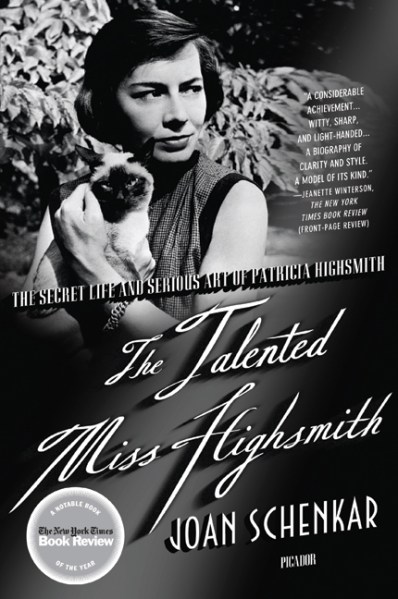 Before looking over Joan Schenkar’s exhaustive biography of Patricia Highsmith, The Talented Miss Highsmith: The Secret Life and Serious Art of Patricia Highsmith, I have to admit that I thought of the writer primarily as a practitioner of pulp fiction, the kind of lurid crime tales at home in airport bookshops. In recent years, I’ve come to reevaluate my stance on crime noir in particular (which I wrote about
  Biblioklept