Read “Small Fry,” a very short story by Anton Chekhov

“Small Fry”

by

Anton Chekhov

“HONORED Sir, Father and Benefactor!” a petty clerk called Nevyrazimov was writing a rough copy of an Easter congratulatory letter. “I trust that you may spend this Holy Day even as many more to come, in good health and prosperity. And to your family also I…”

The lamp, in which the kerosene was getting low, was smoking and smelling. A stray cockroach was running about the table in alarm near Nevyrazimov’s writing hand. Two rooms away from the office Paramon the porter was for the third time cleaning his best boots, and with such energy that the sound of the blacking-brush and of his expectorations was audible in all the rooms.

“What else can I write to him, the rascal?” Nevyrazimov wondered, raising his eyes to the smutty ceiling.

On the ceiling he saw a dark circle—the shadow of the lamp-shade. Below it was the dusty cornice, and lower still the wall, which had once been painted a bluish muddy color. And the office seemed to him such a place of desolation that he felt sorry, not only for himself, but even for the cockroach.

“When I am off duty I shall go away, but he’ll be on duty here all his cockroach-life,” he thought, stretching. “I am bored! Shall I clean my boots?”

And stretching once more, Nevyrazimov slouched lazily to the porter’s room. Paramon had finished cleaning his boots. Crossing himself with one hand and holding the brush in the other, he was standing at the open window-pane, listening.

“They’re ringing,” he whispered to Nevyrazimov, looking at him with eyes intent and wide open. “Already!”

Nevyrazimov put his ear to the open pane and listened. The Easter chimes floated into the room with a whiff of fresh spring air. The booming of the bells mingled with the rumble of carriages, and above the chaos of sounds rose the brisk tenor tones of the nearest church and a loud shrill laugh.

“What a lot of people!” sighed Nevyrazimov, looking down into the street, where shadows of men flitted one after another by the illumination lamps. “They’re all hurrying to the midnight service…. Our fellows have had a drink by now, you may be sure, and are strolling about the town. What a lot of laughter, what a lot of talk! I’m the only unlucky one, to have to sit here on such a day: And I have to do it every year!”

“Well, nobody forces you to take the job. It’s not your turn to be on duty today, but Zastupov hired you to take his place. When other folks are enjoying themselves you hire yourself out. It’s greediness!”

“Devil a bit of it! Not much to be greedy over—two roubles is all he gives me; a necktie as an extra…. It’s poverty, not greediness. And it would be jolly, now, you know, to be going with a party to the service, and then to break the fast…. To drink and to have a bit of supper and tumble off to sleep…. One sits down to the table, there’s an Easter cake and the samovar hissing, and some charming little thing beside you…. You drink a glass and chuck her under the chin, and it’s first-rate…. You feel you’re somebody…. Ech h-h!… I’ve made a mess of things! Look at that hussy driving by in her carriage, while I have to sit here and brood.”

“We each have our lot in life, Ivan Danilitch. Please God, you’ll be promoted and drive about in your carriage one day.”

“I? No, brother, not likely. I shan’t get beyond a ‘titular,’ not if I try till I burst. I’m not an educated man.”

“Our General has no education either, but…”

“Well, but the General stole a hundred thousand before he got his position. And he’s got very different manners and deportment from me, brother. With my manners and deportment one can’t get far! And such a scoundrelly surname, Nevyrazimov! It’s a hopeless position, in fact. One may go on as one is, or one may hang oneself…”

He moved away from the window and walked wearily about the rooms. The din of the bells grew louder and louder…. There was no need to stand by the window to hear it. And the better he could hear the bells and the louder the roar of the carriages, the darker seemed the muddy walls and the smutty cornice and the more the lamp smoked.

“Shall I hook it and leave the office?” thought Nevyrazimov.

But such a flight promised nothing worth having…. After coming out of the office and wandering about the town, Nevyrazimov would have gone home to his lodging, and in his lodging it was even grayer and more depressing than in the office…. Even supposing he were to spend that day pleasantly and with comfort, what had he beyond? Nothing but the same gray walls, the same stop-gap duty and complimentary letters….

Nevyrazimov stood still in the middle of the office and sank into thought. The yearning for a new, better life gnawed at his heart with an intolerable ache. He had a passionate longing to find himself suddenly in the street, to mingle with the living crowd, to take part in the solemn festivity for the sake of which all those bells were clashing and those carriages were rumbling. He longed for what he had known in childhood—the family circle, the festive faces of his own people, the white cloth, light, warmth…! He thought of the carriage in which the lady had just driven by, the overcoat in which the head clerk was so smart, the gold chain that adorned the secretary’s chest…. He thought of a warm bed, of the Stanislav order, of new boots, of a uniform without holes in the elbows…. He thought of all those things because he had none of them.

“Shall I steal?” he thought. “Even if stealing is an easy matter, hiding is what’s difficult. Men run away to America, they say, with what they’ve stolen, but the devil knows where that blessed America is. One must have education even to steal, it seems.”

The bells died down. He heard only a distant noise of carriages and Paramon’s cough, while his depression and anger grew more and more intense and unbearable. The clock in the office struck half-past twelve.

“Shall I write a secret report? Proshkin did, and he rose rapidly.”

Nevyrazimov sat down at his table and pondered. The lamp in which the kerosene had quite run dry was smoking violently and threatening to go out. The stray cockroach was still running about the table and had found no resting-place.

“One can always send in a secret report, but how is one to make it up? I should want to make all sorts of innuendoes and insinuations, like Proshkin, and I can’t do it. If I made up anything I should be the first to get into trouble for it. I’m an ass, damn my soul!”

And Nevyrazimov, racking his brain for a means of escape from his hopeless position, stared at the rough copy he had written. The letter was written to a man whom he feared and hated with his whole soul, and from whom he had for the last ten years been trying to wring a post worth eighteen roubles a month, instead of the one he had at sixteen roubles.

“Ah, I’ll teach you to run here, you devil!” He viciously slapped the palm of his hand on the cockroach, who had the misfortune to catch his eye. “Nasty thing!”

The cockroach fell on its back and wriggled its legs in despair. Nevyrazimov took it by one leg and threw it into the lamp. The lamp flared up and spluttered.

And Nevyrazimov felt better.
“The Man and the Snake” — Ambrose Bierce

“The Man and the Snake”

by

Ambrose Bierce

I

It is of veritabyll report, and attested of so many that there be nowe of wyse and learned none to gaynsaye it, that ye serpente hys eye hath a magnetick propertie that whosoe falleth into its svasion is drawn forwards in despyte of his wille, and perisheth miserabyll by ye creature hys byte.

Stretched at ease upon a sofa, in gown and slippers, Harker Brayton smiled as he read the foregoing sentence in old Morryster’s “Marvells of Science.” “The only marvel in the matter,” he said to himself, “is that the wise and learned in Morryster’s day should have believed such nonsense as is rejected by most of even the ignorant in ours.”

A train of reflections followed—for Brayton was a man of thought— and he unconsciously lowered his book without altering the direction of his eyes. As soon as the volume had gone below the line of sight, something in an obscure corner of the room recalled his attention to his surroundings. What he saw, in the shadow under his bed, were two small points of light, apparently about an inch apart. They might have been reflections of the gas jet above him, in metal nail heads; he gave them but little thought and resumed his reading. A moment later something—some impulse which it did not occur to him to analyze—impelled him to lower the book again and seek for what he saw before. The points of light were still there. They seemed to have become brighter than before, shining with a greenish luster which he had not at first observed. He thought, too, that they might have moved a trifle—were somewhat nearer. They were still too much in the shadow, however, to reveal their nature and origin to an indolent attention, and he resumed his reading. Suddenly something in the text suggested a thought which made him start and drop the book for the third time to the side of the sofa, whence, escaping from his hand, it fell sprawling to the floor, back upward. Brayton, half-risen, was staring intently into the obscurity beneath the bed, where the points of light shone with, it seemed to him, an added fire. His attention was now fully aroused, his gaze eager and imperative. It disclosed, almost directly beneath the foot rail of the bed, the coils of a large serpent—the points of light were its eyes! Its horrible head, thrust flatly forth from the innermost coil and resting upon the outermost, was directed straight toward him, the definition of the wide, brutal jaw and the idiotlike forehead serving to show the direction of its malevolent gaze. The eyes were no longer merely luminous points; they looked into his own with a meaning, a malign significance. Continue reading ““The Man and the Snake” — Ambrose Bierce” →

“Fancy’s Show-Box” — Nathaniel Hawthorne

“Fancy’s Show-Box”

by

Nathaniel Hawthorne

What is guilt? A stain upon the soul. And it is a point of vast interest whether the soul may contract such stains in all their depth and flagrancy from deeds which may have been plotted and resolved upon, but which physically have never had existence. Must the fleshly hand and visible frame of man set its seal to the evil designs of the soul, in order to give them their entire validity against the sinner? Or, while none but crimes perpetrated are cognizable before an earthly tribunal, will guilty thoughts—of which guilty deeds are no more than shadows,—will these draw down the full weight of a condemning sentence in the supreme court of eternity? In the solitude of a midnight chamber or in a desert afar from men or in a church while the body is kneeling the soul may pollute itself even with those crimes which we are accustomed to deem altogether carnal. If this be true, it is a fearful truth.

Let us illustrate the subject by an imaginary example. A venerable gentleman—one Mr. Smith—who had long been regarded as a pattern of moral excellence was warming his aged blood with a glass or two of generous wine. His children being gone forth about their worldly business and his grandchildren at school, he sat alone in a deep luxurious arm-chair with his feet beneath a richly-carved mahogany table. Some old people have a dread of solitude, and when better company may not be had rejoice even to hear the quiet breathing of a babe asleep upon the carpet. But Mr. Smith, whose silver hair was the bright symbol of a life unstained except by such spots as are inseparable from human nature—he had no need of a babe to protect him by its purity, nor of a grown person to stand between him and his own soul. Nevertheless, either manhood must converse with age, or womanhood must soothe him with gentle cares, or infancy must sport around his chair, or his thoughts will stray into the misty region of the past and the old man be chill and sad. Wine will not always cheer him. Continue reading ““Fancy’s Show-Box” — Nathaniel Hawthorne” →

“Vanka” — Anton Chekhov

“Vanka”

by

Anton Chekhov

Nine-year-old Vanka Zhukov, who had been apprentice to the shoemaker Aliakhin for three months, did not go to bed the night before Christmas. He waited till the master and mistress and the assistants had gone out to an early church-service, to procure from his employer’s cupboard a small phial of ink and a penholder with a rusty nib; then, spreading a crumpled sheet of paper in front of him, he began to write.

Before, however, deciding to make the first letter, he looked furtively at the door and at the window, glanced several times at the sombre ikon, on either side of which stretched shelves full of lasts, and heaved a heart-rending sigh. The sheet of paper was spread on a bench, and he himself was on his knees in front of it.

“Dear Grandfather Konstantin Makarych,” he wrote, “I am writing you a letter. I wish you a Happy Christmas and all God’s holy best. I have no mamma or papa, you are all I have.”

Vanka gave a look towards the window in which shone the reflection of his candle, and vividly pictured to himself his grandfather, Konstantin Makarych, who was night-watchman at Messrs. Zhivarev. He was a small, lean, unusually lively and active old man of sixty-five, always smiling and blear-eyed. All day he slept in the servants’ kitchen or trifled with the cooks. At night, enveloped in an ample sheep-skin coat, he strayed round the domain tapping with his cudgel. Behind him, each hanging its head, walked the old bitch Kashtanka, and the dog Viun, so named because of his black coat and long body and his resemblance to a loach. Viun was an unusually civil and friendly dog, looking as kindly at a stranger as at his masters, but he was not to be trusted. Beneath his deference and humbleness was hid the most inquisitorial maliciousness. No one knew better than he how to sneak up and take a bite at a leg, or slip into the larder or steal a muzhik’s chicken. More than once they had nearly broken his hind-legs, twice he had been hung up, every week he was nearly flogged to death, but he always recovered. Continue reading ““Vanka” — Anton Chekhov” →

“Nobody’s Story” — Charles Dickens

“Nobody’s Story”

by

Charles Dickens

He lived on the bank of a mighty river, broad and deep, which was always silently rolling on to a vast undiscovered ocean. It had rolled on, ever since the world began. It had changed its course sometimes, and turned into new channels, leaving its old ways dry and barren; but it had ever been upon the flow, and ever was to flow until Time should be no more. Against its strong, unfathomable stream, nothing made head. No living creature, no flower, no leaf, no particle of animate or inanimate existence, ever strayed back from the undiscovered ocean. The tide of the river set resistlessly towards it; and the tide never stopped, any more than the earth stops in its circling round the sun.

He lived in a busy place, and he worked very hard to live. He had no hope of ever being rich enough to live a month without hard work, but he was quite content, GOD knows, to labour with a cheerful will. He was one of an immense family, all of whose sons and daughters gained their daily bread by daily work, prolonged from their rising up betimes until their lying down at night. Beyond this destiny he had no prospect, and he sought none.

There was over-much drumming, trumpeting, and speech-making, in the neighbourhood where he dwelt; but he had nothing to do with that. Such clash and uproar came from the Bigwig family, at the unaccountable proceedings of which race, he marvelled much. They set up the strangest statues, in iron, marble, bronze, and brass, before his door; and darkened his house with the legs and tails of uncouth images of horses. He wondered what it all meant, smiled in a rough good-humoured way he had, and kept at his hard work. Continue reading ““Nobody’s Story” — Charles Dickens” →

Read Willa Cather’s short story “The Sentimentality of William Tavener”

“The Sentimentality of William Tavener”

by

Willa Cather

It takes a strong woman to make any sort of success of living in the West, and Hester undoubtedly was that. When people spoke of William Tavener as the most prosperous farmer in McPherson County, they usually added that his wife was a “good manager.” She was an executive woman, quick of tongue and something of an imperatrix. The only reason her husband did not consult her about his business was that she did not wait to be consulted.

It would have been quite impossible for one man, within the limited sphere of human action, to follow all Hester’s advice, but in the end William usually acted upon some of her suggestions. When she incessantly denounced the “shiftlessness” of letting a new threshing machine stand unprotected in the open, he eventually built a shed for it. When she sniffed contemptuously at his notion of fencing a hog corral with sod walls, he made a spiritless beginning on the structure—merely to “show his temper,” as she put it—but in the end he went off quietly to town and bought enough barbed wire to complete the fence. When the first heavy rains came on, and the pigs rooted down the sod wall and made little paths all over it to facilitate their ascent, he heard his wife relate with relish the story of the little pig that built a mud house, to the minister at the dinner table, and William’s gravity never relaxed for an instant. Silence, indeed, was William’s refuge and his strength.

William set his boys a wholesome example to respect their mother. People who knew him very well suspected that he even admired her. He was a hard man towards his neighbors, and even towards his sons; grasping, determined and ambitious. Continue reading “Read Willa Cather’s short story “The Sentimentality of William Tavener”” →

“Two Thanksgiving Day Gentlemen” — O. Henry

“Two Thanksgiving Day Gentlemen”

by

O. Henry

There is one day that is ours. There is one day when all we Americans who are not self-made go back to the old home to eat saleratus biscuits and marvel how much nearer to the porch the old pump looks than it used to. Bless the day. President Roosevelt gives it to us. We hear some talk of the Puritans, but don’t just remember who they were. Bet we can lick ’em, anyhow, if they try to land again. Plymouth Rocks? Well, that sounds more familiar. Lots of us have had to come down to hens since the Turkey Trust got its work in. But somebody in Washington is leaking out advance information to ’em about these Thanksgiving proclamations.

The big city east of the cranberry bogs has made Thanksgiving Day an institution. The last Thursday in November is the only day in the year on which it recognizes the part of America lying across the ferries. It is the one day that is purely American. Yes, a day of celebration, exclusively American.

And now for the story which is to prove to you that we have traditions on this side of the ocean that are becoming older at a much rapider rate than those of England are—thanks to our git-up and enterprise.

Stuffy Pete took his seat on the third bench to the right as you enter Union Square from the east, at the walk opposite the fountain. Every Thanksgiving Day for nine years he had taken his seat there promptly at 1 o’clock. For every time he had done so things had happened to him—Charles Dickensy things that swelled his waistcoat above his heart, and equally on the other side. Continue reading ““Two Thanksgiving Day Gentlemen” — O. Henry” →

William Faulkner reads his short story “Shingles for the Lord”

Pap got up a good hour before daylight and caught the mule and rid down to Killegrews’ to borrow the froe and maul. He ought to been back with it in forty minutes. But the sun had rose and I had done milked and fed and was eating my breakfast when he got back, with the mule not only in a lather but right on the edge of the thumps too.

“Fox hunting,” he said. “Fox hunting. A seventy-year-old man, with both feet and one knee, too, already in the grave, squatting all night on a hill and calling himself listening to a fox race that he couldn’t even hear unless they had come up onto the same log he was setting on and bayed into his ear trumpet. Give me my breakfast,” he told maw. “Whitfield is standing there right this minute, straddle of that board tree with his watch in his hand.”
And he was. We rid on past the church, and there was not only Solon Quick’s school-bus truck but Reverend Whitfield’s old mare too. We tied the mule to a sapling and hung our dinner bucket on a limb, and with pap toting Killegrew’s froe and maul and the wedges and me toting our ax, we went on to the board tree where Solon and Homer Bookwright, with their froes and mauls and axes and wedges, was setting on two upended cuts, and Whitfield was standing jest like pap said, in his boiled shirt and his black hat and pants and necktie, holding his watch in his hand. It was gold and in the morning sunlight it looked big as a full-growed squash.
“You’re late,” he said.
So pap told him again about how Old Man Killegrew had been off fox hunting all night, and nobody at home to lend him the froe but Mrs. Killegrew and the cook. And naturally, the cook wasn’t going to lend none of Killegrew’s tools out, and Mrs. Killegrew was worser than deaf than even Killegrew. If you was to run in and tell her the house was afire, she would jest keep on rocking and say she thought so, too,[audience laughter] unless she began to holler back to the cook to turn the dogs loose before you could even open your mouth.

You can listen to Faulkner read his story “Shingles for the Lord” at Mary Washington College. (There’s a full transcript too).

Read Donald Barthelme’s short story, “The Phantom of the Opera’s Friend”

 “The Phantom of the Opera’s Friend”
by
Donald Barthelme

I have never visited him in his sumptuous quarters five levels below the Opera, across the dark lake.

But he has described them. Rich divans, exquisitely carved tables, amazing silk and satin draperies. The large, superbly embellished mantelpiece, on which rest two curious boxes, one containing the figure of a grasshopper, the other the figure of a scorpion…

He can, in discoursing upon his domestic arrangements, become almost merry. For example, speaking of the wine he has stolen from the private cellar of the Opera’s Board of Directors:

“A very adequate Montrachet! Four bottles! Each director accusing every other director! I tell you, it made me feel like a director myself! As if I were worth two or three millions and had a fat, ugly wife! And the trout was admirable. You know what the Poles say—fish, to taste right, must swim three times: in water, butter, and wine. All in all, a splendid evening!”

But he immediately alters the mood by making some gloomy observation. “Our behavior is mocked by the behavior of dogs.”

It is not often that the accents of joy issue from beneath that mask.

Monday. I am standing at the place I sometimes encounter him, a little door at the rear of the Opera (the building has 2, 531 doors to which there are 7, 593 keys). He always appears “suddenly”—a coup de theatre that is, to tell the truth, more annoying than anything else. We enact a little comedy of surprise.

“It’ s you!”

“Yes. ”

“What are you doing here?”

“Waiting. ”

But today no one appears, although I wait for half an hour. I have wasted my time. Except—

Faintly, through many layers of stone, I hear organ music. The music is attenuated but unmistakable. It is his great work Don Juan Triumphant. A communication of a kind.

I rejoice in his immense, buried talent.

(Read the rest here).

Read George Saunders’s “Home,” A Short Story for Veteran’s Day

“You the one who threw down Mr. Klees?” the sheriff said.

“He’s just back from the war,” Ma said.

“Thank you for your service,” the sheriff said. “Might I ask you to refrain from throwing people down in the future?”

“He also threw me down,” Harris said.

“My thing is I don’t want to go around arresting veterans,” the sheriff said. “I myself am a veteran. So if you help me, by not throwing anyone else down, I’ll help you. By not arresting you. Deal?”

“He was also going to burn the house down,” Ma said.

“I wouldn’t recommend burning anything down,” the sheriff said.

“He ain’t himself,” Ma said. “I mean, look at him.”

The sheriff had never seen me before, but it was like admitting he had no basis for assessing how I looked would have been a professional embarrassment.

“He does look tired,” the sheriff said.

Read all of “Home” by George Saunders at The New Yorker. Collected in Tenth of December.

“The Young Girl” — Katherine Mansfield

“The Young Girl”

by

Katherine Mansfield

In her blue dress, with her cheeks lightly flushed, her blue, blue eyes, and her gold curls pinned up as though for the first time—pinned up to be out of the way for her flight—Mrs. Raddick’s daughter might have just dropped from this radiant heaven. Mrs. Raddick’s timid, faintly astonished, but deeply admiring glance looked as if she believed it, too; but the daughter didn’t appear any too pleased—why should she?—to have alighted on the steps of the Casino. Indeed, she was bored—bored as though Heaven had been full of casinos with snuffy old saints for croupiers and crowns to play with.

“You don’t mind taking Hennie?” said Mrs. Raddick. “Sure you don’t? There’s the car, and you’ll have tea and we’ll be back here on this step—right here—in an hour. You see, I want her to go in. She’s not been before, and it’s worth seeing. I feel it wouldn’t be fair to her.”

“Oh, shut up, mother,” said she wearily. “Come along. Don’t talk so much. And your bag’s open; you’ll be losing all your money again.”

“I’m sorry, darling,” said Mrs. Raddick.

“Oh, do come in! I want to make money,” said the impatient voice. “It’s all jolly well for you—but I’m broke!”

“Here—take fifty francs, darling, take a hundred!” I saw Mrs. Raddick pressing notes into her hand as they passed through the swing doors. Continue reading ““The Young Girl” — Katherine Mansfield” →

“The Middle Toe of the Right Foot” — Ambrose Bierce

“The Middle Toe of the Right Foot”

by

Ambrose Bierce

I

It is well known that the old Manton house is haunted. In all the rural district near about, and even in the town of Marshall, a mile away, not one person of unbiased mind entertains a doubt of it; incredulity is confined to those opinionated persons who will be called “cranks” as soon as the useful word shall have penetrated the intellectual demesne of the Marshall Advance. The evidence that the house is haunted is of two kinds; the testimony of disinterested witnesses who have had ocular proof, and that of the house itself. The former may be disregarded and ruled out on any of the various grounds of objection which may be urged against it by the ingenious; but facts within the observation of all are material and controlling.

In the first place the Manton house has been unoccupied by mortals for more than ten years, and with its outbuildings is slowly falling into decay—a circumstance which in itself the judicious will hardly venture to ignore. It stands a little way off the loneliest reach of the Marshall and Harriston road, in an opening which was once a farm and is still disfigured with strips of rotting fence and half covered with brambles overrunning a stony and sterile soil long unacquainted with the plow. The house itself is in tolerably good condition, though badly weather-stained and in dire need of attention from the glazier, the smaller male population of the region having attested in the manner of its kind its disapproval of dwelling without dwellers. It is two stories in height, nearly square, its front pierced by a single doorway flanked on each side by a window boarded up to the very top. Corresponding windows above, not protected, serve to admit light and rain to the rooms of the upper floor. Grass and weeds grow pretty rankly all about, and a few shade trees, somewhat the worse for wind, and leaning all in one direction, seem to be making a concerted effort to run away. In short, as the Marshall town humorist explained in the columns of the Advance, “the proposition that the Manton house is badly haunted is the only logical conclusion from the premises.” The fact that in this dwelling Mr. Manton thought it expedient one night some ten years ago to rise and cut the throats of his wife and two small children, removing at once to another part of the country, has no doubt done its share in directing public attention to the fitness of the place for supernatural phenomena. Continue reading ““The Middle Toe of the Right Foot” — Ambrose Bierce” →

“She Unnames Them” — Ursula K. Le Guin

“She Unnames Them”

by

Ursula K. Le Guin

MOST of them accepted namelessness with the perfect indifference with which they had so long accepted and ignored their names. Whales and dolphins, seals and sea otters consented with particular alacrity, sliding into anonymity as into their element. A faction of yaks, however, protested. They said that “yak” sounded right, and that almost everyone who knew they existed called them that. Unlike the ubiquitous creatures such as rats and fleas, who had been called by hundreds or thousands of different names since Babel, the yaks could truly say, they said, that they had a name. They discussed the matter all summer. The councils of elderly females finally agreed that though the name might be useful to others it was so redundant from the yak point of view that they never spoke it themselves and hence might as well dispense with it. After they presented the argument in this light to their bulls, a full consensus was delayed only by the onset of severe early blizzards. Soon after the beginning of the thaw, their agreement was reached and the designation “yak” was returned to the donor.

Among the domestic animals, few horses had cared what anybody called them since the failure of Dean Swift’s attempt to name them from their own vocabulary. Cattle, sheep, swine, asses, mules, and goats, along with chickens, geese, and turkeys, all agreed enthusiastically to give their names back to the people to whom—as they put it—they belonged.

A couple of problems did come up with pets. The cats, of course, steadfastly denied ever having had any name other than those self-given, unspoken, ineffably personal names which, as the poet named Eliot said, they spend long hours daily contemplating though none of the contemplators has ever admitted that what they contemplate is their names and some onlookers have wondered if the object of that meditative gaze might not in fact be the Perfect, or Platonic, Mouse. In any case, it is a moot point now. It was with the dogs, and with some parrots, lovebirds, ravens, and mynahs, that the trouble arose. These verbally talented individuals insisted that their names were important to them, and flatly refused to part with them. But as soon as they understood that the issue was precisely one of individual choice, and that anybody who wanted to be called Rover, or Froufrou, or Polly, or even Birdie in the personal sense, was perfectly free to do so, not one of them had the least objection to parting with the lowercase (or, as regards German creatures, uppercase) generic appellations “poodle,” “parrot,” “dog,” or “bird,” and all the Linnaean qualifiers that had trailed along behind them for two hundred years like tin cans tied to a tail. Continue reading ““She Unnames Them” — Ursula K. Le Guin” →

“The Tell-Tale Heart” by Edgar Allan Poe

harryclarke

“The Tell-Tale Heart”

by

Edgar Allan Poe

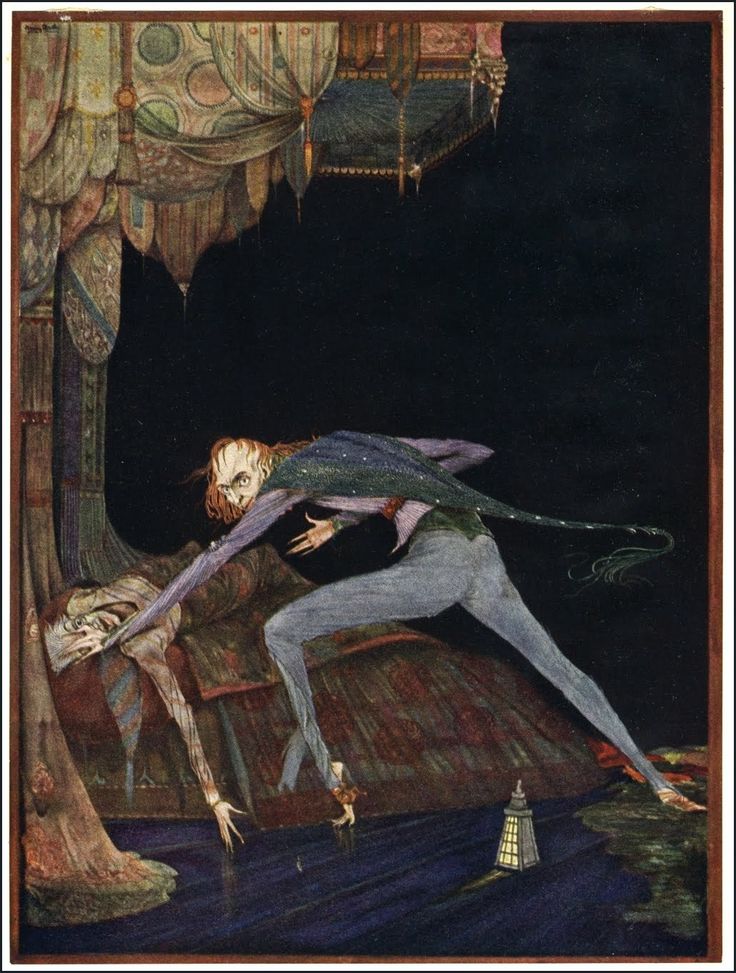
(Illustration by Harry Clarke)

TRUE!—nervous—very, very dreadfully nervous I had been and am; but why will you say that I am mad? The disease had sharpened my senses—not destroyed—not dulled them. Above all was the sense of hearing acute. I heard all things in the heaven and in the earth. I heard many things in hell. How, then, am I mad? Hearken! and observe how healthily—how calmly I can tell you the whole story.

It is impossible to say how first the idea entered my brain; but once conceived, it haunted me day and night. Object there was none. Passion there was none. I loved the old man. He had never wronged me. He had never given me insult. For his gold I had no desire. I think it was his eye! yes, it was this! He had the eye of a vulture—a pale blue eye, with a film over it. Whenever it fell upon me, my blood ran cold; and so by degrees—very gradually—I made up my mind to take the life of the old man, and thus rid myself of the eye forever. Continue reading ““The Tell-Tale Heart” by Edgar Allan Poe” →

“The Company of Wolves” — Angela Carter

“The Company of Wolves”

by

Angela Carter

One beast and only one howls in the woods by night.

The wolf is carnivore incarnate and he’s as cunning as he is ferocious; once he’s had a taste of flesh then nothing else will do.

At night, the eyes of wolves shine like candle flames, yellowish, reddish, but that is because the pupils of their eyes fatten on darkness and catch the light from your lantern to flash it back to you–red for danger; if a wolf’s eyes reflect only moonlight, then they gleam a cold and unnatural green, a mineral, a piercing colour. If the benighted traveller spies those luminous, terrible sequins stitched suddenly on the black thickets, then he knows he must run, if fear has not struck him stock-still.

But those eyes are all you will be able to glimpse of the forest assassins as they cluster invisibly round your smell of meat as you go through the wood unwisely late. They will be like shadows, they will be like wraiths, grey members of a congregation of nightmare; hark! his long, wavering howl … an aria of fear made audible.

The wolfsong is the sound of the rending you will suffer, in itself a murdering.

It is winter and cold weather. In this region of mountain and forest, there is now nothing for the wolves to eat. Goats and sheep are locked up in the byre, the deer departed for the remaining pasturage on the southern slopes–wolves grow lean and famished. There is so little flesh on them that you could count the starveling ribs through their pelts, if they gave you time before they pounced. Those slavering jaws; the lolling tongue; the rime of saliva on the grizzled chops–of all the teeming perils of the night and the forest, ghosts, hobgoblins, ogres that grill babies upon gridirons, witches that fatten their captives in cages for cannibal tables, the wolf is worst for he cannot listen to reason.

You are always in danger in the forest, where no people are. Step between the portals of the great pines where the shaggy branches tangle about you, trapping the unwary traveller in nets as if the vegetation itself were in a plot with the wolves who live there, as though the wicked trees go fishing on behalf of their friends–step between the gateposts of the forest with the greatest trepidation and infinite precautions, for if you stray from the path for one instant, the wolves will eat you. They are grey as famine, they are as unkind as plague. Continue reading ““The Company of Wolves” — Angela Carter” →

“Talent” — Anton Chekhov

“Talent”

by

Anton Chekhov

AN artist called Yegor Savvitch, who was spending his summer holidays at the house of an officer’s widow, was sitting on his bed, given up to the depression of morning. It was beginning to look like autumn out of doors. Heavy, clumsy clouds covered the sky in thick layers; there was a cold, piercing wind, and with a plaintive wail the trees were all bending on one side. He could see the yellow leaves whirling round in the air and on the earth. Farewell, summer! This melancholy of nature is beautiful and poetical in its own way, when it is looked at with the eyes of an artist, but Yegor Savvitch was in no humour to see beauty. He was devoured by ennui and his only consolation was the thought that by to-morrow he would not be there. The bed, the chairs, the tables, the floor, were all heaped up with cushions, crumpled bed-clothes, boxes. The floor had not been swept, the cotton curtains had been taken down from the windows. Next day he was moving, to town.

His landlady, the widow, was out. She had gone off somewhere to hire horses and carts to move next day to town. Profiting by the absence of her severe mamma, her daughter Katya, aged twenty, had for a long time been sitting in the young man’s room. Next day the painter was going away, and she had a great deal to say to him. She kept talking, talking, and yet she felt that she had not said a tenth of what she wanted to say. With her eyes full of tears, she gazed at his shaggy head, gazed at it with rapture and sadness. And Yegor Savvitch was shaggy to a hideous extent, so that he looked like a wild animal. His hair hung down to his shoulder-blades, his beard grew from his neck, from his nostrils, from his ears; his eyes were lost under his thick overhanging brows. It was all so thick, so matted, that if a fly or a beetle had been caught in his hair, it would never have found its way out of this enchanted thicket. Yegor Savvitch listened to Katya, yawning. He was tired. When Katya began whimpering, he looked severely at her from his overhanging eyebrows, frowned, and said in a heavy, deep bass:

“I cannot marry.”

“Why not?” Katya asked softly.

“Because for a painter, and in fact any man who lives for art, marriage is out of the question. An artist must be free.” Continue reading ““Talent” — Anton Chekhov” →

“Discovery” — Guy de Maupassant

The steamer was crowded with people and the crossing promised to be good. I was going from Havre to Trouville.

The ropes were thrown off, the whistle blew for the last time, the whole boat started to tremble, and the great wheels began to revolve, slowly at first, and then with ever-increasing rapidity.

We were gliding along the pier, black with people. Those on board were waving their handkerchiefs, as though they were leaving for America, and their friends on shore were answering in the same manner.

The big July sun was shining down on the red parasols, the light dresses, the joyous faces and on the ocean, barely stirred by a ripple. When we were out of the harbor, the little vessel swung round the big curve and pointed her nose toward the distant shore which was barely visible through the early morning mist. On our left was the broad estuary of the Seine, her muddy water, which never mingles with that of the ocean, making large yellow streaks clearly outlined against the immense sheet of the pure green sea.

As soon as I am on a boat I feel the need of walking to and fro, like a sailor on watch. Why? I do not know. Therefore I began to thread my way along the deck through the crowd of travellers. Suddenly I heard my name called. I turned around. I beheld one of my old friends, Henri Sidoine, whom I had not seen for ten years. Continue reading ““Discovery” — Guy de Maupassant” →