
(Via; for more on tramping read W.H. Davies’s The Autobiography of a Super-Tramp).

(Via; for more on tramping read W.H. Davies’s The Autobiography of a Super-Tramp).
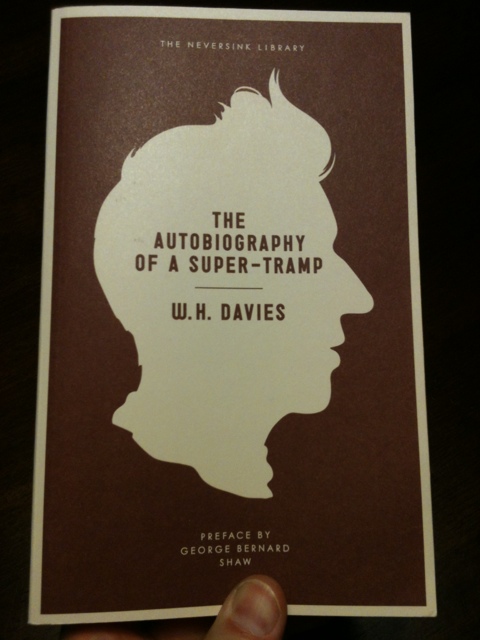
The Autobiography of a Super-Tramp documents W.H. Davies’s picaresque adventures in America in the last decade of the nineteenth century. In bildungsroman mode, Davies begins by relating the story of his childhood in Wales, where he was raised by his grandparents after his father died and his mother essentially abandoned her children. Despite his grandparents’ care, Davies soon turns to petty crime, shoplifting for sport (as well as to provide trifles for his girlfriend). He’s caught, tried, and beaten, an early run-in that would set a template for future dealings with authority figures. A restless spirit with a hankering for adventure, Davies has trouble attaining steady work; he’s a bit of a romantic, always stuck in a book. He elects to set off for America. In one of the funnier moments in the book, Davies describes writing a letter comparing America to England. Davies mails the missive home—only he’s still in Liverpool and has yet to see the New World, let alone the open sea. Of course, after years trekking across the US, Davies got to know much of the national characteristic; here he is reflecting—
My impression of Americans from the beginning is of the best, and I have never since had cause to alter my mind. They are a kind, sympathetic race of people and naturally proud of their country. The Irish-American is inclined to be the most bitter, remembering from his youth the complaints of his parents, who were driven through unjust laws from their own beloved land; and such a man is not to be idly aggravated, for life is a serious subject to him. This man is not to be aggravated, especially under the consideration that our conscience is not too clean in this respect, and that we are apt to be very slow in making that open confession which is good for the soul. The most pleasing trait in Americans, which cannot for long escape us, is their respect for women and the way in which the latter do deserve it.
In a strange moment that’s never quite fully explained (there are lots of these in Super-Tramp), upon arrival in America, our hero elects to take up with a vagabond named Brum, who teaches the would-be tramp the ins-and-outs of jumping rail, beating trail, and begging from town to town. In one inspired episode, Brum takes our hero to Michigan, where vagabonds could wait out the winter in warm jails with plenty of food (and tobacco). Here, the tramps could barter their own sentences with the complicity of the judge and jailers, who were basically working a scam on the taxpayers. (Luckily, no one makes undue profits by overcrowding prisons in America today. Right? Right?) Brum is one of the first players in a large cast of indigents and outsiders, men of dubious honesty and strange talents whose common thread is that they are all aliens to mainstream society. These are self-exiles whose only telos is movement itself.
These themes of travel and outsider status link Davies’s narratives strongly to those two Jacks of all trades, London and Kerouac, although the clean, spare style of Super-Tramp shares more blood with London’s reportorial rhythms than Kerouac’s unbound typing. It’s also hard to read Super-Tramp without recalling Steinbeck’s bindlestiffs, and just as in Steinbeck’s finest works, there’s depth, humility, and pathos in Davies’s writing, whether he’s describing picking berries, sharing a drink with the fellows, or moving cattle across the Atlantic.
And if Davies demonstrates empathy for his fellow man, that empathy extends to his keen descriptions of nature and animals; his tender descriptions of the poor cattle he helps transport to England are especially moving. Here, Davies shows the reader his naturalist sympathies—
I like to see to a good scientific bout by men who know the use of their hands, but would rather walk twenty miles than see animals in strife. Although of a quiet disposition, my fondness for animals is likely at any time to lead me into danger. After reading cases of vivisection I have often had dreams of boldly entering such places, routing the doctors with an iron bar, cutting the cords and freeing the animals, despite of any hurt I might receive from bites and scratches. Perhaps I should cut a ridiculous figure, walking the crowded streets with a poor meek creature under each arm, but that would not bother me in the performance of a humane action.
These dual drives—empathy and outrage against injustice—guide Super-Tramp, set against an abiding spirit of freedom and nature. As the narrative progresses, Davies repeatedly foregrounds the Darwinian peril the emerging capitalist industrial culture places on ordinary people. His note on vivisection above becomes tragically ironic late in the book when a terrible accident on the rails claims one of his feet.
Despite his hard (if self-elected) life, Davies would later become more comfortable as one of the most famous poets of his age in England, lauded for his plain, naturalist style, and championed by George Bernard Shaw (who wrote the preface to Super-Tramp and helped get the book published). The Autobiography of a Super-Tramp is an engaging page-turner that will likely appeal to fans of Jack London and John Steinbeck or anyone fascinated by the grime and romance of a hobo jungle. With its emphasis on the human face of those who refuse to play into the capitalist system, the book is as timely as it ever was.
And yes, the band got their name from the book.
The Autobiography of a Super-Tramp is part of Melville House’s new Neversink line.
The good people at Melville House, debut The Neversink Library this week, a line of international titles that have been overlooked, neglected, and under-appreciated, many languishing out of print for years. I was pleased as punch to get three from the fall line up (another Neversink title coming out this Fall is a new edition of Karel Capek’s War with the Newts, covered by Biblioklept affiliate Noquar just a few weeks ago). Pics of the titles below—you can see how handsome and unified the design is here.
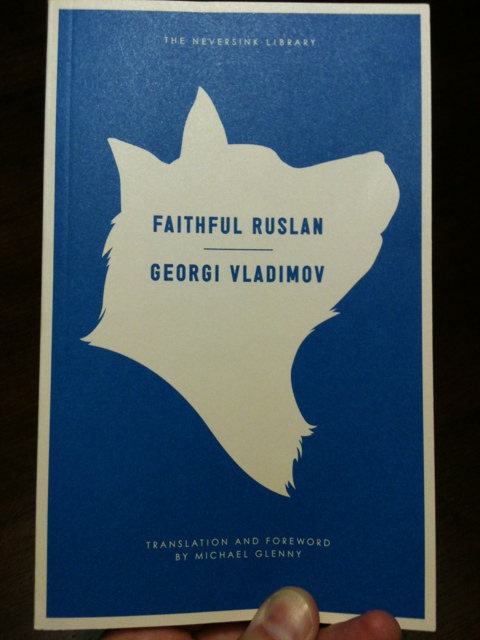
Georgi Vladimov’s Faithful Ruslan—
Set in a remote Siberian depot immediately following the demolition of one of the gulag’s notorious camps and the emancipation of its prisoners, Faithful Ruslan is an embittered cri de oeur from a writer whose circumstances obliged him to resist the violence of arbitrary power. “Every writer who writes anything in this country is made to feel he has committed a crime,” Georgi Vladimov said. Dissident, he said, is a word that “they force on you.” His mother, a victim of Stalin’s anti-Semitic policy, had been interred for two years in one of the camps from which Vladimov derived the wrenching detail of Faithful Ruslan. The novel circulated in samizdat for more than a decade, often attributed to Solzhenitsyn, before its publication in the West led to Vladimov’s harassment and exile.
A starving stray, tortured and abandoned by the godlike “Master” whom he has unconditionally loved, Ruslan and his cadre of fellow guard dogs dutifully wait for the arrival of new prisoners—but the unexpected arrival of a work party provokes a climactic bloodletting. Fashioned from the perceptions of an uncomprehending animal, Vladimov’s insistently ironic indictment of the gulag spirals to encompass all of Man’s inexplicable cruelty.
 The President by Georges Simenon—
At 82, the former premier lives in alert and suspicious retirement— self exile—on the Normandy coast, writing his anxiously anticipated memoirs and receiving visits from statesman and biographers. In his library is the self-condemning, handwritten confession of the premier’s former attaché, Chalamont, hidden between the pages of a sumptuously produced work of privately printed pornography—a confession that the premier himself had dictated and forced Chalamont to sign. Now the long-thwarted Chalamont has been summoned to form a new coalition in the wake of the government’s collapse. The premier alone possesses the secret of Chalamont’s guilt, of his true character—and has publicly vowed: “He’ll never be Premier as long as I’m alive . . . Nor when I’m dead, either.”
Inspired by French Premier Georges Clemenceau, The President is a masterpiece of psychological suspense and a probing account of the decline of power.
I think this is the one I’ll dip into first: The Autobiography of a Super-Tramp by W.H. Davies—
An untutored Welsh tramp who became a popular poet acclaimed by the conservative Georgians and the vanguard Ezra Pound alike, W. H. Davies surprised his contemporaries with the unlikeliest portrait of the artist as a young man ever written.
After a delinquent childhood Davies renounced home and apprenticeship and at twenty-two sailed to America—the first of more than a dozen Atlantic crossings, often made by cattle boat. From 1893 to 1899 he was schooled by the hard men of the road, disdaining regular work and subsisting by begging. Crossing Canada to join the “Klondyke” gold rush, Davies fell while hopping a train. His foot was crushed and his leg amputated. “All the wildness had been taken out of me,” Davies wrote, “and my adventures after this were not of my own seeking.”
Praised by Osbert Sitwell for his “primitive splendour and directness,” Davies evokes the beauty and frontier violence of turn-of-the-century America in prose that George Bernard Shaw commended to “literary experts for its style alone.” The insurgent wanderlust that found an American voice in Jack London and Jack Kerouac is expressed here in a raucous true adventure story by the man Shaw called “the incorrigible Supertramp who wrote this amazing book.”
 Biblioklept