“The Wasted Land” — A 1996 David Foster Wallace Profile Unearthed

Big kudos to Craig Ferman who tracked down and posted an obscure 1996 Details magazine profile on David Foster Wallace by David Strietfield.  You can read the full profile here. Here are a few (heartbreaking) excerpts:

He doesn’t want Infinite Jest to be seen as autobiography, which it’s not. On the other hand, if Wallace hadn’t been hospitalized in 1988 and put on a suicide watch, he might not have written so accurately about Kate, a character in Infinite Jest who keeps trying to die: “It’s like something horrible is about to happen,” she explains to her doctor, “there’s the feeling that there’s something you have to do right away to stop it but you don’t know what it is you have to do, and then it’s happening, too, the whole horrible time, it’s about to happen and also it’s happening all at the same time.” . . .

Unlike some of his characters, Wallace managed to extricate himself from the downward spiral before the damage became permanent—these days, he won’t even drink beer. Moreover, he got the raw impetus for a new book. By this point, Wallace was living in upstate New York, in an apartment so small that he had to move everything onto the bed when he wanted to write. “It was,” he says, “like spending two years in a submarine.”

Recently he found a Mennonite house of worship, which he finds sympathetic even if the hymns are impossible to sing. “The more I believe in something, and the more I take something other than me seriously, the less bored I am, the less self-hating. I get less scared. When I was going through that hard time a few years ago, I was scared all the time.” It’s not a trip he ever plans to take again.
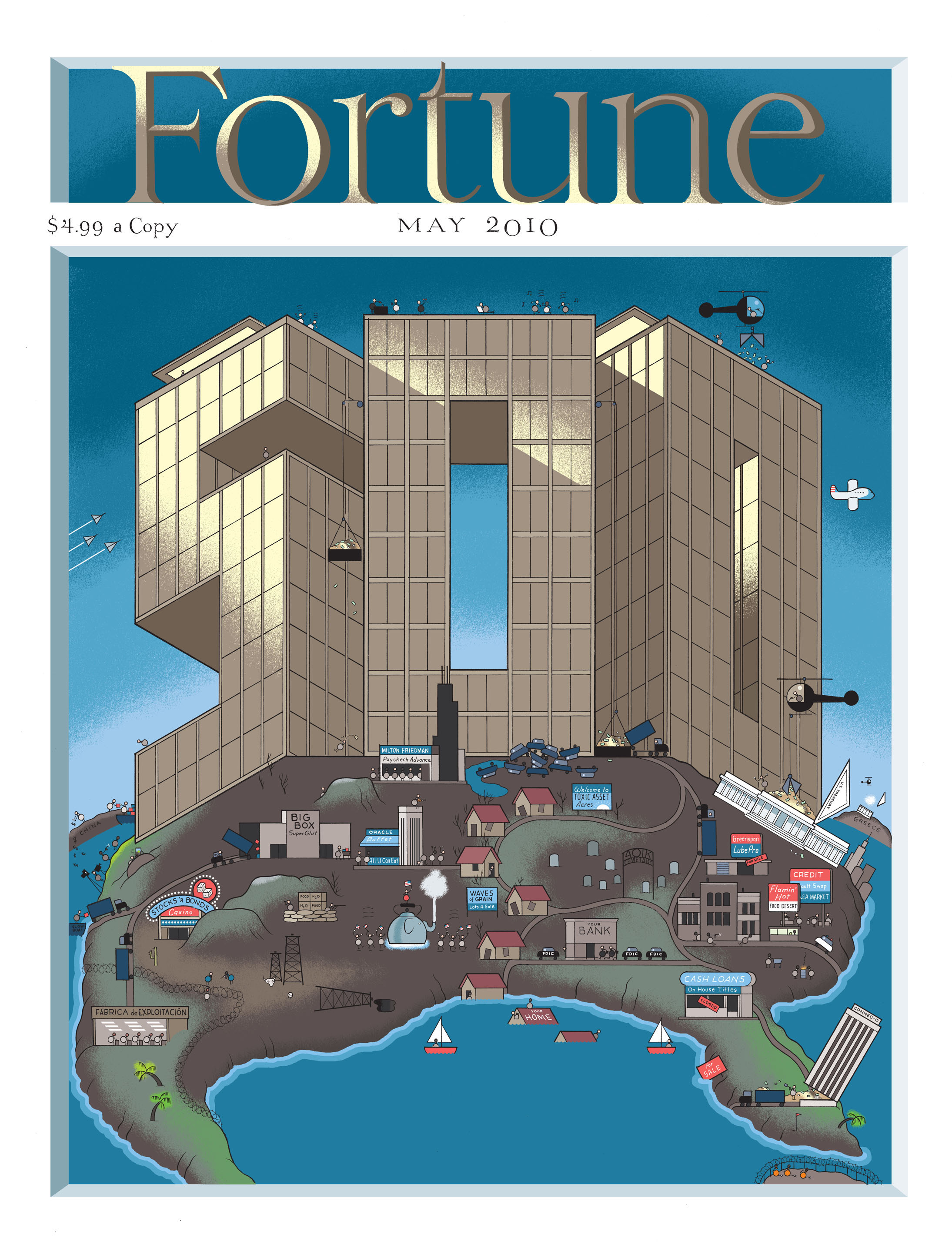
Chris Ware’s Rejected Fortune Cover

Cartoonist Chris Ware’s rejected cover for Fortune magazine. Guess his satire was too sharp. Via RW730:

“A Thoroughfare of Learning” — Nietzsche and Teacher Appreciation Week

National Teacher Appreciation Week winds down today. Have you thanked that special teacher in your life? Or at least thought about him or her? No? Maybe your teachers scarred you. Or ruined you. It’s possible. But probably not all of them. I’m sure at least one of them was really important to you, right?

Although Biblioklept World Wide Industries brings in the kind of moolah that allows me to literally swim in cash à la Scrooge McDuck, I retain my day job as a teacher of literature in the English language; I do this because, you know, I care. So me waxing heavy on why teachers matter and blah blah blah is sort of like waitresses overtipping other waitresses because, you know, they know. So I’ll just say that teachers are generally overworked, underpaid, and perhaps undervalued in our society, and I appreciate all of you–all of you who taught me and shaped me and mentored me and shared your wisdom with me, and all of you who I’ve worked with over the years who’ve inspired me to do better and be better. Thanks.

So well anyway, I’ve been skimming again through Nietzsche’s highly-aphoristic volume Human, All Too Human for the past week, and came across this passage, section 200, Caution in writing and teaching. Quoting in full:

Whoever has once begun to write and felt the passion of writing in himself, learns from almost everything he does or experiences only what is communicable for a writer. He no longer thinks of himself but rather of the writer and his public. He wants insight, but not for his own use. Whoever is a teacher is usually incapable of doing anything of his own for his own good. He always thinks of the good of his pupils, and all new knowledge gladdens him only to the extent that he can teach it. Ultimately he regards himself as a thoroughfare of learning, and in general as a tool, so that he has lost seriousness about himself.

Ouch! Did Nietzsche just call me a tool? I think his words are actually quite insightful–teachers do think of themselves as instruments through which they may better their pupils. But I don’t think that that is the only end for knowledge as far as teachers are concerned, and I don’t think that that makes teachers unserious about knowledge. Knowledge-as-enlightenment and self-improvement is great of course, but knowledge-as-transcendence–that is, knowledge as wisdom and experience that can be passed from person to person, shared, communicated–that’s what’s really meaningful in life.