Bret Easton Ellis Disses David Foster Wallace

At a in a reading in Hackney, England, two days ago, Bret Easton Ellis dissed the late great David Foster Wallace:

Question: David Foster Wallace – as an American writer, what is your opinion now that he has died?

Answer: Is it too soon? It’s too soon right? Well I don’t rate him. The journalism is pedestrian, the stories scattered and full of that Mid-Western faux-sentimentality and Infinite Jest is unreadable. His life story and his battle with depression however is really quite touching . . .

Via HTMLGIANT, via The Howling Fantods. The discussion at HTMLGIANT’s comment section is pretty great right now (see our own comment thread below for comments detailing HTMLGIANT readers who claim that BEE’s quote is misrepresented/mistranscribed), with a few commentators bringing up an interview in which DFW said the following about BEE:

I think it’s a kind of black cynicism about today’s world that Ellis and certain others depend on for their readership. Look, if the contemporary condition is hopelessly shitty, insipid, materialistic, emotionally retarded, sadomasochistic, and stupid, then I (or any writer) can get away with slapping together stories with characters who are stupid, vapid, emotionally retarded, which is easy, because these sorts of characters require no development. With descriptions that are simply lists of brand-name consumer products. Where stupid people say insipid stuff to each other. If what’s always distinguished bad writing—flat characters, a narrative world that’s cliched and not recognizably human, etc.—is also a description of today’s world, then bad writing becomes an ingenious mimesis of a bad world. If readers simply believe the world is stupid and shallow and mean, then Ellis can write a mean shallow stupid novel that becomes a mordant deadpan commentary on the badness of everything. Look man, we’d probably most of us agree that these are dark times, and stupid ones, but do we need fiction that does nothing but dramatize how dark and stupid everything is? In dark times, the definition of good art would seem to be art that locates and applies CPR to those elements of what’s human and magical that still live and glow despite the times’ darkness. Really good fiction could have as dark a worldview as it wished, but it’d find a way both to depict this world and to illuminate the possibilities for being alive and human in it. You can defend “Psycho” as being a sort of performative digest of late-eighties social problems, but it’s no more than that.
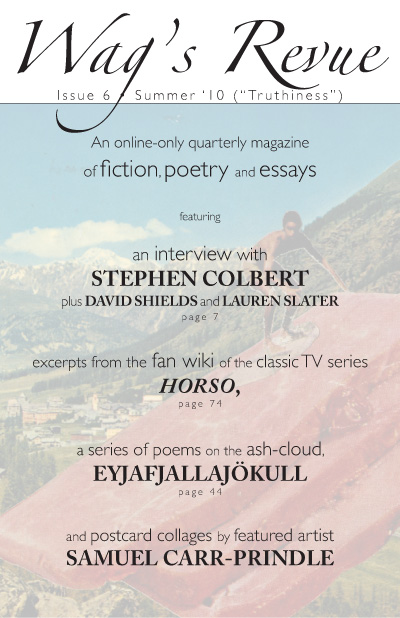
Wag’s Revue #6 Features Stephen Colbert, David Shields, and More

Issue 6 of the online literary journal Wag’s Revue is out now, and features interviews with Stephen Colbert and Reality Hunger author David Shields. They’re calling it the “Truthiness” issue, which I guess is appropriate. Here’s Colbert actually talking about Shields:

WG: Despite your professed aversion to books, you often have guests on the show from the world of literature. In fact, David Shields, who we recently interviewed, was on your show shortly after we spoke with him.

SC: Yeah, you guys should get a nice Colbert bump out of that.

WG: How do you reconcile that, though?

SC: Reconcile what? Having Shields on the show? I nailed Shields. You can go to the tape and see that. I mean, the guy’s book is the equivalent of you guys putting clips from my show on your website and calling it “The Wag-bert Report.” It’s—basically, it’s Wikipedia. A bunch of unattributed, slapped-together quotes. Mostly taken from Britannica.

“A bunch of unattributed, slapped-together quotes”–that’s about right, although it’s always a precarious position to agree with Colbert’s persona. As for the Shield’s interview, well, he manages to say a number of embarrassing things. Here he is explaining why he’s too busy to actually read the novels he’d love to see extinct:

What I find tedious are works that genuflect at the altar of narrative. What happens with so many books by supposedly intelligent writers is that the intelligence gets tamped down: ‘I’ll tell this story and the meaning will crawl through the cracks of the narrative at six crucial points.’ That’s not worth it. Part of my conversion, you could say, resulted of becoming aware of mortality. This is what I focused on in my previous book [The Thing About Life is One Day You’ll Be Dead]. This is it. This is my entire life. We are mortal beings watching the earth for a short time. I don’t have time for a 600-page novel that tells me that crime doesn’t pay.

Interviewer Sandra Allen has the intelligence to call Shields out on this. Observe:

SA: But doesn’t this dismissal also potentially dismiss art? Dismiss a reader experiencing the glorious immersion in the art that is Crime and Punishment, or for that matter Swann’s Way or Ulysses or 2666?

DS: First of all, most of the books that you mentioned were written a long time ago. I love Proust above all else pretty much. Of course if you want to read Crime and Punishment, Swann’s Way, these glacially-paced novels that have no place in a 21st century universe, you can. Even the Bolaño was written ten or so years ago. I’m trying to figure out how we’re going to write now.

Shields then blathers about how Reality Hunger, like Monet or Ulysses or Beethoven’s 5th (!) is really renewing art, claims that all of the critics who hated on Reality Hunger merely proved his point (Shields offers no support for this argument), and generally poses as a would-be revolutionary/college sophomore who just read half of Roland Barthes’s Mythologies. The interview is basically great ammunition for anyone who saw through Reality Hunger.

James Wood Summarizes David Mitchell’s The Thousand Autumns of Jacob de Zoet

I’m a few hours from the end of the audiobook version of David Mitchell’s new novel The Thousand Autumns of Jacob de Zoet. It’s fantastic stuff so far–engaging, imaginative, complex, and satisfying in its richness. Here’s a summary of the book from James Wood’s review of the book in The New Yorker, July 5, 2010:

Jacob de Zoet is a pious, pedantic, upright young clerk for the Dutch East Indies Company, newly arrived on the man-made island of Dejima, in the bay of Nagasaki. It is 1799. The Japanese, enforcing their policy of isolation, confined the Dutch to their post at Dejima, a kind of floating village connected by a bridge to the mainland, and strictly monitored them. The Dutch were effectively prohibited from entering the landmass of Japan, except for the purpose of making an annual visitation to the shogun, in Edo; religious services were banned, and books of Christian devotion were seized upon arrival. Jacob is quickly involved in two difficult narratives: as an employee of the utmost probity, he is tasked with auditing the company, and purging its corruption (various employees have been fiddling the books and stealing goods); unfortunately, the man who has bestowed that task, Unico Vorstenbosch, the chief of the Dejima trading station, is himself on the take. When Jacob confronts Vorstenbosch about his dishonesty, he is suddenly isolated, without allies.

The second struggle also isolates Jacob: he falls in love with Orito Aibagawa, an unusual Japanese woman who works as a midwife, and who has been taking medical instruction from a Dutch physician and intellectual, Dr. Marinus, long resident on Dejima. It is almost impossible for Jacob to advance his love; he is not even sure that Orito returns it, and, even if she did, how could a red-haired Dutchman and a wellborn Japanese woman form any serious bond? But, before anything might occur, Orito disappears. Her father has died, leaving large debts, and it seems that Orito’s family, in order to settle those debts, has “sold” the daughter into a kind of slavery: against her will, she is taken to a remote rural nunnery, run by a powerful and malevolent warlord, the Abbot Enomoto. Just as Jacob fought to unravel the corruptions of his company, so he now strives to unravel the corrupt potency of the Abbot Enomoto and his cultlike temple. As an English reviewer has remarked, the Abbot’s temple, where the enslaved nuns are drugged and impregnated by willing monks, is reminiscent of the world of Japanese anime.

This summary is really the best part of Wood’s review, which works overtime to find fault in what is a very good book. He spends a good deal of his review dithering over the space Mitchell occupies in the contemporary literary world–is Mitchell a postmodernist? A post-postmodernist? A late postmodernist? It’s all quite silly, and I’ll probably write about it in a later post.