We should first of all distinguish stable classifications from provisional ones. Stable classifications are those which, in principle, you continue to respect; provisional classifications are those supposed to last only a few days, the time it takes for a book to discover, or rediscover, its definitive place. This may be a book recently acquired and not read yet, or else a book recently read that you don’t quite know where to place and which you have promised to yourself you will put away on the occasion of a forthcoming ‘great arranging’, or else a book whose reading has been interrupted and that you don’t to classify before taking it up again and finishing it, or else a book you have used constantly over a given period, or else a book you have taken down to look up a piece of information or a reference and which you haven’t yet put back in its place, or else a book that you can’t put back in its place, or else a book that you can’t put back in its rightful place because it doesn’t belong to you and you’ve several times promised to give it back, etc.
—Georges Perec, from “The Art and Manner of Arranging One’s Books”
Book shelves series #9, ninth Sunday of 2012: In which I photograph three book shelves that I will examine more closely over the next several weeks.
Georges Perec goes on to admit that over three-quarters of his own books are provisionally categorized (at best). Libraries, like governments and tectonic plates and personalities, are not stable entities. Still, most of us try to impose some sense of order on our book collection, even if it’s an order apparent and relevant to ourselves alone. The three book shelves photographed below are probably the most “stable” in the house:
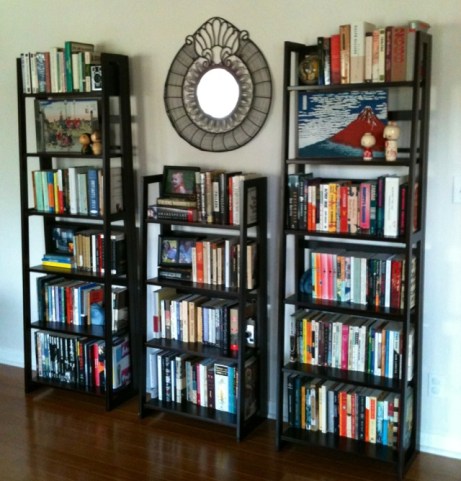
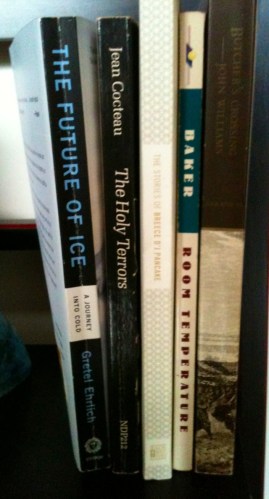
Despite an ongoing process of accretion, relocation, and removal, these shelves tend to remain fairly constant, with minor rearrangements happening maybe monthly instead of weekly or daily. As of today, there’s only one slim piece of a shelf “free”—that is, holding unsorted books waiting to be read, shelved, or, in one case, reviewed (I swear I’ll make another stab at writing up Breece D’J Pancake one day . . .). These books will be elsewhere by the time I get to photographing the shelf they rest on now:

 Biblioklept