Bridge/Rain/Hiroshige/Van Gogh

List with No Name #22

  1. Superman character design reboot — everything’s exactly the same, only Superman now has small orange-feathered wings growing out of his neck. Clark Kent wears a permanent neck brace.
  2. Stunning new issue reveals Batman won’t eat broccoli.
  3. Special Aquaman appearance in Little Mermaid reboot in which Aquaman murders Scuttle.
  4. Martian Manhunter releases dope mixtape (under his alias J’onn J’onzz); Pitchfork gives it a 6.2.
  5. Wonder Woman sends back her sarapatel — “Sorry, just doesn’t taste authentic.”
  6. Flash is the subject of a shortlived 1990s TV show remembered fondly by exactly no one. Danny Elfman composes the score.
  7. Green Lantern stalks former high school girlfriend on Facebook; spends hours watching locomotive trains on YouTube; argues frequently with neighbors; has occasional thoughts about suicide.

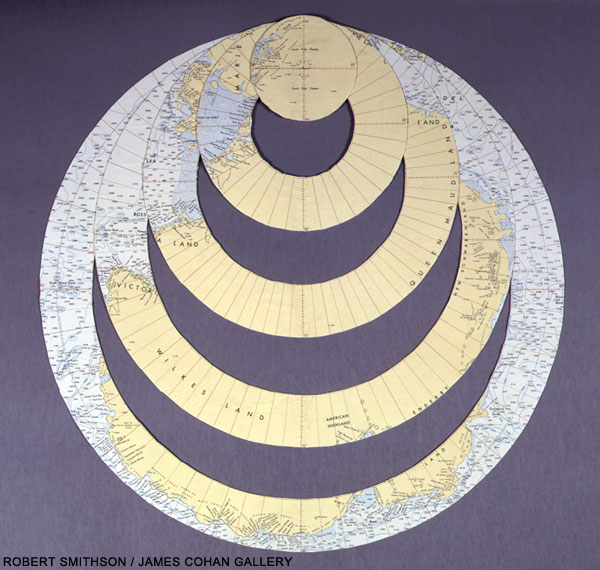
Antarktis — Robert Smithson

untitled_antarktis_900

Plagiarism

The first century Roman poet Martial used the Latin word plagiarius to complain that another poet had kidnapped his verses.

Plagiarius: kidnapper, seducer, plunderer, one who kidnaps the child or slave of another.

Anglicized by Johnson in 1601.

Plagiary, adjective. 1. Stealing men; kidnapping. 2. Practicing literary theft.

Based on the Indo-European root *-plak, “to weave” (seen for instance in Greek plekein, Bulgarian “плета” pleta, Latin plectere, all meaning “to weave”).

Listen Fates, who sit nearest of gods to the throne of Zeus, and weave with shuttles of adamant, inescapable devices for councels of every kind beyond counting.

Neith.

Frigg.

Brigantia.

If, while riding a horse overland, a man should come upon a woman spinning, then that is a very bad sign; he should turn around and take another way.

Wonderful, wonderful, yet again the sword of fate severs the head from the hydra of chance.

When shall we three meet again

In thunder, lightning, or in rain?

As we, or mother Dana, weave and unweave our bodies from day to day, their molecules shuttled to and fro, so does the artist weave and unweave his image.

In the 19th century there was a literary scandal when the leading Sterne scholar of the day discovered that many of the quintessentially Sternean passages of Tristram Shandy had been lifted from other authors.

Typically, a passage lamenting the lack of originality among contemporary writers was plagiarised from Burton’s Anatomy of Melancholy.

Now academics call the plagiarism “intertextuality.”

When the hurlyburly’s done,

When the battle’s lost and won.

Urðr.

Verðandi.

Skuld.

Olaudah Equiano was born in 1745 in Eboe, in what is now Nigeria. When he was about eleven, Equiano was kidnapped and sold to slave traders headed to the West Indies.

When our women are not employed with the men in tillage, their usual occupation is spinning and weaving cotton, which they afterwards dye, and make it into garments.

“I did so, sir, for my sins,” said I; “for it was by his means and the procurement of my uncle, that I was kidnapped within sight of this town, carried to sea, suffered shipwreck and a hundred other hardships, and stand before you to-day in this poor accoutrement.”

Persephone.

Europa.

Ganymede.

Plagiarism begins at home.

Nothing is said which has not been said before.

Originality: Judicious imitation.

Perhaps the efforts of the true poets, founders, religions, literatures, all ages, have been, and ever will be, our time and times to come, essentially the same—to bring people back from their present strayings and sickly abstractions, to the costless, average, divine, original concrete.

Hippolyta.

Helen.

Rapunzel.

I am against the prophets, saith the Lord, that steal My words every one from his neighbor.

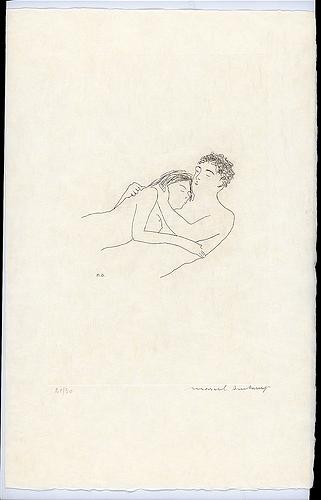
After Love — Marcel Duchamp

after-love-1968

Katherine Anne Porter on F. Scott Fitzgerald (She Wasn’t a Fan)

Katherine Anne Porter in her Paris Review interview:

PORTER

I’ve never belonged to any group or huddle of any kind. You cannot be an artist and work collectively. Even the fact that I went to Mexico when everybody else was going to Europe—I went to Mexico because I felt I had business there. And there I found friends and ideas that were sympathetic to me. That was my entire milieu. I don’t think anyone even knew I was a writer. I didn’t show my work to anybody or talk about it, because—well, no one was particularly interested in that. It was a time of revolution, and I was running with almost pure revolutionaries!

INTERVIEWER

And you think that was a more wholesome environment for a writer than, say, the milieu of the expatriated artist in Europe at the same time?

PORTER

Well, I know it was good for me. I would have been completely smothered—completely disgusted and revolted—by the goings-on in Europe. Even now when I think of the twenties and the legend that has grown up about them, I think it was a horrible time: shallow and trivial and silly. The remarkable thing is that anybody survived in such an atmosphere—in a place where they could call F. Scott Fitzgerald a great writer!

INTERVIEWER

You don’t agree?

PORTER

Of course I don’t agree. I couldn’t read him then and I can’t read him now. There was just one passage in a book called Tender Is the Night—I read that and thought, “Now I will read this again,” because I couldn’t be sure. Not only didn’t I like his writing, but I didn’t like the people he wrote about. I thought they weren’t worth thinking about, and I still think so. It seems to me that your human beings have to have some kind of meaning. I just can’t be interested in those perfectly stupid meaningless lives. And I don’t like the same thing going on now—the way the artist simply will not face up to the final reckoning of things.

Seated Woman (Olga) — Pablo Picasso