A Woman in Netherlandish Dress Seen from Behind — Albrecht Dürer

Selections from One-Star Amazon Reviews of Joyce’s Ulysses

[Ed. note: The following citations come from one-star Amazon reviews of James Joyce’s Ulysses. To be clear, I think Ulysses is a marvelous, rewarding read. While one or two of the reviews are tongue-in-cheek, most one-star reviews of the book are from very, very angry readers who feel duped]

I can sum this book up in two words: “Ass Beating”.

What an awful book this is?

I bought this having been a huge fan of the cartoon series, but Mr Joyce has taken a winning formula and produced a prize turkey. After 20 pages not only had Ulysses failed to even board his spaceship, but I had no idea at all what on earth was going on. Verdict: Rubbish.

When an English/American writer try to explain his/her ideas about life(I mention ideas about meaning,purpose and philosophy of life)and when he/she try to do this with complicated ideas and long sentences(or like very short ones especially in this particular book);what his/her work become to is:A tremendous nonsense!!!

Thi’ got to be the worst, I- I – I mean the worst ever written book ever. Know why? ‘Cause he’ such a showoff, know what I MEAN? He’s ingenious I’ll giv’ ’em that, but ingenuity my friends tire and enervate. Get to the point and stick to it ‘s my motto.

This is one of those books that “smart” people like to “read.”

The grammar is so disjointed as to make it nearly impossible to read.

Ulysses is basically an unbridled attack on the very ideas of heroism, romantic love and sexual fulfillment, and objective literary expression.

What’s with all the foreign languages?

It has no real meaning.

It is a blasphemy that it ever was published.

Anyone who tells you they’ve read this so-called book all the way through is probably lying through their teeth.It is impossible to endure this torture.

A babbling, senseless tome upheld by “literary luminaries” who fear being cast into the tasteless bourgeois darkness for dissent? Yes, that’s the gist.

I discovered that the novel was not what I though it would be.

Joyce is an aesthetic bother of Marcel Duchamp (known for The Fountain, a urinal, now a museum piece) and John Cage (the composer of pieces for prepared piano, where the piano’s strings are mangled with trash.

Two positive things I can say about James Joyce is that he has a great sounding name and he gives wonderful titles to his works.

Ask yourself – are you going to enjoy a book that neccesitates your literature teacher lie next to you and explain its ‘sophistication’ to you ?

It’s the worst book which has ever been written.

Unless you really hate yourself, do not attempt to read this book.

The truth is this book stinks. For one thing it is vulgar, which, I hate to disappoint anyone, requires no talent at all. This is a talent any six year-old boy possesses.

The book is not so good, it is boring, it is a colection of words and a continuous experimentation of styles that, unhappily, do not mean anything to the meaning of the story; that is, the book’s language is snobbish and useless. Those who say that “love” such a writing are to be thought about as non-readers or as victims of a literary abnormality.

…the single most destructive piece of Literature ever written…

I’m all for challenging reads, but not for gibberish which academics persist in labeling erudition.

This book is extremely dull!!! My book club decided to read this book after one of the members visited the James Joyce tower in Ireland, which the author supposedly wrote part of the book in.

Ulysses is a failed novel because Joyce was a bad writer (shown by his other works).

In conclusion, Don’t read the book. Burn it hard. Do not let your children read the book—it will mutilate their brain cells.
June 16, 1838 (Nathaniel Hawthorne)

Tremont, Boston, June 16th.–Tremendously hot weather to-day. Went on board the Cyane to see Bridge, the purser. Took boat from the end of Long Wharf, with two boatmen who had just landed a man. Row round to the starboard side of the sloop, where we pass up the steps, and are received by Bridge, who introduces us to one of the lieutenants,–Hazard. Sailors and midshipmen scattered about,–the middies having a foul anchor, that is, an anchor with a cable twisted round it, embroidered on the collars of their jackets. The officers generally wear blue jackets, with lace on the shoulders, white pantaloons, and cloth caps. Introduced into the cabin,–a handsome room, finished with mahogany, comprehending the width of the vessel; a sideboard with liquors, and above it a looking-glass; behind the cabin, an inner room, in which is seated a lady, waiting for the captain to come on board; on each side of this inner cabin, a large and convenient state-room with bed,–the doors opening into the cabin. This cabin is on a level with the quarter-deck, and is covered by the poop-deck. Going down below stairs, you come to the ward-room, a pretty large room, round which are the state-rooms of the lieutenants, the purser, surgeon, etc. A stationary table. The ship’s main-mast comes down through the middle of the room, and Bridge’s chair, at dinner, is planted against it. Wine and brandy produced; and Bridge calls to the Doctor to drink with him, who answers affirmatively from his state-room, and shortly after opens the door and makes his appearance. Other officers emerge from the side of the vessel, or disappear into it, in the same way. Forward of the wardroom, adjoining it, and on the same level, is the midshipmen’s room, on the larboard side of the vessel, not partitioned off, so as to be shut up. On a shelf a few books; one midshipman politely invites us to walk in; another sits writing. Going farther forward, on the same level, we come to the crew’s department, part of which is occupied by the cooking-establishment, where all sorts of cooking is going on for the officers and men. Through the whole of this space, ward-room and all, there is barely room to stand upright, without the hat on. The rules of the quarterdeck (which extends aft from the main-mast) are, that the midshipmen shall not presume to walk on the starboard side of it, nor the men to come upon it at all, unless to speak to an officer. The poop-deck is still more sacred,–the lieutenants being confined to the larboard side, and the captain alone having a right to the starboard. A marine was pacing the poop-deck, being the only guard that I saw stationed in the vessel,–the more stringent regulations being relaxed while she is preparing for sea. While standing on the quarter-deck, a great piping at the gangway, and the second cutter comes alongside, bringing the consul and some other gentleman to visit the vessel. After a while, we are rowed ashore with them, in the same boat. Its crew are new hands, and therefore require much instruction from the cockswain. We are seated under an awning. The guns of the Cyane are medium thirty-two pounders; some of them have percussion locks.

At the Tremont, I had Bridge to dine with me: iced champagne, claret in glass pitchers. Nothing very remarkable among the guests. A wine-merchant, French apparently, though he had arrived the day before in a bark from Copenhagen: a somewhat corpulent gentleman, without so good manners as an American would have in the same line of life, but good-natured, sociable, and civil, complaining of the heat. He had rings on his fingers of great weight of metal, and one of them had a seal for letters; brooches at the bosom, three in a row, up and down; also a gold watch-guard, with a seal appended. Talks of the comparative price of living, of clothes, etc., here and in Europe. Tells of the prices of wines by the cask and pipe. Champagne, he says, is drunk of better quality here than where it grows.–A vendor of patent medicines, Doctor Jaques, makes acquaintance with me, and shows me his recommendatory letters in favor of himself and drugs, signed by a long list of people. He prefers, he says, booksellers to druggists as his agents, and inquired of me about them in this town. He seems to be an honest man enough, with an intelligent face, and sensible in his talk, but not a gentleman, wearing a somewhat shabby brown coat and mixed pantaloons, being ill-shaven, and apparently not well acquainted with the customs of a fashionable hotel. A simplicity about him that is likable, though, I believe, he comes from Philadelphia.–Naval officers, strolling about town, bargaining for swords and belts, and other military articles; with the tailor, to have naval buttons put on their shore-going coats, and for their pantaloons, suited to the climate of the Mediterranean. It is the almost invariable habit of officers, when going ashore or staying on shore, to divest themselves of all military or naval insignia, and appear as private citizens. At the Tremont, young gentlemen with long earlocks,–straw hats, light, or dark-mixed.–The theatre being closed, the play-bills of many nights ago are posted up against its walls.

From Nathaniel Hawthorne’s American Note-Books.

A Letter From James Joyce to Nora Barnacle, 12/13/1909

James_and_Nora

I would be delighted to feel my flesh tingling under your hand. Do you know what I mean, Nora dear? I wish you would smack me or flog me even. Not in play, dear, in earnest and on my naked flesh. I wish you were strong, strong, dear, and had a big full proud bosom and big fat thighs.  I would love to be whipped by you, Nora love! I would love to have done something to displease you, something trivial even, perhaps one of my rather dirty habits that make you laugh: and then to hear you call me into your room and then to find you sitting in an armchair with your fat thighs far apart and your face deep red with anger and a cane in your hand. To see you point to what I had done and then with a movement of rage pull me towards you and throw me face downwards across your lap. Then to feel your hands tearing down my trousers and inside clothes and turning up my shirt, to be struggling in your strong arms and in your lap, to feel you bending down (like an angry nurse whipping a child’s bottom) until your big full bubbies almost touched me and to feel you flog, flog, flog me viciously on my naked quivering flesh!!

Film Footage of the First Bloomsday Celebration in 1954

Film footage of the first Bloomsday celebration (June 16, 1954)–a great find by Antoine Malette, who posted the video along with an account of the journey as told in Flann O’Brien: An Illustrated Biography. The film was shot by John Ryan, and shows an extremely inebriated Brian O’Nolan (aka Flann O’Brien) having to be helped around by pals Anthony Cronin and Patrick Kavanagh. We’re also treated to a scene of Kavanagh taking a piss with Joyce’s cousin Tom Joyce, a dentist who joined the merry band. (The scene will undoubtedly recall to you that marvelous moment in Ulysses when “first Stephen, then Bloom, in penumbra urinated“). The troupe didn’t quite finish their mission, getting sidetracked by booze and quarrels. Read the full account at Malette’s site.

Summary of Bloom’s Day in Ulysses — Evan Lavender-Smith (From Old Notebooks)

Makes breakfast for his wife. Goes to the butcher. Goes to the post office. Goes to church. Goes to a chemist. Goes to a public bath. Goes to a funeral. Goes to a newspaper press. Goes to a locksmith to canvass an ad. Feeds some seagulls. Goes to a bar. Helps a blind man cross the street. Goes to the museum. Goes to to the library. Visits a bookseller. Window-shops. Goes to a restaurant. Listens to some live music. Writes a love letter. Goes to another bar. Nearly gets in a fight. Masturbates to a beautiful eighteen-year-old exhibitionist giving him a private show. Takes an alfresco nap. Takes up a collection for a widow. Goes to a hospital to visit a pregnant woman. Flirts with a nurse. Feeds a stray dog. Goes to a whorehouse. Helps avert a row with the police. Goes to a cabman’s shelter and listens to a sailor tell stories. Breaks into his own house. Urinates under the stars with another man. Watches the sunrise. Kisses his wife on her arse.

It would have been the single busiest, most adventurous day of my life.

From Evan Lavender-Smith’s From Old Notebooks.


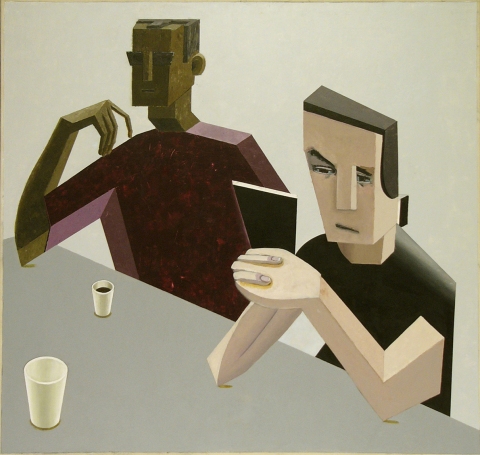
Coffee — Mernet Larsen

coffee Mernet-Larsen_4

Young Woman Dreaming of The Ise Stories — Hosoda Eishi