
Detail from Der Jungbrunnen (The Fountain of Youth), 1546 by Lucas Cranach the Elder (c. 1472–1553)

Detail from Der Jungbrunnen (The Fountain of Youth), 1546 by Lucas Cranach the Elder (c. 1472–1553)
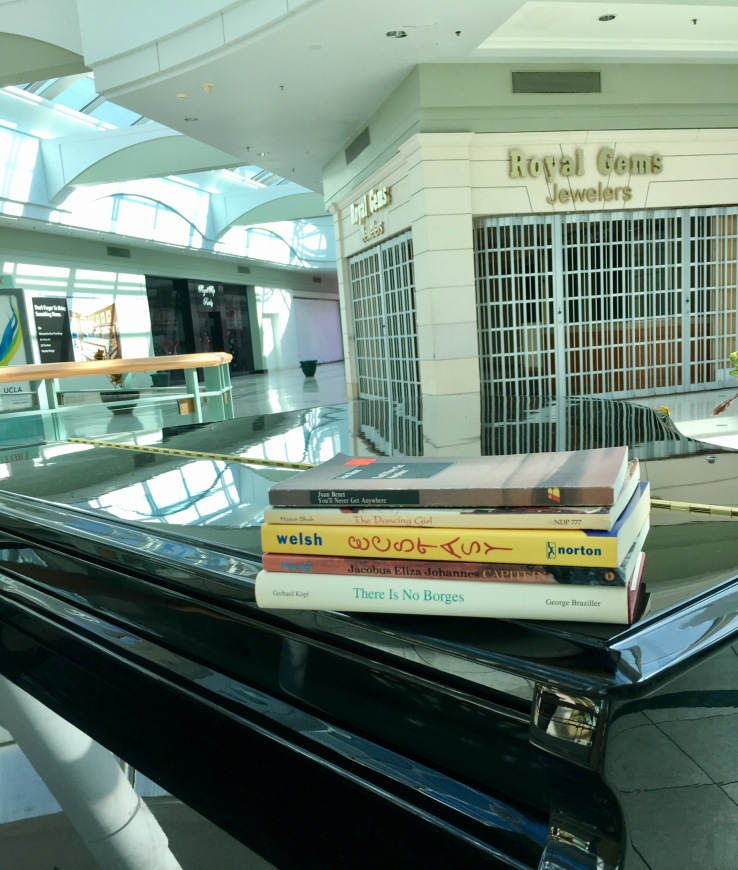
I had been awake for almost twenty hours when I walked out of the Warner Center Marriott’s arctic AC into the concrete heat of the San Fernando Valley. My wife had to work for a few hours, so I was looking for a bar or something—something other than the hotel lobby (or LA traffic).
There was an enormous mall across the street, the Westfield Promenade. I entered by the AMC Theatre, one of the only five businesses remaining in the sprawling two-storied mall (it’s over half a million square feet). It was over 100 degrees outside in the Valley’s afternoon heat, and the mall was unairconditioned, stale, expansive but somehow stifling. The place appeared entirely empty except for a stray bored AMC employee scrolling through her phone. (Later, I’d see a man sleeping on a table and an inattentive security guard). A sad scatter of arcade games defined a loose threshold between the AMC’s going concern and the rest of the mall, which was clearly dead.
There’s something wonderfully Ballardian about dead malls—their vastness, the traces and ghosts of commerce stamped on them, echoes of a lost vibrancy that simultaneously suggest new and even unimagined future possibilities.


I love dead malls. I was born in 1979, and these kind of malls–the kind best summed up in their vitality in a film like Fast Times at Ridgemont High—helped to define my youth (even if I defined myself in part against the mall and mall culture): I bought the Breeders’ album Last Splash on tape at Camelot Music; I suffered through Stone’s Natural Born Killers; I ate at the weird cafeteria, cornbread squares and Jell-O squares wobbling on ugly green plastic trays.
Once, I saw Glenn Danzig browsing at the B. Dalton book store.
Of the half dozen remaining stores in the Westfield Promenade, only one is a retail space—oddly enough, a bookstore—Crown Books, a large spot that looked like it once sold new books but now seems to only sell old books, many of them Christian. Half of the space also seems to double as a Halloween store. The power went out twice while I was in there.
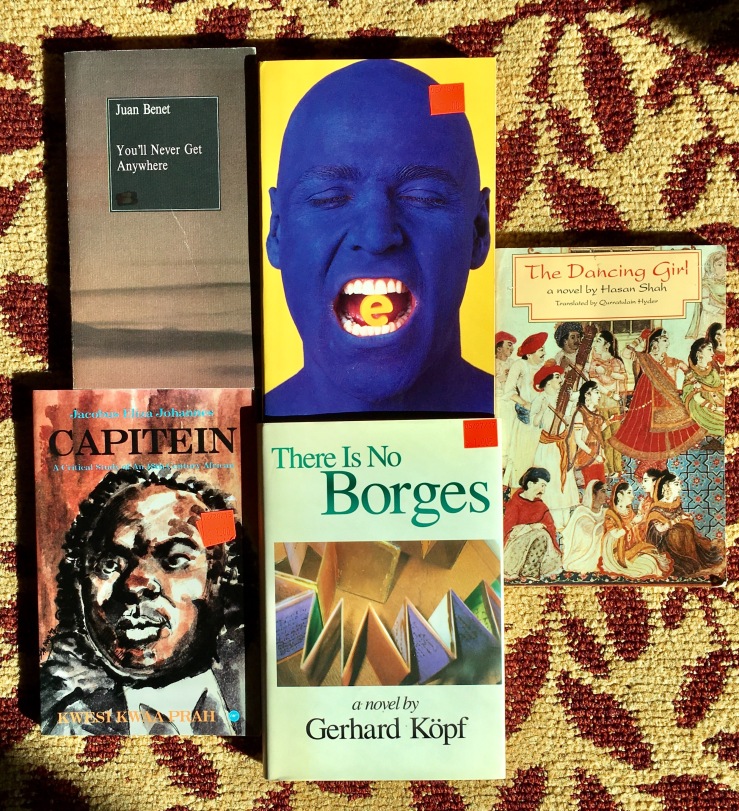
The hardbacked spine of Gerhard Kopf’s novel There Is No Borges caught my attention. It was part of a large section of “clearance” books (although everything in the store seemed to be on clearance). These books were a dollar each or five for a dollar, a mathematics that screams, Please haul these away for us. (Earlier that day at the Charlotte airport, I’d paid three dollars for 16 ounces of bottled water).
Here are the covers of the books I paid not quite 22 U.S. cents for (after taxes). Please excuse the horrid hotel carpet in the background:
(Later that night my wife and I walked a few blocks past the dead mall to the live mall—an outdoor mall, vibrant, green, bustling with children and their adults and pets, music, water, chain stores, and boutiques, and crowded restaurants. There wasn’t a bookstore there).
One can’t study the masters too much—I mean, from the amateur’s view-point; in the case of an artist it depends on the receptivity of his temperament. Velasquez didn’t like Raphael, and it was Boucher who warned Fragonard, when he went to Rome, not to take the Italian painters too seriously. Imitation may be the sincerest form of flattery, but it sometimes stifles individuality. I think it is probably the belief that never again will this planet have another golden age of painting and sculpture that arouses in me the melancholy I mention. Music has passed its prime and is now entering the twilight of perfections past for ever. So is it with the Seven Arts. Nevertheless, there is no need of pessimism. Even if we could, it would not be well to repeat the formulas of art accomplished, born as they were of certain conditions, social as well as technical. Other days, other plays. And that is the blight on all academic art. “Traditional art,” says Frank Rutter, “is the art of respectable plagiarism,” a slight variation on Paul Gauguin’s more revolutionary axiom. No fear of any artist being too original. “There is no isolated truth,” exclaimed Millet; but Constable wrote: “A good thing is never done twice.” Best of all, it was R. A. M. Stevenson who said in effect that after studying Velasquez at the Prado he had modified his opinions as to the originality of modern art. Let us admit that there is no hope of ever rivalling the dead; yet a new beauty may be born, a new vision, and with it necessarily new technical procedures. When I say “new,” I mean a new variation on the past. To-day the Chinese and Assyrian are revived. It is the denial of these very obvious truths that makes academic critics slightly ridiculous. They obstinately refuse to see the sunlight on the canvases of the Impressionists just as they deny the sincerity and power of the so-called post-Impressionists. The transvaluation of critical values must follow in the trail of revolutions.
From James Huneker’s “The Melancholy of Masterpieces.” Collected in Ivory, Apes and Peacocks (1915).

 Biblioklept
