
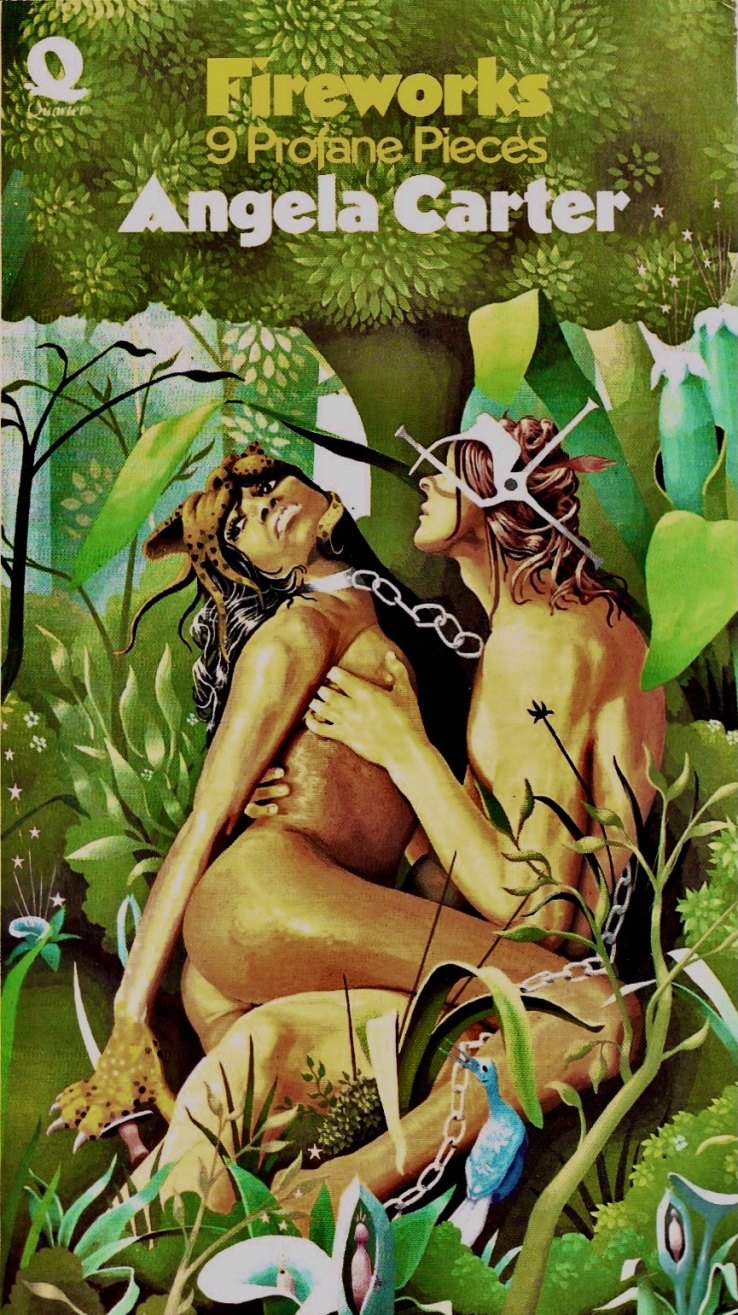
It’s October, and maybe you want some light heavy reading, something titillating but deep, sharp, maybe a little gross at times, always unnerving, right?
How about reading Angela Carter’s 1974 collection Fireworks?
Subtitled Nine Profane Pieces, the collection features nine profane pieces. Actually, I don’t think profane is the right adjective (although I’d always cede to Carter’s judgment in matters of diction). Many, no, most, of these stories approach the spiritual—albeit in a roundabout, okay, profane, manner. In the phallically-titled “Penetrating to the Heart of the Forest,” for example, Carter reimagines Adam and Eve in a new garden through a lens that ironizes both Rousseau’s notion of the noble savage as well as the European colonial project in general. There’s also some mild incest in the tale, to boot—so, okay, sure, profane.
The noun in Carter’s subtitle, pieces, is wholly accurate: the selections in Fireworks have a unified tone, but are disparate in form. There are fabulous thrillers here (“The Loves of Lady Purple,” the story of a puppet prostitute who sucks the life out of her ventriloquist master), morality tales (“Master,” a riff on the Great White Hunter with a figurative middle finger pointed in the general direction of Defoe’s Crusoe), and reminiscences that approach so-called autofiction (“A Souvenir of Japan” and “The Smile of Winter,” mementos of the years Carter lived in Japan). “Flesh and the Mirror” expands on Carter’s years in Japan, but swerves into Borgesian territory; “Reflections” goes straight through the Borgesian mirror into Burroughs world (William S., with just a touch of Edgar R.).
The strongest piece in the collection, at least in my estimation, is “The Executioner’s Beautiful Daughter,” which reads like a travelogue into incestuous abjection. “Here we are, high in the uplands,” our detached narrator begins, before offering up an anthropological catalog of life in that upland. The barest ghost of a plot clutches onto “The Executioner’s Beautiful Daughter,” and the piece is all the stronger for it. Instead, we get a cold, ugly study in cruelty and horror.
Readers new to Carter might prefer to start with her seminal 1979 collection The Bloody Chamber, a book whose inverted fairy tales eviscerate the adjective I used in the previous clause, that adjective seminal. The Bloody Chamber is great! (Check out “Wolf-Alice” for a taste.) (And while I’m hanging out in parentheses, I’ll point out that Burning Your Boats collects pretty much all of Carter’s short fiction.) But back to Fireworks—if the pieces here are not as refined and unified as the anti-fairy tales that comprise Carter’s more-celebrated collection The Bloody Chamber, they are all the more fascinating as studies in sadomasochism, alienation, and the emerging of a new literary consciousness. Great stuff.

 Biblioklept