
Disjunction, simultaneity, irrationalism, anti-illusionism, self-reflexiveness, medium-as-message, political olympianism, and a moral pluralism approaching moral entropy—these are not the whole story either.
A worthy program for postmodernist fiction, I believe, is the synthesis or transcension of these antitheses, which may be summed up as premodernist and modernist modes of writing. My ideal postmodernist author neither merely repudiates nor merely imitates either his twentieth-century modernist parents or his nineteenth-century premodernist grandparents. He has the first half of our century under his belt, but not on his back. Without lapsing into moral or artistic simplism, shoddy craftsmanship, Madison Avenue venality, or either false or real naïveté, he nevertheless aspires to a fiction more democratic in its appeal than such late-modernist marvels (by my definition) as Beckett’s Texts for Nothing or Nabokov’s Pale Fire. He may not hope to reach and move the devotees of James Michener and Irving Wallace—not to mention the great mass of television-addicted non-readers. But he should hope to reach and delight, at least part of the time, beyond the circle of what Mann used to call the Early Christians: professional devotees of high art.
I feel this in particular for practitioners of the novel, a genre whose historical roots are famously and honorably in middle-class popular culture. The ideal postmodernist novel will somehow rise above the quarrel between realism and irrealism, formalism and “contentism,” pure and committed literature, coterie fiction and junk fiction. Alas for professors of literature, it may not need as much teaching as Joyce’s or Nabokov’s or Pynchon’s books, or some of my own. On the other hand, it will not wear its heart on its sleeve, either; at least not its whole heart. (In a recent published exchange between William Gass and John Gardner, Gardner declares that he wants everybody to love his books; Gass replies that he would no more want his books to be loved by everybody than he’d want his daughter to be loved by everybody, and suggests that Gardner is confusing love with promiscuity.) My own analogy would be with good jazz or classical music: One finds much on successive listenings or close examination of the score that one didn’t catch the first time through; but the first time through should be so ravishing—and not just to specialists—that one delights in the replay.
Lest this postmodern synthesis sound both sentimental and impossible of attainment, I offer two quite different examples of works which I believe approach it, as perhaps such giants as Dickens and Cervantes may be said to anticipate it. The first and more tentative example (it is not meant to be a blockbuster) is Italo Calvino’s Cosmicomics (1965): beautifully written, enormously appealing space-age fables—“perfect dreams,” John Updike has called them—whose materials are as modern as the new cosmology and as ancient as folktales, but whose themes are love and loss, change and permanence, illusion and reality, including a good deal of specifically Italian reality. Like all fine fantasists, Calvino grounds his nights in local, palpable detail: Along with the nebulae and the black holes and the lyricism, there is a nourishing supply of pasta, bambini, and good-looking women sharply glimpsed and gone forever. A true postmodernist, Calvino keeps one foot always in the narrative past—characteristically the Italian narrative past of Boccaccio, Marco Polo, or Italian fairy tales—and one foot in, one might say, the Parisian structuralist present; one foot in fantasy, one in objective reality, etc. It is appropriate that he has, I understand, been chastized from the left by the Italian communist critics and from the right by the Italian Catholic critics; it is symptomatic that he has been praised by fellow authors as divergent as John Updike, Gore Vidal, and myself. I urge everyone to read Calvino at once, beginning with Cosmicomics and going right on, not only because he exemplifies my postmodernist program, but because his fiction is both delicious and high in protein.
An even better example is Gabriel García Márquez’s One Hundred Years of Solitude (1967): as impressive a novel as has been written so far in the second half of our century and one of the splendid specimens of that splendid genre from any century. Here the synthesis of straightforwardness and artifice, realism and magic and myth, political passion and nonpolitical artistry, characterization and caricature, humor and terror, are so remarkably sustained that one recognizes with exhilaration very early on, as with Don Quixote and Great Expectations and Huckleberry Finn, that one is in the presence of a masterpiece not only artistically admirable, but humanly wise, lovable, literally marvelous. One had almost forgotten that new fiction could be so wonderful as well as so merely important. And the question whether my program for postmodernism is achievable goes happily out the window, like one of García Márquez’s characters on flying carpets. Praise be to the Spanish language and imagination! As Cervantes stands as an exemplar of premodernism and a great precursor of much to come, and Jorge Luis Borges as an exemplar of dernier cri modernism and at the same time as a bridge between the end of the nineteenth century and the end of the twentieth, so Gabriel García Márquez is in that enviable succession: an exemplary postmodernist and a master of the storyteller’s art.
From John Barth’s 1980 essay “The Literature of Replenishment.”
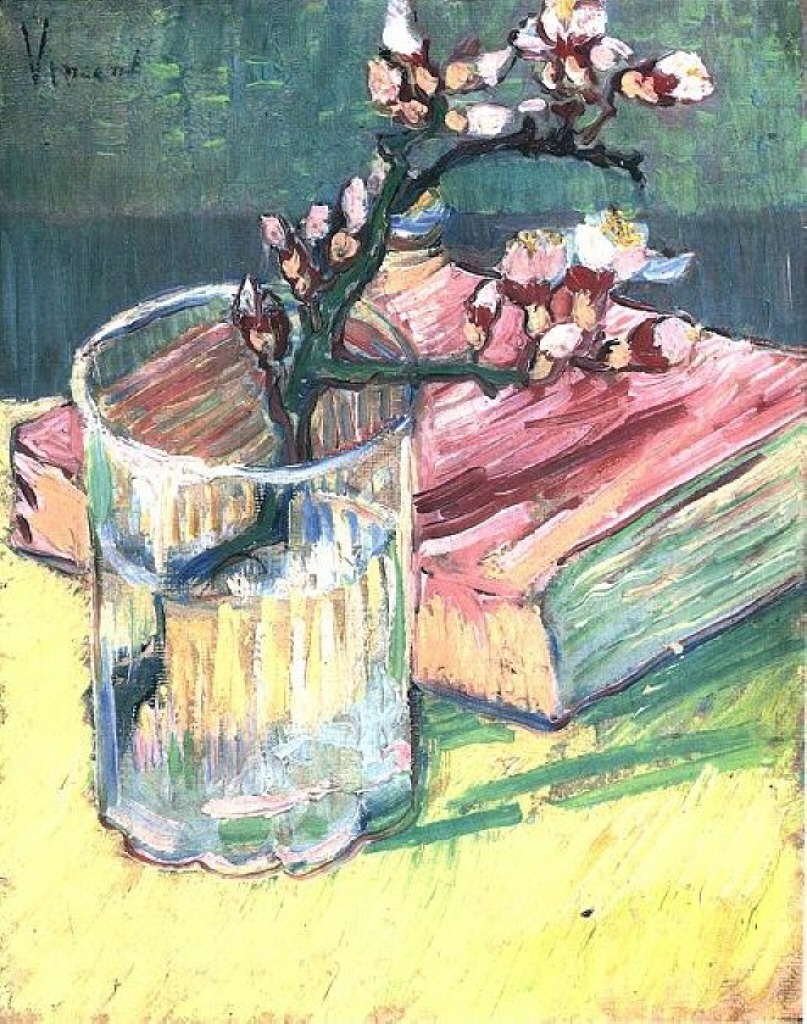 Blossoming Almond Branch in a Glass with a Book, 1888 by Vincent van Gogh (1853–1890)
 Biblioklept