“The Executioner’s Beautiful Daughter” — Angela Carter

“The Executioner’s Beautiful Daughter”

by

Angela Carter


Here, we are high in the uplands.

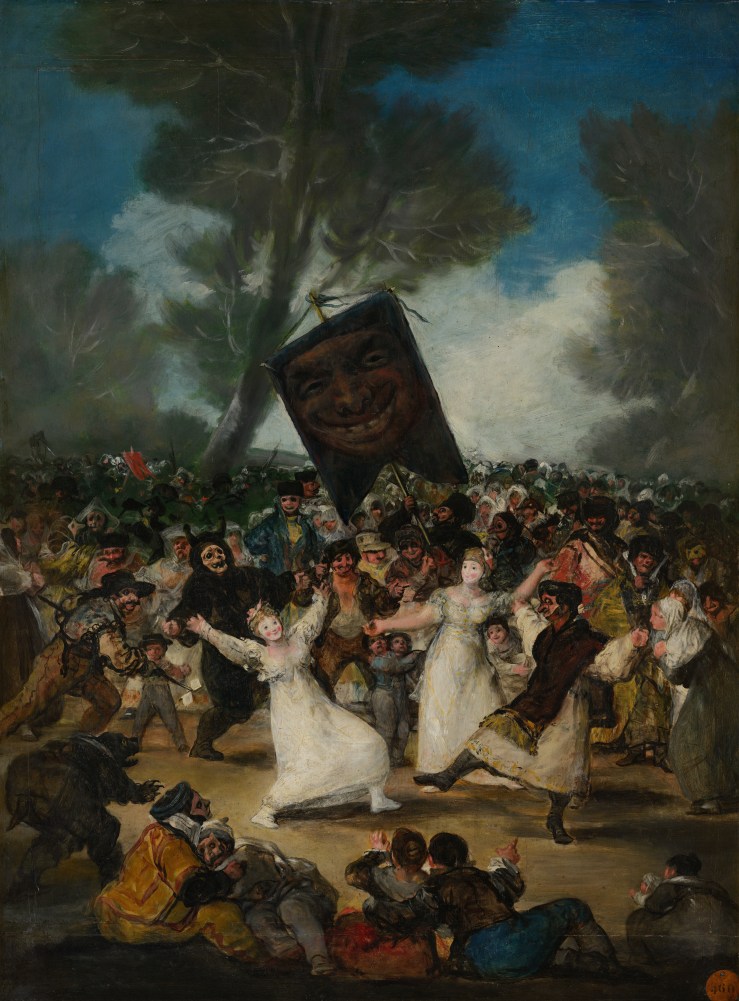
A baleful almost-music, that of the tuneless cadences of an untutored orchestra repercussing in an ecstatic agony of echoes against the sounding boards of the mountains, lured us into the village square where we discover them twanging, plucking and abusing with horsehair bows a wide variety of crude stringed instruments. Our feet crunch upon dryly whispering shifting sawdust freshly scattered over impacted surfaces of years of sawdust clotted, here and there, with blood shed so long ago it has, with age, acquired the colour and texture of rust . . . sad, ominous stains, a threat, a menace, memorials of pain.

There is no brightness in the air. Today the sun will not irradiate the heroes of the dark spectacle to which accident and disharmony combined to invite us. Here, where the air is choked all day with diffuse moisture tremulously, endlessly the point of becoming rain, light falls as if filtered through muslin so at all hours a crepuscular gloaming prevails; the sky looks as though it is about to weep and so, gloomily illuminated through unshed tears, the tableau vivant before us is suffused with the sepia tints of an old photograph and nothing within it moves. The intent immobility of the spectators, wholly absorbed as they are in the performance of their hieratic ritual, is scarcely that of living things and this tableau vivant might be better termed a nature morte for the mirthless carnival is a celebration of a death. Their eyes, the whites of which are yellowish, are all fixed, as if attached by taut, invisible strings upon a wooden block lacquered black with the spilt dews of a millennia of victims.

And now the rustic bandsmen suspend their unmelodious music. This death must be concluded in the most dramatic silence. The wild mountain-dwellers are gathered together to watch a public execution; that is the only entertainment the country offers.

Time, suspended like the rain, begins again in silence, slowly. Continue reading ““The Executioner’s Beautiful Daughter” — Angela Carter”

Posted in Art

Picnic at Wittenham — George Warner Allen

Picnic at Wittenham, 1948 by George Warner Allen 1916-1988

October — William Merritt Chase

October, 1893 by William Merritt Chase (1849-1916)

Uzbek Woman in Tashkent — Vasily Vereshchagin

Uzbek Woman in Tashkent, 1873 by Vasily Vereshchagin (1842-1904)

Crowning of the Happy Feline — Leonor Fini

Crowning of the Happy Feline, 1974 by Leonor Fini (1908-1996)

The Green Room — Salman Toor

The Green Room, 2019 by Salman Toor (b. 1983)

Reading Girls — Helene Schjerfbeck

Lukevat tytöt (Reading Girls), 1907 by Helene Schjerfbeck (1862-1946)

Salome — Henry Ossawa Tanner

Salome, 1900 by Henry Ossawa Tanner (1859-1937)

King Kong à Paris — Sergio Ceccotti

King Kong à Paris, 2019 by Sergio Ceccotti (b. 1935)

The Dice Are Cast — Francine Van Hove

Les dés sont jetés (The Dice Are Cast), 2016  by Francine Van Hove (b. 1942)

“The Challenge” — Jorge Luis Borges

“The Challenge”

by

Jorge Luis Borges

Translated by d by Norman Thomas di Giovanni


All over the Argentine runs a story that may belong to legend or to history or (which may be just another way of saying it belongs to legend) to both things at once. Its best recorded versions are to be found in the unjustly forgotten novels about outlaws and desperadoes written in the last century by Eduardo Gutiérrez; among its oral versions, the first one I heard came from a neighborhood of Buenos Aires bounded by a penitentiary, a river, and a cemetery, and nicknamed Tierra del Fuego. The hero of this version was Juan Muraña, a wagon driver and knife fighter to whom are attributed all the stories of daring that still survive in what were once the outskirts of the city’s Northside. That first version was quite simple. A man from the Stockyards or from Barracas, knowing about Muraña’s reputation (but never having laid eyes on him), sets out all the way across town from the Southside to take him on. He picks the fight in a corner saloon, and the two move into the street to have it out. Each is wounded, but in the end Muraña slashes the other man’s face and tells him, “I’m letting you live so you’ll come back looking for me again.”

What impressed itself in my mind about the duel was that it had no ulterior motive. In conversation thereafter (my friends know this only too well), I grew fond of retelling the anecdote. Around 1927, I wrote it down, giving it the deliberately laconic title “Men Fought.” Years later, this same anecdote helped me work out a lucky story—though hardly a good one—called “Streetcorner Man.” Then, in 1950, Adolfo Bioy-Casares and I made use of it again to plot a film script that the producers turned down and that would have been called On the Outer Edge. It was about hard-bitten men like Muraña who lived on the outskirts of Buenos Aires before the turn of the century. I thought, after such extensive labors, that I had said farewell to the story of the disinterested duel. Then, this year, out in Chivilcoy, I came across a far better version. I hope this is the true one, although since fate seems to take pleasure in a thing’s happening many times over, both may very well be authentic. Two quite bad stories and a script that I still think of as good came out of the poorer first version; out of the second, which is complete and perfect, nothing can come. Without working in metaphors or details of local color, I shall tell it now as it was told to me. The story took place to the west, in the district of Chivilcoy, sometime back in the 1870’s. Continue reading ““The Challenge” — Jorge Luis Borges”

Head — Cecil Collins

Head, 1963 by Cecil Collins 1908-1989

The Vision and Inspiration of Joan of Arc — Louis Maurice Boutet de Monvel

The Vision and Inspiration of Joan of Arc, c. late 1909-early 1913 by Louis Maurice Boutet de Monvel (1850-1913)

Cigninota — Walton Ford

Cigninota, 2020 by Walton Ford (b. 1960)

Fool and Bird — Cecil Collins

Fool and Bird, 1978 by Cecil Collins (1908-1989)

Petroleum — Martin Wittfooth 

Petroleum, 2021 by Martin Wittfooth (b. 1981)

Double Portrait — Fairfield Porter

Double Portrait,1968 by Fairfield Porter (1907-1975)