“Counterman” — Paul Violi

“Counterman”
by
Paul Violi

What’ll it be?
Roast beef on rye, with tomato and mayo.
Whaddaya want on it?
A swipe of mayo.
Pepper but no salt.
You got it. Roast beef on rye.
You want lettuce on that?
No. Just tomato and mayo.
Tomato and mayo. You got it.
…Salt and pepper?
No salt, just a little pepper.
You got it. No salt.
You want tomato.
Yes. Tomato. No lettuce.
No lettuce. You got it.
…No salt, right?
Right. No salt.
You got it. Pickle?
No, no pickle. Just tomato and mayo.
And pepper.
Pepper.
Yes, a little pepper.
Right. A little pepper.
No pickle.
Right. No pickle.
You got it.
Next!
Roast beef on whole wheat, please,
With lettuce, mayonnaise and a center slice
Of beefsteak tomato.
The lettuce splayed, if you will,
In a Beaux Arts derivative of classical acanthus,
And the roast beef, thinly sliced, folded
In a multi-foil arrangement
That eschews Bragdonian pretensions
Or any idea of divine geometric projection
For that matter, but simply provides
A setting for the tomato
To form a medallion with a dab
Of mayonnaise as a fleuron.
And—as eclectic as this may sound—
If the mayonnaise can also be applied
Along the crust in a Vitruvian scroll
And as a festoon below the medallion,
That would be swell.
You mean like in the Cathedral St. Pierre in Geneva?
Yes, but the swag more like the one below the rosette
At the Royal Palace in Amsterdam.
You got it.
Next!

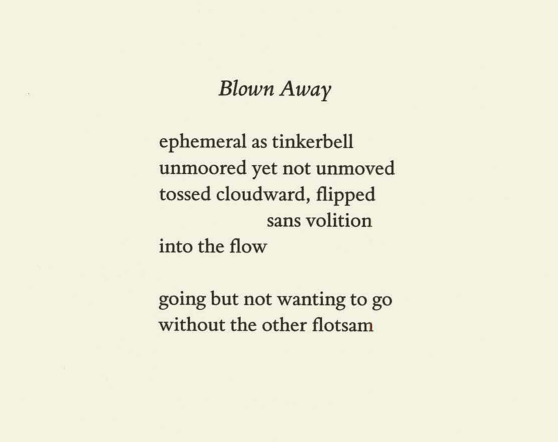
“Blown Away” — Tom Clark

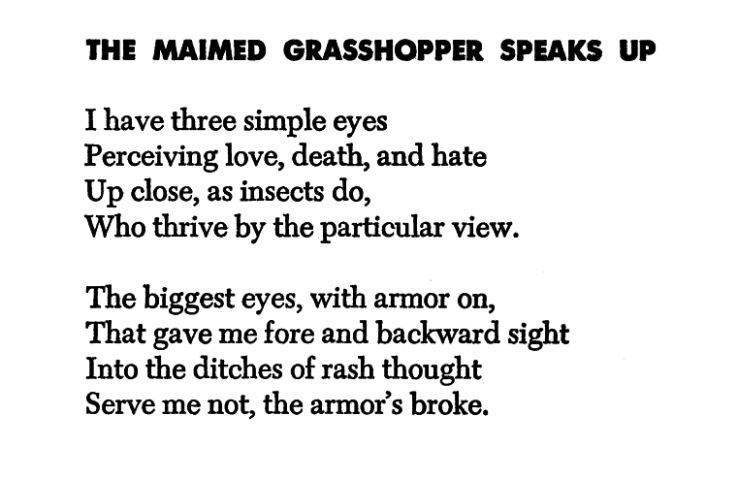
“The Maimed Grasshopper Speaks Up” — Jean Garrigue

“One Train May Hide Another” — Kenneth Koch

“One Train May Hide Another”

by Kenneth Koch


(sign at a railroad crossing in Kenya)

In a poem, one line may hide another line,
As at a crossing, one train may hide another train.
That is, if you are waiting to cross
The tracks, wait to do it for one moment at
Least after the first train is gone. And so when you read
Wait until you have read the next line—
Then it is safe to go on reading.
In a family one sister may conceal another,
So, when you are courting, it’s best to have them all in view
Otherwise in coming to find one you may love another.
One father or one brother may hide the man,
If you are a woman, whom you have been waiting to love.
So always standing in front of something the other
As words stand in front of objects, feelings, and ideas.
One wish may hide another. And one person’s reputation may hide
The reputation of another. One dog may conceal another
On a lawn, so if you escape the first one you’re not necessarily safe;
One lilac may hide another and then a lot of lilacs and on the Appia Antica
     one tomb
May hide a number of other tombs. In love, one reproach may hide
     another,
One small complaint may hide a great one.
One injustice may hide another—one colonial may hide another,
One blaring red uniform another, and another, a whole column. One bath
    may hide another bath
As when, after bathing, one walks out into the rain.
One idea may hide another: Life is simple
Hide Life is incredibly complex, as in the prose of Gertrude Stein
One sentence hides another and is another as well. And in the laboratory
One invention may hide another invention,
One evening may hide another, one shadow, a nest of shadows.
One dark red, or one blue, or one purple—this is a painting
By someone after Matisse. One waits at the tracks until they pass,
These hidden doubles or, sometimes, likenesses. One identical twin
May hide the other. And there may be even more in there! The
     obstetrician
Gazes at the Valley of the Var. We used to live there, my wife and I, but
One life hid another life. And now she is gone and I am here.
A vivacious mother hides a gawky daughter. The daughter hides
Her own vivacious daughter in turn. They are in
A railway station and the daughter is holding a bag
Bigger than her mother’s bag and successfully hides it.
In offering to pick up the daughter’s bag one finds oneself confronted by
     the mother’s
And has to carry that one, too. So one hitchhiker
May deliberately hide another and one cup of coffee
Another, too, until one is over-excited. One love may hide another love or
     the same love
As when “I love you” suddenly rings false and one discovers
The better love fingering behind, as when “I’m full of doubts”
Hides “I’m certain about something and it is that”
And one dream may hide another as is well known, always, too. In the
     Garden of Eden
Adam and Eve may hide the real Adam and Eve.
Jerusalem may hide another Jerusalem.
When you come to something, stop to let it pass
So you can see what else is there. At home, no matter where,
Internal tracks pose dangers, too: one memory
Certainly hides another, that being what memory is all about,
The eternal reverse succession of contemplated entities. Reading A
     Sentimental Journey look around
When you have finished, for Tristram Shandy, to see
If it is standing there, it should be, stronger
And more profound and theretofore hidden as Santa Maria Maggiore
May be hidden by similar churches inside Rome. One sidewalk
May hide another, as when you’re asleep there, and
One song hide another song; a pounding upstairs
Hide the beating of drums. One friend may hide another, you sit at the
     foot of a tree
With one and when you get up to leave there is another
Whom you’d have preferred to talk to all along. One teacher,
One doctor, one ecstasy, one illness, one woman, one man
May hide another. Pause to let the first one pass.
You think, Now it is safe to cross and you are hit by the next one. It can be
     important
To have waited at least a moment to see what was already there.
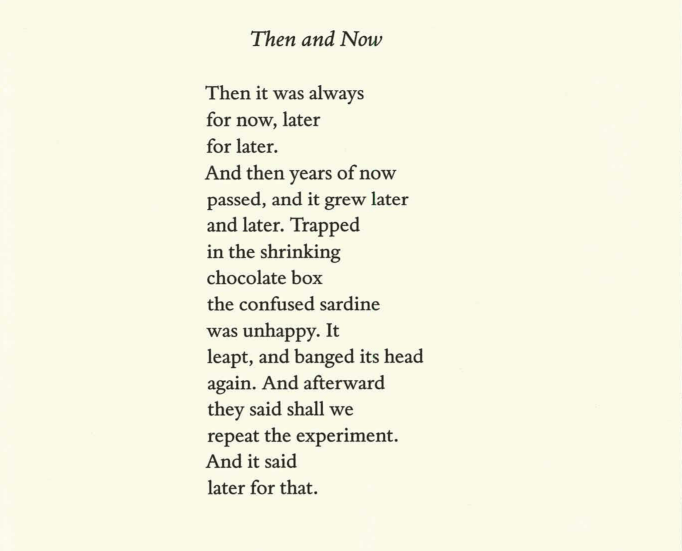
“Then and Now” — Tom Clark

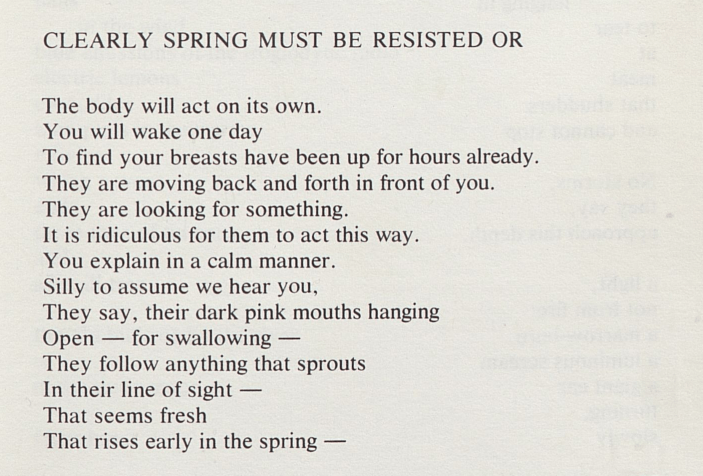
“Clearly Spring Must Be Resisted Or” — Elena Wilkinson

“The Unruly Child” — Bob Perelman

“The Unruly Child”

by

Bob Perelman


There is a company called Marathon Oil, mother,
Very far away and very big and, again, very
Desirable. Who isn’t? Back connecting pure dots,
Fleecy intelligence lapped in explanatory sound
The faces make difficult.
Learn the language.
That beautiful tongue-in-cheek hostage situation:
My mind, up close, in pjs, and I use it.
Wanting to fuck an abstraction nine times in a row,
Continuous melismata, don’t stop, don’t stop, no name, no picture.
There is a series of solids, mother,
Called people, who rise to the transparent obtainable
Solo windows, mornings, afternoons,
And there are military operations called
Operation Patio, Operation Menu.
It is the individuals who finally get the feel of the tenses.
So that it may snow, has to snow on the muddy corpse.
There is a boundary, mother, very far away and very
Continuous, broken, to interrogate civilians, the self,
The text, networks of viewers found wanting a new way
To cook chicken, why not?, to kill while falling asleep.
There is the one language not called money, and the other not called explosions.

“There was upon the sill a pencil mark” — Edna St. Vincent Millay

“There was upon the sill a pencil mark”

by

Edna St. Vincent Millay


There was upon the sill a pencil mark,
Vital with shadow when the sun stood still
At noon, but now, because the day was dark,
It was a pencil mark upon the sill.
And the mute clock, maintaining ever the same
Dead moment, blank and vacant of itself,
Was a pink shepherdess, a picture frame,
A shell marked Souvenir, there on the shelf.
Whence it occurred to her that he might be,
The mainspring being broken in his mind,
A clock himself, if one were so inclined,
That stood at twenty minutes after three -
The reason being for this, it might be said,
That things in death were neither clocks nor people, 
    but only dead.

There is no universal Poetry | Adrienne Rich

I hope never to idealize poetry—it has suffered enough from that. Poetry is not a healing lotion, an emotional massage, a kind of linguistic aromatherapy. Neither is it a blueprint, nor an instruction manual, nor a billboard. There is no universal Poetry anyway, only poetries and poetics, and the streaming, intertwining histories to which they belong. There is room, indeed necessity, for both Neruda and César Vallejo, for Pier Paolo Pasolini and Alfonsina Storni, for Audre Lorde and Aimé Césaire, for both Ezra Pound and Nelly Sachs. Poetries are no more pure and simple than human histories are pure and simple. Poetry, like silk or coffee or oil or human flesh, has had its trade routes. And there are colonized poetics and resilient poetics, transmissions across frontiers not easily traced.

From Adrienne Rich’s Plenary Lecture at the Conference on Poetry and Politics, University of Stirling, Scotland, 13 July 2006. Collected in Essential Essays.

“Before I got my eye put out” — Emily Dickinson

“Before I got my eye put out”

by

Emily Dickinson


Before I got my eye put out –
I liked as well to see
As other creatures, that have eyes –
And know no other way –
But were it told to me, Today,
That I might have the Sky
For mine, I tell you that my Heart
Would split, for size of me –
The Meadows – mine –
The Mountains – mine –
All Forests – Stintless stars –
As much of noon, as I could take –
Between my finite eyes –
The Motions of the Dipping Birds –
The Morning’s Amber Road –
For mine – to look at when I liked,
The news would strike me dead –
So safer – guess – with just my soul
Opon the window pane
Where other creatures put their eyes –
Incautious – of the Sun –

“Here” — Grace Paley

“Hazard Response” — Tom Clark

“Hazard Response”

by

Tom Clark


As in that grey exurban wasteland in Gatsby
When the white sky darkens over the city
Of ashes, far from the once happy valley,
This daze spreads across the blank faces
Of the inhabitants, suddenly deprived
Of the kingdom’s original promised gift.
Did I say kingdom when I meant place
Of worship? Original when I meant
Damaged in handling? Promised when
I meant stolen? Gift when I meant
Trick? Inhabitants when I meant slaves?
Slaves when I meant clowns
Who have wandered into test sites? Test
Sites when I meant contagious hospitals?
Contagious hospitals when I meant clouds
Of laughing gas? Laughing gas
When I meant tears? No, it’s true,
No one should be writing poetry
In times like these, Dear Reader,
I don’t have to tell you of all people why.
It’s as apparent as an attempted
Punch in the eye that actually
Catches only empty air—which is
The inside of your head, where
The green ritual sanction
Of the poem has been cancelled.

“There Was a Jar in Oregon” — Ursula K. Le Guin

“Nodding” — Tom Clark

“One day is there of the series / Termed Thanksgiving day” — Emily Dickinson

ED

“Goblin Market” — Christina Rossetti

“Goblin Market”

by

Christina Rossetti


Morning and evening
Maids heard the goblins cry:
“Come buy our orchard fruits,
Come buy, come buy:
Apples and quinces,
Lemons and oranges,
Plump unpeck’d cherries,
Melons and raspberries,
Bloom-down-cheek’d peaches,
Swart-headed mulberries,
Wild free-born cranberries,
Crab-apples, dewberries,
Pine-apples, blackberries,
Apricots, strawberries;—
All ripe together
In summer weather,—
Morns that pass by,
Fair eves that fly;
Come buy, come buy:
Our grapes fresh from the vine,
Pomegranates full and fine,
Dates and sharp bullaces,
Rare pears and greengages,
Damsons and bilberries,
Taste them and try:
Currants and gooseberries,
Bright-fire-like barberries,
Figs to fill your mouth,
Citrons from the South,
Sweet to tongue and sound to eye;
Come buy, come buy.”

Evening by evening
Among the brookside rushes,
Laura bow’d her head to hear,
Lizzie veil’d her blushes:
Crouching close together
In the cooling weather,
With clasping arms and cautioning lips,
With tingling cheeks and finger tips.
“Lie close,” Laura said,
Pricking up her golden head:
“We must not look at goblin men,
We must not buy their fruits:
Who knows upon what soil they fed
Their hungry thirsty roots?”
“Come buy,” call the goblins
Hobbling down the glen. Continue reading ““Goblin Market” — Christina Rossetti”

Hell talkt my brain awake (“Dream Song #30,” John Berryman)

img_1807