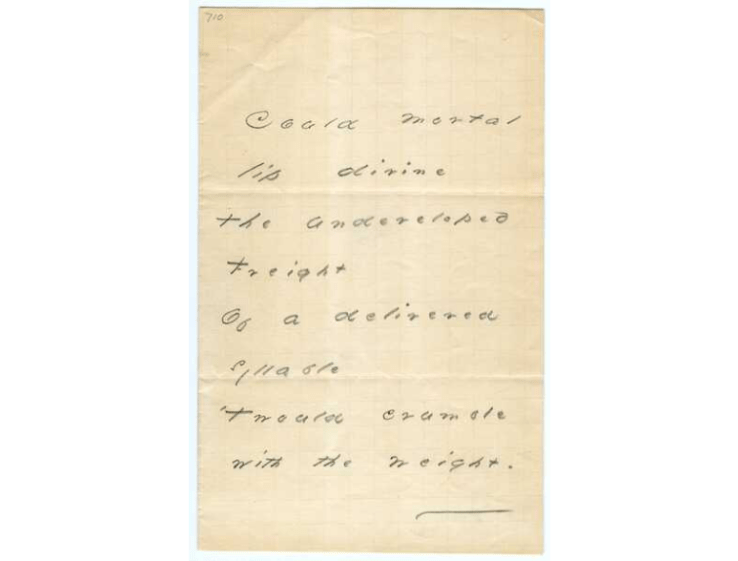
Could mortal lip divine
The undeveloped freight
Of a delivered syllable,
‘T would crumble with the weight.
Emily Dickinson

Could mortal lip divine
The undeveloped freight
Of a delivered syllable,
‘T would crumble with the weight.
Emily Dickinson
“Florida Road Workers”
by
Langston Hughes
Hey, Buddy!
Look at me!
I’m makin’ a road
For the cars to fly by on,
Makin’ a road
Through the palmetto thicket
For light and civilization
To travel on.
I’m makin’ a road
For the rich to sweep over
In their big cars
And leave me standin’ here.
Sure,
A road helps everybody.
Rich folks ride —
And I get to see ’em ride.
I ain’t never seen nobody
Ride so fine before.
Hey, Buddy, look!
I’m makin’ a road!

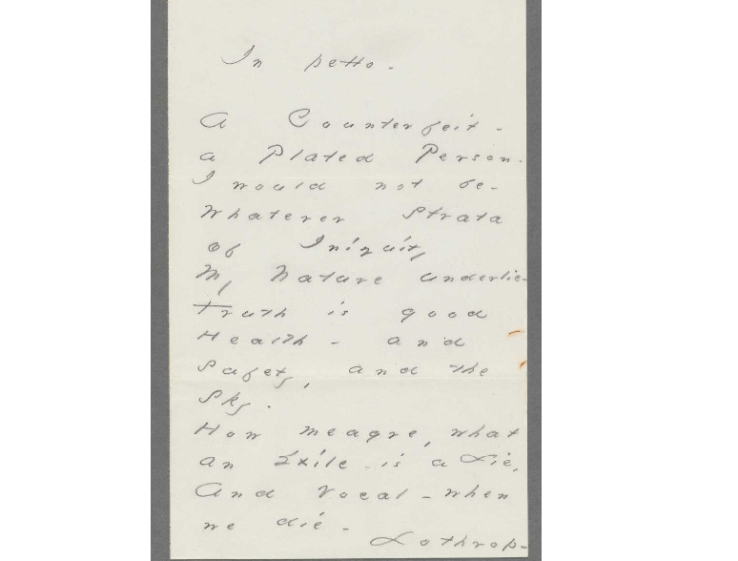
A Counterfeit — a Plated Person —
I would not be —
Whatever strata of Iniquity
My Nature underlie —
Truth is good Health — and Safety, and the Sky.
How meagre, what an Exile — is a Lie,
And Vocal — when we die —
Emily Dickinson
If the fable of “The grasshopper and the ants” was amended so that the world ended before the turn of winter, then the grasshopper would have been wiser and the moral would have vindicated him. In a story, the location of the ending is very deliberate.
From David Berman’s December 1994 essay/poem/riff “Clip-On Tie,” which could be read as a Christmas story, if you like.

“Bread”
by
Sharon Olds
When my daughter makes bread, a cloud of flour
hangs in the air like pollen. She sifts and
sifts again, the salt and sugar
close as the grain of her skin. She heats the
water to body temperature
with the sausage lard, fragrant as her scalp
the day before hair-wash, and works them together on a
floured board. Her broad palms
bend the paste toward her and the heel of her hand
presses it away, until the dough
begins to snap, glossy and elastic as the torso bending over it,
this ten-year-old girl, random specks of yeast
in her flesh beginning to heat,
her volume doubling every month now, but still
raw and hard. She slaps the dough and it crackles under her palm, sleek and
ferocious and still leashed, like her body, no
breasts rising like bubbles of air toward the surface
of the loaf. She greases the pan, she is
shaped, glazed, and at any moment goes
into the oven, to turn to that porous
warm substance, and then under the
knife to be sliced for the having, the tasting, and the
giving of life.

“One Train May Hide Another”
by Kenneth Koch
(sign at a railroad crossing in Kenya)

“The Unruly Child”
by
Bob Perelman
“There was upon the sill a pencil mark”
by
Edna St. Vincent Millay
There was upon the sill a pencil mark,
Vital with shadow when the sun stood still
At noon, but now, because the day was dark,
It was a pencil mark upon the sill.
And the mute clock, maintaining ever the same
Dead moment, blank and vacant of itself,
Was a pink shepherdess, a picture frame,
A shell marked Souvenir, there on the shelf.
Whence it occurred to her that he might be,
The mainspring being broken in his mind,
A clock himself, if one were so inclined,
That stood at twenty minutes after three -
The reason being for this, it might be said,
That things in death were neither clocks nor people,
but only dead.
I hope never to idealize poetry—it has suffered enough from that. Poetry is not a healing lotion, an emotional massage, a kind of linguistic aromatherapy. Neither is it a blueprint, nor an instruction manual, nor a billboard. There is no universal Poetry anyway, only poetries and poetics, and the streaming, intertwining histories to which they belong. There is room, indeed necessity, for both Neruda and César Vallejo, for Pier Paolo Pasolini and Alfonsina Storni, for Audre Lorde and Aimé Césaire, for both Ezra Pound and Nelly Sachs. Poetries are no more pure and simple than human histories are pure and simple. Poetry, like silk or coffee or oil or human flesh, has had its trade routes. And there are colonized poetics and resilient poetics, transmissions across frontiers not easily traced.
From Adrienne Rich’s Plenary Lecture at the Conference on Poetry and Politics, University of Stirling, Scotland, 13 July 2006. Collected in Essential Essays.
“Before I got my eye put out”
by
Emily Dickinson