“The Dictionary of the Wolf” — Melvin B. Tolson

“The Dictionary of the Wolf”

by

Melvin B. Tolson


“We all declare for liberty,” Lincoln said.
“We use the word and mean all sorts of things:
In the sweat of thy face shalt thou eat bread.
Rifle the basket that thy neighbor brings.”

The grizzled axman squinted at Honest Abe,
The six feet four of him, gaunt, sad of face,
The hands to split a log or cradle a babe,
The cracked palm hat, the homespun of his race.

“The wolf tears at the sheep’s throat: and the sheep
Extols the shepherd for cudgeling tyranny;
The wolf, convulsed with indignation deep,
Accuses the shepherd of murdering liberty.

“But the dictionary of the wolf is writ
In words the rats of time chew bit by bit.”

Karintha — James Puryear

Karintha, from the portfolio Cane, 2000 by James Puryear (b. 1941)


“Karintha”

by

Jean Toomer

from Cane


Her skin is like dusk on the eastern horizon,

O can’t you see it,

O can’t you see it,

Her skin is like dusk on the eastern horizon

. . . When the sun goes down.

Men had always wanted her, this Karintha, even as a child, Karintha carrying beauty, perfect as dusk when the sun goes down. Old men rode her hobby-horse upon their knees. Young men danced with her at frolics when they should have been dancing with their grown-up girls. God grant us youth, secretly prayed the old men. The younger fellows counted the time to pass before she would be old enough to mate with them. This interest of the male, that wishes to ripen a growing thing too soon, could mean no good to her. Continue reading “Karintha — James Puryear”

“Lovers of the Poor ” — Gwendolyn Brooks

“The Lovers of the Poor”
by
Gwendolyn Brooks

arrive. The Ladies from the Ladies’ Betterment League
Arrive in the afternoon, the late light slanting
In diluted gold bars across the boulevard brag
Of proud, seamed faces with mercy and murder hinting
Here, there, interrupting, all deep and debonair,
The pink paint on the innocence of fear;
Walk in a gingerly manner up the hall.
Cutting with knives served by their softest care,
Served by their love, so barbarously fair.
Whose mothers taught: You’d better not be cruel!
You had better not throw stones upon the wrens!
Herein they kiss and coddle and assault
Anew and dearly in the innocence
With which they baffle nature. Who are full,
Sleek, tender-clad, fit, fiftyish, a-glow, all
Sweetly abortive, hinting at fat fruit,
Judge it high time that fiftyish fingers felt
Beneath the lovelier planes of enterprise.
To resurrect. To moisten with milky chill.
To be a random hitching-post or plush.
To be, for wet eyes, random and handy hem.
                        Their guild is giving money to the poor.
The worthy poor. The very very worthy
And beautiful poor. Perhaps just not too swarthy?
perhaps just not too dirty nor too dim
Nor—passionate. In truth, what they could wish
Is—something less than derelict or dull.
Not staunch enough to stab, though, gaze for gaze!
God shield them sharply from the beggar-bold!
The noxious needy ones whose battle’s bald
Nonetheless for being voiceless, hits one down.
                        But it’s all so bad! and entirely too much for them.
The stench; the urine, cabbage, and dead beans,
Dead porridges of assorted dusty grains,
The old smoke, heavy diapers, and, they’re told,
Something called chitterlings. The darkness. Drawn
Darkness, or dirty light. The soil that stirs.
The soil that looks the soil of centuries.
And for that matter the general oldness. Old
Wood. Old marble. Old tile. Old old old.
Not homekind Oldness! Not Lake Forest, Glencoe.
Nothing is sturdy, nothing is majestic,
There is no quiet drama, no rubbed glaze, no
Unkillable infirmity of such
A tasteful turn as lately they have left,
Glencoe, Lake Forest, and to which their cars
Must presently restore them. When they’re done
With dullards and distortions of this fistic
Patience of the poor and put-upon.
                        They’ve never seen such a make-do-ness as
Newspaper rugs before! In this, this “flat,”
Their hostess is gathering up the oozed, the rich
Rugs of the morning (tattered! the bespattered. . . .)
Readies to spread clean rugs for afternoon.
Here is a scene for you. The Ladies look,
In horror, behind a substantial citizeness
Whose trains clank out across her swollen heart.
Who, arms akimbo, almost fills a door.
All tumbling children, quilts dragged to the floor
And tortured thereover, potato peelings, soft-
Eyed kitten, hunched-up, haggard, to-be-hurt.
                        Their League is allotting largesse to the Lost.
But to put their clean, their pretty money, to put
Their money collected from delicate rose-fingers
Tipped with their hundred flawless rose-nails seems . . .
                        They own Spode, Lowestoft, candelabra,
Mantels, and hostess gowns, and sunburst clocks,
Turtle soup, Chippendale, red satin “hangings,”
Aubussons and Hattie Carnegie. They Winter
In Palm Beach; cross the Water in June; attend,
When suitable, the nice Art Institute;
Buy the right books in the best bindings; saunter
On Michigan, Easter mornings, in sun or wind.
Oh Squalor! This sick four-story hulk, this fibre
With fissures everywhere! Why, what are bringings
Of loathe-love largesse? What shall peril hungers
So old old, what shall flatter the desolate?
Tin can, blocked fire escape and chitterling
And swaggering seeking youth and the puzzled wreckage
Of the middle passage, and urine and stale shames
And, again, the porridges of the underslung
And children children children. Heavens! That
Was a rat, surely, off there, in the shadows? Long
And long-tailed? Gray? The Ladies from the Ladies’
Betterment League agree it will be better
To achieve the outer air that rights and steadies,
To hie to a house that does not holler, to ring
Bells elsetime, better presently to cater
To no more Possibilities, to get
Away. Perhaps the money can be posted.
Perhaps they two may choose another Slum!
Some serious sooty half-unhappy home!—
Where loathe-love likelier may be invested.
                        Keeping their scented bodies in the center
Of the hall as they walk down the hysterical hall,
They allow their lovely skirts to graze no wall,
Are off at what they manage of a canter,
And, resuming all the clues of what they were,
Try to avoid inhaling the laden air.

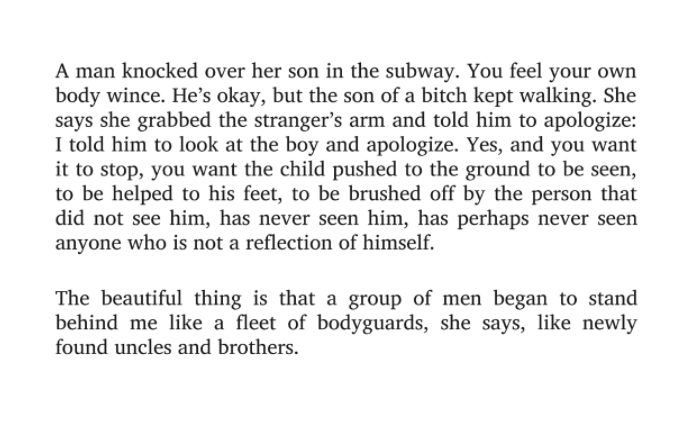
“Conversation Overheard in a Graveyard” — Lucille Clifton

“Unsuspecting” — Jean Toomer

“Winter Moon” — Langston Hughes

Fundamentals of Esperanto — Srikanth Reddy

“Fundamentals of Esperanto”

by

Srikanth Reddy


The grammatical rules of this language can be learned in one
sitting.

Nouns have no gender & end in -o; the plural terminates in -oj
(pronounced -oy) & the accusative, -on (plural 0ojn).

Amiko, friend; amikoj, friends; amikon & amikojn, accusative
friend & friends.

Adjectives end in –a & take plural & accusative endings to
agree with things.

Ma amiko is my friend.

All verbs are regular & have only one form for each tense or
mood; they are not altered for person or number. Mi havas
bonajn amikojn is simply to say I have good friends.

Adverbs end in –e.

La bonaj amiko estas ie. The good friend is here.

A new book appears in Esperanto every week. Radio stations in
Europe, the United States, China, Russia & Brazil broadcast in
Esperanto, as does Vatican Radio. In 1959, UNESCO declared the
International Federation of Esperanto Speakers to be in accord with
its mission & granted this body consultative status. The youth
branch of the International Federation of Esperanto Speakers, UTA,
has offices in 80 different countries & organizes social events where
young people curious about the movement may dance to recordings
by Esperanto artists, enjoy complimentary soft drinks & take home
Esperanto versions of major literary works including the Old
Testament & A Midsummer Night’s Dream. William Shatner’s first
feature-length vehicle was a horror film shot entirely in Esperanto.
Esperanto is among the languages currently sailing into deep space
on board the Voyager spacecraft.

Esperanto is an artificial language
constructed in 1887 by L.
L. Zamenhof, a polish
oculist. I first came
across Fundamento Esperanto, the text
which introduced this system
to the world, as I travelled abroad

following a somewhat difficult period
in my life. It was twilight & snowing on the
railway platform just outside
Warsaw where I had missed
my connection. A man in a crumpled track suit
& dark glasses pushed a cart
piled high with ripped & weathered volumes—

sex manuals, detective stories, yellowing
musical scores & outdated physics textbooks,
old copies of Life, new smut,
an atlas translated,
a grammar, The Mirror, Soviet-bloc comics,
a guide to the rivers &
mountains, thesauri, inscrutable

musical scores & mimeographed physics books,
defective stories, obsolete sex manuals—
one of which caught my notice
(Dr. Esperanto,
Zamenhof’s pen name, translates as He Who Hopes) &
since I had time, I traded
my used Leaves of Grass for a copy.

Mi amas vin, bela amiko.
I’m afraid I will never be lonely enough.
There’s a man from Quebec in my head,

a friend to the purple martins.
Purple martins are the Cadillac of swallows.
All purple martins are dying or dead.
Brainscans of grown purple martins suggest
these creatures feel the same levels of doubt

& bliss as an eight-year-old girl in captivity.
While driving home from the brewery
one night this man from Quebec heard a radio program
about purple martins & the next day he set out
to build them a house
in his own back yard. I’ve never built anything,
let alone a house,

not to mention a home
for somebody else.

I’ve never unrolled a blueprint onto a workbench,
sunk a post,
or sent the neighbor’s kid pedalling off
to the store for a bag full of nails.

I’ve never waited ten years for a swallow.

Never put in aluminum floors to smooth over the waiting.
Never piped sugar water through colored tubes
to each empty nest lined with newspaper shredded
with strong, tired hands.
Never dismantled the entire affair

& put it back together again.
Still no swallows.
I never installed the big light that stays on through the night

to keep owls away. Never installed lesser lights,
never rested on Sunday

with a beer on the deck surveying
what I had done
& what yet remained to be done, listening to Styx

while the neighbor kids ran through my sprinklers.
I have never collapsed in abandon.
Never prayed.
But enough about purple martins.

As we speak, Esperanto is being corrupted
by upset languages such as Interlingua,
Klingon, Java & various cryptophasic tongues.

Our only hope of reversing this trend is to write
the Esperanto epic. Through its grandeur
& homegrown humility, it will spur men

to freeze the mutating patios so the children
of our children’s children may dwell in this song
& find comfort in its true texture & frame.

It’s worth a try. As I imagine it, it ends
in the middle of things. Every line of the work
is a first & a last line & this is the spring

of its action. Of course, there’s a journey
& inside that journey, an implicit voyage
through the underworld. There’s a bridge

made of boats; a carp stuffed with flowers;
a comic dispute among sweetmeat vendors;
a digression on shadows; men clapping

in fields to scare away crows; an unending list
of warships: The Unternehmen, The Impresa,
The Muyarchi, Viec Lam, The Przedsiebiorstwo,

The Indarka, The Enterprise, L’Entreprise,
Entrepeno… One could go on. But by now,
all the characters have turned into swallows

& bank as one flock in the sky—that is,
all except one. That’s how we finally learn
who the hero was all along. Weary & old,

he sits on a rock & watches his friends
fly by one by one out of the song,
then turns back to the journey they all began

long ago, keeping the river to his right.

“The Preacher’s Daughter” — Victoria Kennefick


“The Preacher’s Daughter”

by

Victoria Kennefick


We drink too much pineapple rum, straight from the bottle,
bitch about the red-haired girl, the fetish model,
a preacher’s daughter with a thing for unreasonable shoes.

From her faded patchwork quilt, bleeding
hearts, we watched her mutate into a PVC Alice Liddell.
How did she manage in seven-inch patent heels?

She was tall as wheat — or the ceiling was low.
Cradling a mewing ginger-ball, she kissed the mirror
where their confederate-blue eyes

matched. Three scars began to scab on her arm,
deep big-cat scrawls she told us she cut herself
because it’s art and her clients like her

that way. We followed her clip-clop down
the rabbit hole; me, to hear tales of her running track
in those shoes; you, to see her white skin even paler

under lights. Back in your dorm room, I am static.
You pay to watch her pixelated Snow White online;
complain her constant chatter ruined it, or her, for you.

“wishes for sons” — Lucille Clifton

“wishes for sons”

by

Lucille Clifton


i wish them cramps.
i wish them a strange town
and the last tampon.
i wish them no 7-11.

i wish them one week early
and wearing a white skirt.
i wish them one week late.

later i wish them hot flashes
and clots like you
wouldn’t believe. let the
flashes come when they
meet someone special.
let the clots come
when they want to.

let them think they have accepted
arrogance in the universe,
then bring them to gynecologists
not unlike themselves.

“Two Guys Get out of a Car” — Richard Brautigan

“Seven Stages of Man” — Diane Kruchkow

Police cannot suppress | Emily Dickinson

“The Mob within the Heart”

by

Emily Dickinson


The mob within the heart
Police cannot suppress
The riot given at the first
Is authorized as peace

Uncertified of scene
Or signified of sound
But growing like a hurricane
In a congenial ground.

“Square” — A.R. Ammons

“Ode to Failure” — Allen Ginsberg

“The Answer” — Jim Carroll

“Snakes” — Tom Clark

“Sugar” — Gertrude Stein

“Sugar”

by

Gertrude Stein


A violent luck and a whole sample and even then quiet.

Water is squeezing, water is almost squeezing on lard. Water, water is a mountain and it is selected and it is so practical that there is no use in money. A mind under is exact and so it is necessary to have a mouth and eye glasses.

A question of sudden rises and more time than awfulness is so easy and shady. There is precisely that noise.

A peck a small piece not privately overseen, not at all not a slice, not at all crestfallen and open, not at all mounting and chaining and evenly surpassing, all the bidding comes to tea.

A separation is not tightly in worsted and sauce, it is so kept well and sectionally.

Put it in the stew, put it to shame. A little slight shadow and a solid fine furnace.

The teasing is tender and trying and thoughtful.

The line which sets sprinkling to be a remedy is beside the best cold.

A puzzle, a monster puzzle, a heavy choking, a neglected Tuesday.

Wet crossing and a likeness, any likeness, a likeness has blisters, it has that and teeth, it has the staggering blindly and a little green, any little green is ordinary.

One, two and one, two, nine, second and five and that.

A blaze, a search in between, a cow, only any wet place, only this tune.

Cut a gas jet uglier and then pierce pierce in between the next and negligence. Choose the rate to pay and pet pet very much. A collection of all around, a signal poison, a lack of languor and more hurts at ease.

A white bird, a colored mine, a mixed orange, a dog.

Cuddling comes in continuing a change.

A piece of separate outstanding rushing is so blind with open delicacy.

A canoe is orderly. A period is solemn. A cow is accepted.

A nice old chain is widening, it is absent, it is laid by.