“Conversation Overheard in a Graveyard” — Lucille Clifton

“Unsuspecting” — Jean Toomer

“Winter Moon” — Langston Hughes

Fundamentals of Esperanto — Srikanth Reddy

“Fundamentals of Esperanto”

by

Srikanth Reddy


The grammatical rules of this language can be learned in one
sitting.

Nouns have no gender & end in -o; the plural terminates in -oj
(pronounced -oy) & the accusative, -on (plural 0ojn).

Amiko, friend; amikoj, friends; amikon & amikojn, accusative
friend & friends.

Adjectives end in –a & take plural & accusative endings to
agree with things.

Ma amiko is my friend.

All verbs are regular & have only one form for each tense or
mood; they are not altered for person or number. Mi havas
bonajn amikojn is simply to say I have good friends.

Adverbs end in –e.

La bonaj amiko estas ie. The good friend is here.

–

A new book appears in Esperanto every week. Radio stations in
Europe, the United States, China, Russia & Brazil broadcast in
Esperanto, as does Vatican Radio. In 1959, UNESCO declared the
International Federation of Esperanto Speakers to be in accord with
its mission & granted this body consultative status. The youth
branch of the International Federation of Esperanto Speakers, UTA,
has offices in 80 different countries & organizes social events where
young people curious about the movement may dance to recordings
by Esperanto artists, enjoy complimentary soft drinks & take home
Esperanto versions of major literary works including the Old
Testament & A Midsummer Night’s Dream. William Shatner’s first
feature-length vehicle was a horror film shot entirely in Esperanto.
Esperanto is among the languages currently sailing into deep space
on board the Voyager spacecraft.

–

Esperanto is an artificial language
constructed in 1887 by L.
L. Zamenhof, a polish
oculist. I first came
across Fundamento Esperanto, the text
which introduced this system
to the world, as I travelled abroad

following a somewhat difficult period
in my life. It was twilight & snowing on the
railway platform just outside
Warsaw where I had missed
my connection. A man in a crumpled track suit
& dark glasses pushed a cart
piled high with ripped & weathered volumes—

sex manuals, detective stories, yellowing
musical scores & outdated physics textbooks,
old copies of Life, new smut,
an atlas translated,
a grammar, The Mirror, Soviet-bloc comics,
a guide to the rivers &
mountains, thesauri, inscrutable

musical scores & mimeographed physics books,
defective stories, obsolete sex manuals—
one of which caught my notice
(Dr. Esperanto,
Zamenhof’s pen name, translates as He Who Hopes) &
since I had time, I traded
my used Leaves of Grass for a copy.

–

Mi amas vin, bela amiko.
I’m afraid I will never be lonely enough.
There’s a man from Quebec in my head,

a friend to the purple martins.
Purple martins are the Cadillac of swallows.
All purple martins are dying or dead.
Brainscans of grown purple martins suggest
these creatures feel the same levels of doubt

& bliss as an eight-year-old girl in captivity.
While driving home from the brewery
one night this man from Quebec heard a radio program
about purple martins & the next day he set out
to build them a house
in his own back yard. I’ve never built anything,
let alone a house,

not to mention a home
for somebody else.

I’ve never unrolled a blueprint onto a workbench,
sunk a post,
or sent the neighbor’s kid pedalling off
to the store for a bag full of nails.

I’ve never waited ten years for a swallow.

Never put in aluminum floors to smooth over the waiting.
Never piped sugar water through colored tubes
to each empty nest lined with newspaper shredded
with strong, tired hands.
Never dismantled the entire affair

& put it back together again.
Still no swallows.
I never installed the big light that stays on through the night

to keep owls away. Never installed lesser lights,
never rested on Sunday

with a beer on the deck surveying
what I had done
& what yet remained to be done, listening to Styx

while the neighbor kids ran through my sprinklers.
I have never collapsed in abandon.
Never prayed.
But enough about purple martins.

–

As we speak, Esperanto is being corrupted
by upset languages such as Interlingua,
Klingon, Java & various cryptophasic tongues.

Our only hope of reversing this trend is to write
the Esperanto epic. Through its grandeur
& homegrown humility, it will spur men

to freeze the mutating patios so the children
of our children’s children may dwell in this song
& find comfort in its true texture & frame.

It’s worth a try. As I imagine it, it ends
in the middle of things. Every line of the work
is a first & a last line & this is the spring

of its action. Of course, there’s a journey
& inside that journey, an implicit voyage
through the underworld. There’s a bridge

made of boats; a carp stuffed with flowers;
a comic dispute among sweetmeat vendors;
a digression on shadows; men clapping

in fields to scare away crows; an unending list
of warships: The Unternehmen, The Impresa,
The Muyarchi, Viec Lam, The Przedsiebiorstwo,

The Indarka, The Enterprise, L’Entreprise,
Entrepeno… One could go on. But by now,
all the characters have turned into swallows

& bank as one flock in the sky—that is,
all except one. That’s how we finally learn
who the hero was all along. Weary & old,

he sits on a rock & watches his friends
fly by one by one out of the song,
then turns back to the journey they all began

long ago, keeping the river to his right.

“The Preacher’s Daughter” — Victoria Kennefick


“The Preacher’s Daughter”

by

Victoria Kennefick


We drink too much pineapple rum, straight from the bottle,
bitch about the red-haired girl, the fetish model,
a preacher’s daughter with a thing for unreasonable shoes.

From her faded patchwork quilt, bleeding
hearts, we watched her mutate into a PVC Alice Liddell.
How did she manage in seven-inch patent heels?

She was tall as wheat — or the ceiling was low.
Cradling a mewing ginger-ball, she kissed the mirror
where their confederate-blue eyes

matched. Three scars began to scab on her arm,
deep big-cat scrawls she told us she cut herself
because it’s art and her clients like her

that way. We followed her clip-clop down
the rabbit hole; me, to hear tales of her running track
in those shoes; you, to see her white skin even paler

under lights. Back in your dorm room, I am static.
You pay to watch her pixelated Snow White online;
complain her constant chatter ruined it, or her, for you.

“wishes for sons” — Lucille Clifton

“wishes for sons”

by

Lucille Clifton


i wish them cramps.
i wish them a strange town
and the last tampon.
i wish them no 7-11.

i wish them one week early
and wearing a white skirt.
i wish them one week late.

later i wish them hot flashes
and clots like you
wouldn’t believe. let the
flashes come when they
meet someone special.
let the clots come
when they want to.

let them think they have accepted
arrogance in the universe,
then bring them to gynecologists
not unlike themselves.

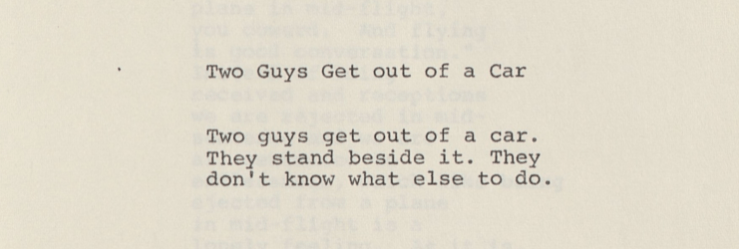
“Two Guys Get out of a Car” — Richard Brautigan

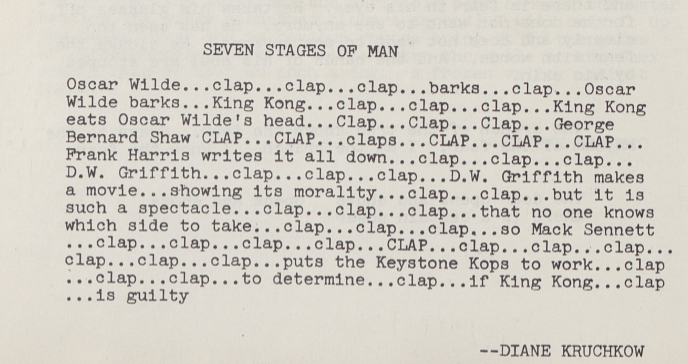
“Seven Stages of Man” — Diane Kruchkow

Police cannot suppress | Emily Dickinson

“The Mob within the Heart”

by

Emily Dickinson


The mob within the heart
Police cannot suppress
The riot given at the first
Is authorized as peace

Uncertified of scene
Or signified of sound
But growing like a hurricane
In a congenial ground.

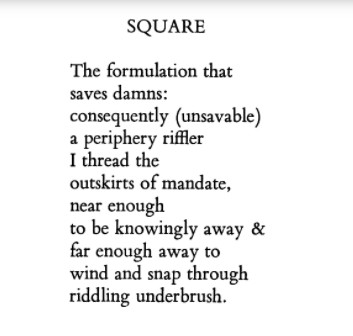
“Square” — A.R. Ammons

“Ode to Failure” — Allen Ginsberg

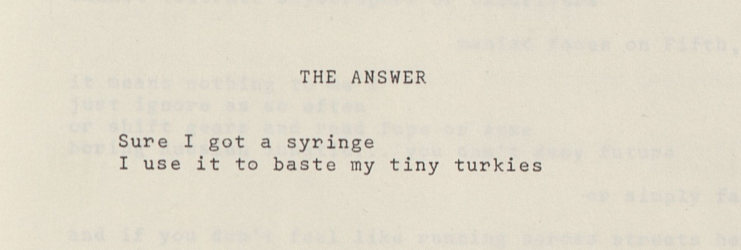
“The Answer” — Jim Carroll

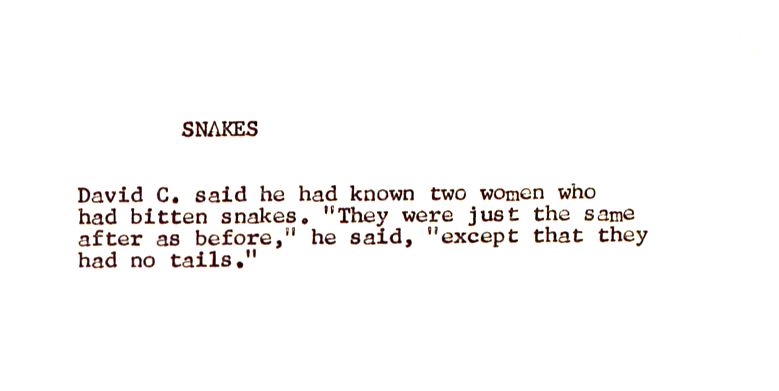
“Snakes” — Tom Clark

“Sugar” — Gertrude Stein

“Sugar”

by

Gertrude Stein


A violent luck and a whole sample and even then quiet.

Water is squeezing, water is almost squeezing on lard. Water, water is a mountain and it is selected and it is so practical that there is no use in money. A mind under is exact and so it is necessary to have a mouth and eye glasses.

A question of sudden rises and more time than awfulness is so easy and shady. There is precisely that noise.

A peck a small piece not privately overseen, not at all not a slice, not at all crestfallen and open, not at all mounting and chaining and evenly surpassing, all the bidding comes to tea.

A separation is not tightly in worsted and sauce, it is so kept well and sectionally.

Put it in the stew, put it to shame. A little slight shadow and a solid fine furnace.

The teasing is tender and trying and thoughtful.

The line which sets sprinkling to be a remedy is beside the best cold.

A puzzle, a monster puzzle, a heavy choking, a neglected Tuesday.

Wet crossing and a likeness, any likeness, a likeness has blisters, it has that and teeth, it has the staggering blindly and a little green, any little green is ordinary.

One, two and one, two, nine, second and five and that.

A blaze, a search in between, a cow, only any wet place, only this tune.

Cut a gas jet uglier and then pierce pierce in between the next and negligence. Choose the rate to pay and pet pet very much. A collection of all around, a signal poison, a lack of languor and more hurts at ease.

A white bird, a colored mine, a mixed orange, a dog.

Cuddling comes in continuing a change.

A piece of separate outstanding rushing is so blind with open delicacy.

A canoe is orderly. A period is solemn. A cow is accepted.

A nice old chain is widening, it is absent, it is laid by.

William Carlos Williams’ anecdote on meeting T.S. Eliot / by Allen Ginsberg / as told to Bockris-Wylie

W.C. Williams anecdote meeting T.S. Eliot

by

Allen Ginsberg

as told to Bockris-Wylie


Note: This isn’t an article deliberately written nor an interview untouched. It’s conversation transcribed, edited punctuated and condensed by interviewers. The words are mine but the style of transcription – timing, context, punctuation, tone – is mostly by Bockris–Wiley handiwork.

Allen Ginsberg

6 February 74

I never met Eliot, I just saw him reading at the Y once. Marianne Moore was in the audience and I remember him saying, “and now I have a request from somebody to read Dry Salvages, a request which is in command, coming from so distinguished a poet as Miss Moore, as it does.” Very elegant! And then he read some poems written thirty years before.

It was nice to hear him read them in person, but it was very diplomatic, he was too stiff, or much locked in a single image, it would have been interesting if he had had a little bit of Dali’s element of Surprise. I remember I told Robert Duncan when we (Orlovsky & Kerouac) were going to go and see Dali, and Duncan very sweetly said, “Please give him my respects, and say that he has always enchanted us as the genius of surprise.”

So it would have been interesting to see Eliot pulling out some element of surprise, like coming on the stage half–naked, wearing a grape fig haircut, or coming on dressed like a bishop or some kind of pope in drag, or in an 18th-century courtiers costume, or –improvising a poem right there on the stage. Something really astounding – would have been another Eliot.

Williams had a bony-nosed dislike of Eliot, characterized by Williams statement “Eliot was such a great genius he set American poetry back thirty years.”

What really pissed Williams off, Williams once told me, they met once, (and they’ve been rivals for the aesthetic affections of Pound) — and Williams said that Eliot was introduced to him: “Oh, Dr. Williams, how marvelous to meet you. I read many of your characters, you should write more of them. I do admire the characters you’ve done.” By characters he meant the old english form, it’s an outline of a person, a social picture sketch, character of the happy warrior, etc.

Williams said, “Why that son of a bitch! I’ve never heard . . . Completely patronizing!” I think Williams objection was that Eliot was trying to interpret Williams efforts in terms of English traditionalism — Eliot’s forms and formulas and terminalogic categories – rather than acknowledge the specific thing Williams was trying to do, which was to write something uncategorically American, raw eared and Rutherford-eyed

(That’s the only meeting they ever had apparently. And I don’t think it’s been recorded anywhere.)


This text was published in The World #29, April 1974. “Bockris-Wylie” refers to a writing partnership between Victor Brockis (whose Lou Reed biography is good trashy fun) and Andrew Wylie, who later became a powerful literary agent (I have gotten multiple takedown notices from the Wylie Agency in the past.

I have done my best to replicate the original typography of The World’s piece, including their complete disrespect of the possessive apostrophe.

“Oysters” — Anne Sexton

“Oysters”

by

Anne Sexton


Oysters we ate,
sweet blue babies,
twelve eyes looked up at me,
running with lemon and Tabasco.
I was afraid to eat this father-food
and Father laughed and
drank down his martini,
clear as tears.
It was a soft medicine
that came from the sea into my mouth,
moist and plump.
I swallowed.
It went down like a large pudding.
Then I ate one o’clock and two o’clock.
Then I laughed and then we laughed
and let me take note –
there was a death,
the death of childhood
there at the Union Oyster House
for I was fifteen
and eating oysters
and the child was defeated.
The woman won.

“Run the Red Lights” — Ed Skoog

“Run the Red Lights”

by

Ed Skoog

When my mother sent me for cigarettes
I’d buy a candy bar too, sign her name
to the book, and walk out with the green-
and-white carton, Virginia Slims 100s,
under my arm, the chocolate already gone.
Sugar, my god! like newspaper cartoon 
panels spread out on the kitchen table
where I’d pretend to smoke, imitating her.
After the corner store closed we made our groceries
at Dillon’s, joined the impersonal. A villain
snatched her purse there when I was away at college
and on the phone she told me, excitedly,
how Topeka police chased the culprit, and she named
each street, each intersection and landmark,
the whole adventure, just for her. 
I’m grateful now to the sedentary house
though I’ve grown as large on candy as John Candy. 
My older brothers left home and our meals stayed
the same, a skillet high with beef Stroganoff,
pot roast in broth, chili con carne,
cheese sandwiches with mayo, flocks of fried chicken. 
Then the whole house went on a diet of cold
tofu cubes, a broken disk of lemon in a water glass,
cottage cheese measured onto lettuce,
and then back to London broil the next night,
no questions asked—lovely. We were emotions
without form, and I carry it with me, 
not just in frame, arm and jowl and belly,
but here in the intergalactic space of written
thought, the infinite stage where we come
talk to each other. Sugar makes me curious.
After Katrina, I took the diet where you eat meat,
and lost almost a hundred pounds from a surfeit
of bacon, sautéed pork medallions, beef & lamb.
The weight fell away like a knight’s armor
after a joust. I bought shirts at a regular store.
I played softball and ran bases, bounded them,
as if on a new, more forgiving planet. And
I went crazy, evened out, broke down again,
inconsolable at the finale of Six Feet Under,
tears for my mother, postponed, and more
torrented for delay. Opening the book of grief
requires you read all the way to the end,
every time. Driving to work, I stopped
bewildered at a gas station, paid cash for two
Snickers providing more salvation
than I have ever known from religion’s acres.
I write about the West and the South and home,
their tenderness and trouble and the weird spirits
breaking the best days. Still I find myself down
by the river at twilight. On the bridge deliberate-
seeming people walk by like victorious aliens,
past the consequential palaces lit as before,
the faces turning in their rotisseries. 
In profile, my mother looked like Alex Chilton,
lead singer of the Box Tops, and then Big Star. 
I used to see Chilton around New Orleans, 
in line at the grocery store, walking down Esplanade.
My mother also had a solo career, playing
solitaire and watching her own TV in the kitchen
and dying before everyone else. Dying, Chilton
urged his wife to run the red lights, his last words,
and when I had to leave my mother in the hospital
that was hard, and then again at the funeral
I set a marble under her folded hands, 
don’t know why. It’s been ten years.
Ten fingers, the closed eye of each knuckle,
each nail its years’ fullest day moon.
Which shed the other? My scar from opening
a window, such force to move the wood frame,
so little to shatter glass it held. To be held so
again. Ten years, so forty seasons, eight endings
and beginnings, well, always a gust in them
which is the sigh of how she would note leaf and bird.
One hand to hold the coffee cup, one the cigarette. 
The red ember she became at midnight. Red light. Eye.