“Paul Delvaux: The Village of the Mermaids” — Lisel Mueller

“Paul Delvaux: The Village of the Mermaids”

by

Lisel Mueller


Who is that man in black, walking
away from us into the distance?
The painter, they say, took a long time
finding his vision of the world.

The mermaids, if that is what they are
under their full-length skirts,
sit facing each other
all down the street, more of an alley,
in front of their gray row houses.
They all look the same, like a fair-haired
order of nuns, or like prostitutes
with chaste, identical faces.
How calm they are, with their vacant eyes,
their hands in laps that betray nothing.
Only one has scales on her dusky dress.

It is 1942; it is Europe,
and nothing fits. The one familiar figure
is the man in black approaching the sea,
and he is small and walking away from us.

Warm, capable | Keats

“This living hand, now warm and capable”

by
John Keats

This living hand, now warm and capable
Of earnest grasping, would, if it were cold
And in the icy silence of the tomb,
So haunt thy days and chill thy dreaming nights
That thou would wish thine own heart dry of blood
So in my veins red life might stream again,
And thou be conscience-calm’d–see here it is–
I hold it towards you.

“Entry in an Unknown Hand” — Franz Wright 

“Entry in an Unknown Hand”

by

Franz Wright


And still nothing happens. I am not arrested.
By some inexplicable oversight

nobody jeers when I walk down the street.

I have been allowed to go on living in this
room. I am not asked to explain my presence
anywhere.

What posthypnotic suggestions were made; and
are any left unexecuted?

Why am I so distressed at the thought of taking
certain jobs?

They are absolutely shameless at the bank——
You’d think my name meant nothing to them. Non-
chalantly they hand me the sum I’ve requested,

but I know them. It’s like this everywhere——

they think they are going to surprise me: I,
who do nothing but wait.

Once I answered the phone, and the caller hung up——
very clever.

They think that they can scare me.

I am always scared.

And how much courage it requires to get up in the
morning and dress yourself. Nobody congratulates
you!

At no point in the day may I fall to my knees and
refuse to go on, it’s not done.

I go on

dodging cars that jump the curb to crush my hip,

accompanied by abrupt bursts of black-and-white
laughter and applause,

past a million unlighted windows, peered out at
by the retired and their aged attack-dogs—

toward my place,

the one at the end of the counter,

the scalpel on the napkin.


“Blueprints and Others” — John Ashbery

“Blueprints and Others”
by
John Ashbery

The man across the street seems happy,
or pleased. Sometimes a porter evades the grounds.
After you play a lot with the military
you are my own best customer.
I’ve done five of that.
Make my halloween. Ask me not to say it.
The old man wants to see you — now.
That’s all right, but find your own.
Do you want to stop using these?
Last winning people told me to sit on the urinal.
Do not put on others what you can put on yourself.
How to be in the city my loved one.
Men in underwear    …    A biography field
like where we live in the mountains,
a falling. Yes I know you have.
Troves of merchandise, you know, “boomer buzz.”
Hillbilly sculptures of the outside.
(They won’t see anybody.)

“Berryman” — W.S. Merwin

“Berryman”

by

W.S. Merwin


I will tell you what he told me
in the years just after the war
as we then called
the second world war

don’t lose your arrogance yet he said
you can do that when you’re older
lose it too soon and you may
merely replace it with vanity

just one time he suggested
changing the usual order
of the same words in a line of verse
why point out a thing twice

he suggested I pray to the Muse
get down on my knees and pray
right there in the corner and he
said he meant it literally

it was in the days before the beard
and the drink but he was deep
in tides of his own through which he sailed
chin sideways and head tilted like a tacking sloop

he was far older than the dates allowed for
much older than I was he was in his thirties
he snapped down his nose with an accent
I think he had affected in England

as for publishing he advised me
to paper my wall with rejection slips
his lips and the bones of his long fingers trembled
with the vehemence of his views about poetry

he said the great presence
that permitted everything and transmuted it
in poetry was passion
passion was genius and he praised movement and invention

I had hardly begun to read
I asked how can you ever be sure
that what you write is really
any good at all and he said you can’t

you can’t you can never be sure
you die without knowing
whether anything you wrote was any good
if you have to be sure don’t write

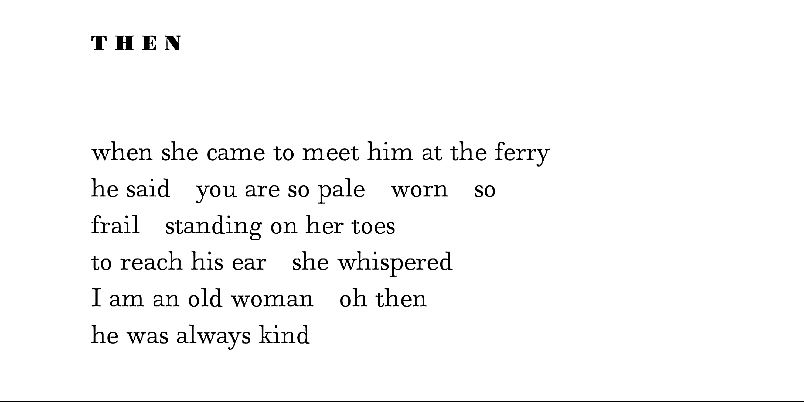
“Then” — Grace Paley

“1492” — Emma Lazarus

“Hell Pig” — Aimee Nezhukumatathil

“Hell Pig”
by
Aimee Nezhukumatathil

To keep me from staying out late at night,
my mother warned of the Hell Pig. Black and full
of hot drool, eyes the color of a lung—it’d follow me
home if I stayed past my curfew. How to tell my friends
to press Pause in the middle of a video, say their good-byes
while I shuffled up the stairs and into my father’s waiting
blue car? How to explain this to my dates, whisper
why we could not finish this dance? It’s not like the pig
had any special powers or could take a tiny bite
from my leg—only assurances that it was simply
scandal to be followed home. When my date and I
pull into my driveway and dim the lights, we take
care to make all the small noises that get made
in times like these even smaller: squeaks in the seats,
a slow spin of the radio dial, the silver click of my belt.
Too late. A single black hair flickers awake the ear
of the dark animal waiting for me at the end of the walk.
My fumbling of keys and various straps a wild dance
to the door—the pig grunting in tune to each hurried step, each
of his wet breaths puffing into tiny clouds, a small storm brewing.

“Identity” — W.S. Merwin

“Identity”

by

W.S. Merwin


When Hans Hofmann became a hedgehog
somewhere in a Germany that has
vanished with its forests and hedgerows
Shakespeare would have been a young actor
starting out in a country that was
only a word to Hans who had learned
from those who had painted animals
only from hearing tales about them
without ever setting eyes on them
or from corpses with the lingering
light mute and deathly still forever
held fast in the fur or the feathers
hanging or lying on a table
and he had learned from others who had
arranged the corpses of animals
as though they were still alive in full
flight or on their way but this hedgehog
was there in the same life as his own
looking around at him with his brush
of camel hair and his stretched parchment
of sheepskin as he turned to each sharp
particular quill and every black
whisker on the long live snout and those
flat clawed feet made only for trundling
and for feeling along the dark undersides
of stones and as Hans took them in he
turned into the Hans that we would see

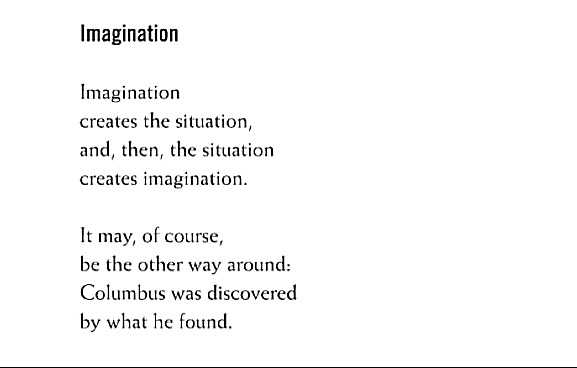
“Imagination” — James Baldwin

“Cassette County” — David Berman

“Cassette County”

by

David Berman


This is meant to be in praise of the interval called hangover,
a sadness not co-terminous with hopelessness,
and the North American doubling cascade
that (keep going) “this diamond lake is a photo lab”
and if predicates really do propel the plot
then you might see Jerusalem in a soap bubble
or the appliance failures on Olive Street
across these great instances,
because “the complex Italians versus the basic Italians”
because what does a mirror look like (when it’s not working)
but birds singing a full tone higher in the sunshine.

I’m going to call them Honest Eyes until I know if they are,
in the interval called slam-clicker, Realm of Pacific,
because the second language wouldn’t let me learn it
because I have heard of you for a long time occasionally
because diet cards may be the recovery evergreen
and there is a new benzodiazepene called Distance,

anti-showmanship, anti-showmanship, anti-showmanship.

I suppose a broken window is not symbolic
unless symbolic means broken, which I think it sorta does,
and when the phone jangles
what’s more radical, the snow or the tires,
and what does the Bible say about metal fatigue
and why do mothers carry big scratched-up sunglasses
in their purses.

Hello to the era of going to the store to buy more ice
because we are running out.
Hello to feelings that arrive unintroduced.
Hello to the nonfunctional sprig of parsley
and the game of finding meaning in coincidence.

Because there is a second mind in the margins of the used book
because Judas Priest (source: Firestone Library)
sang a song called Stained Class,
because this world is 66% Then and 33% Now,

and if you wake up thinking “feeling is a skill now”
or “even this glass of water seems complicated now”
and a phrase from a men’s magazine (like single-district cognac)
rings and rings in your neck,
then let the consequent misunderstandings
(let the changer love the changed)
wobble on heartbreakingly nu legs
into this street-legal nonfiction,
into this good world,
this warm place
that I love with all my heart,

anti-showmanship, anti-showmanship, anti-showmanship.

“The Shirt” — Robert Pinsky

“The Shirt”

by

Robert Pinsky


The back, the yoke, the yardage. Lapped seams,
The nearly invisible stitches along the collar
Turned in a sweatshop by Koreans or Malaysians

Gossiping over tea and noodles on their break
Or talking money or politics while one fitted
This armpiece with its overseam to the band

Of cuff I button at my wrist. The presser, the cutter,
The wringer, the mangle. The needle, the union,
The treadle, the bobbin. The code. The infamous blaze

At the Triangle Factory in nineteen-eleven.
One hundred and forty-six died in the flames
On the ninth floor, no hydrants, no fire escapes—

The witness in a building across the street
Who watched how a young man helped a girl to step
Up to the windowsill, then held her out

Away from the masonry wall and let her drop.
And then another. As if he were helping them up
To enter a streetcar, and not eternity.

A third before he dropped her put her arms
Around his neck and kissed him. Then he held
Her into space, and dropped her. Almost at once

He stepped to the sill himself, his jacket flared
And fluttered up from his shirt as he came down,
Air filling up the legs of his gray trousers—

Like Hart Crane’s Bedlamite, “shrill shirt ballooning.”
Wonderful how the pattern matches perfectly
Across the placket and over the twin bar-tacked

Corners of both pockets, like a strict rhyme
Or a major chord. Prints, plaids, checks,
Houndstooth, Tattersall, Madras. The clan tartans

Invented by mill-owners inspired by the hoax of Ossian,
To control their savage Scottish workers, tamed
By a fabricated heraldry: MacGregor,

Bailey, MacMartin. The kilt, devised for workers
To wear among the dusty clattering looms.
Weavers, carders, spinners. The loader,

The docker, the navvy. The planter, the picker, the sorter
Sweating at her machine in a litter of cotton
As slaves in calico headrags sweated in fields:

George Herbert, your descendant is a Black
Lady in South Carolina, her name is Irma
And she inspected my shirt. Its color and fit

And feel and its clean smell have satisfied
Both her and me. We have culled its cost and quality
Down to the buttons of simulated bone,

The buttonholes, the sizing, the facing, the characters
Printed in black on neckband and tail. The shape,
The label, the labor, the color, the shade. The shirt.

Goblin Market — Primrose Harley

Goblin Market, by Primrose Harley (1908-1978)


“Goblin Market”

by

Christina Rossetti


Morning and evening
Maids heard the goblins cry:
“Come buy our orchard fruits,
Come buy, come buy:
Apples and quinces,
Lemons and oranges,
Plump unpeck’d cherries,
Melons and raspberries,
Bloom-down-cheek’d peaches,
Swart-headed mulberries,
Wild free-born cranberries,
Crab-apples, dewberries,
Pine-apples, blackberries,
Apricots, strawberries;—
All ripe together
In summer weather,—
Morns that pass by,
Fair eves that fly;
Come buy, come buy:
Our grapes fresh from the vine,
Pomegranates full and fine,
Dates and sharp bullaces,
Rare pears and greengages,
Damsons and bilberries,
Taste them and try:
Currants and gooseberries,
Bright-fire-like barberries,
Figs to fill your mouth,
Citrons from the South,
Sweet to tongue and sound to eye;
Come buy, come buy.”

Continue reading “Goblin Market — Primrose Harley” →

Summer’s Almost Gone — William Trowbridge

“Summer’s Almost Gone”
by
William Trowbridge

The squirrels are spreading the rumor: no more monkey business.
The Dow Jones hops up, then down, then back up, trying for attention,
           up against dog days.
The Capitol dome rattles like a witch doctor’s gourd. “More Republicans,”
           warn the talking drums.
The networks labor underground to stockpile T, A, and blood capsules
           for Sweeps Week, when all hell won’t be enough to save some.
Pedestrians slip into light coats of pollen and mold spores.
The Enquirer reports the sighting of Satan’s image over Chicago during
           the heat emergency. His words were, “For the hottest deals in town,
           see Sal at Mutto’s Chevrolet on East Wacker.”
The old elms shrug: “You think this is hot: we could tell you about hot.”
Walmart and Kmart burgeon into crooked towers of back-to-school
           candy. They’re heaven-bound, via the moon. Greeters offer
           themselves to the lowest common denominator. There’s a Blue-
           Light on moon caps.
Representatives from Tire City have announced they intend a hostile
           takeover and cleansing of their former territory, now known as
           Carpet City. Furniture City will not intervene.
The NFL’s negotiating for rights to the Baptist Church.
The carnies have packed up the Tilt-A-Whirl and Ferris wheel, leaving us
           up to our ass in free parking.
Everyone under 30 dreams of shoplifting some Air Jordans for school.
Everyone over 30 dreams of going to prison for shoplifting.
The hypochondriacs wake up noticing little dark spots in front of their
           eyes, think they could be in the middle of something serious.
“Winterize now,” say the prime-time commercials. “Spend, spend, spend!”
           cry the cicadas and katydids over the scorched, moonlit lawns.

A dream you can’t shake: See above | David Berman

From The Minus Times #29, as republished in The Minus Times Collected. 

“Classic Water” — David Berman

“Classic Water”

by

David Berman


I remember Kitty saying we shared a deep longing for
the consolation prize, laughing as we rinsed the stagecoach.

I remember the night we camped out
           and I heard her whisper
“think of me as a place” from her sleeping bag
           with the centaur print.

I remember being in her father’s basement workshop
when we picked up an unknown man sobbing
over the shortwave radio

and the night we got so high we convinced ourselves
that the road was a hologram projected by the headlight beams.

I remember how she would always get everyone to vote
on what we should do next and the time she said
“all water is classic water” and shyly turned her face away.

At volleyball games her parents sat in the bleachers
like ambassadors from Indiana in all their midwestern schmaltz.

She was destroyed when they were busted for operating
a private judicial system within U.S. borders.


Sometimes I’m awakened in the middle of the night
by the clatter of a room service cart and I think back on Kitty.

Those summer evenings by the government lake,
talking about the paradox of multiple Santas
or how it felt to have your heart broken.

I still get a hollow feeling on Labor Day when the summer ends

and I remember how I would always refer to her boyfriends
as what’s-his-face, which was wrong of me and I’d like
to apologize to those guys right now, wherever they are:

No one deserves to be called what’s-his-face.

“Peach” — D.H. Lawrence

“Peach”

by

D.H. Lawrence


Would you like to throw a stone at me?
Here, take all that’s left of my peach.

Blood-red, deep:
Heaven knows how it came to pass.
Somebody’s pound of flesh rendered up.

Wrinkled with secrets
And hard with the intention to keep them.

Why, from silvery peach-bloom,
From that shallow-silvery wine-glass on a short stem
This rolling, dropping, heavy globule?

I am thinking, of course, of the peach before I ate it.

Why so velvety, why so voluptuous heavy?
Why hanging with such inordinate weight?
Why so indented?

Why the groove?
Why the lovely, bivalve roundnesses?
Why the ripple down the sphere?
Why the suggestion of incision?

Why was not my peach round and finished like a billiard ball?
It would have been if man had made it.
Though I’ve eaten it now.

But it wasn’t round and finished like a billiard ball;
And because I say so, you would like to throw something at me.

Here, you can have my peach stone.