“Hymn from a Watermelon Pavilion” — Wallace Stevens

“Hymn from a Watermelon Pavilion”
by
Wallace Stevens

You dweller in the dark cabin,
To whom the watermelon is always purple,
Whose garden is wind and moon,
Of the two dreams, night and day,
What lover, what dreamer, would choose
The one obscured by sleep?
Here is the plantain by your door
And the best cock of red feather
That crew before the clocks.
A feme may come, leaf-green,
Whose coming may give revel
Beyond revelries of sleep,
Yes, and the blackbird spread its tail,
So that the sun may speckle,
While it creaks hail.
You dweller in the dark cabin,
Rise, since rising will not waken,
And hail, cry hail, cry hail.

“Victory” — Denis Johnson

“Victory”

by

Denis Johnson


the woman whose face has just finished breaking
with a joy so infinite

and heavy that it might be grief has won
a car on a giveaway show, for her family,

for an expanse of souls that washes from a million
picture tubes onto the blank reaches

of the air. meanwhile, the screams are packing
the air to a hardness: in the studio

the audience will no longer move, will be caught
slowly, like ancient, staring mammals, figuring

out the double-cross within the terrible progress
of a glacier. here, i am suddenly towering

with loneliness, repeating to this woman’s
only face, this time, again, i have not won.

“A Little Called Pauline” — Gertrude Stein

“A Little Called Pauline”

by

Gertrude Stein


A little called anything shows shudders.

Come and say what prints all day. A whole few watermelon. There is no pope.

No cut in pennies and little dressing and choose wide soles and little spats really little spices.

A little lace makes boils. This is not true.

Gracious of gracious and a stamp a blue green white bow a blue green lean, lean on the top.

If it is absurd then it is leadish and nearly set in where there is a tight head.

A peaceful life to arise her, noon and moon and moon. A letter a cold sleeve a blanket a shaving house and nearly the best and regular window.

Nearer in fairy sea, nearer and farther, show white has lime in sight, show a stitch of ten. Count, count more so that thicker and thicker is leaning.

I hope she has her cow. Bidding a wedding, widening received treading, little leading mention nothing.

Cough out cough out in the leather and really feather it is not for.

Please could, please could, jam it not plus more sit in when.

“As the Human Village Prepares for Its Fate” — Tom Clark

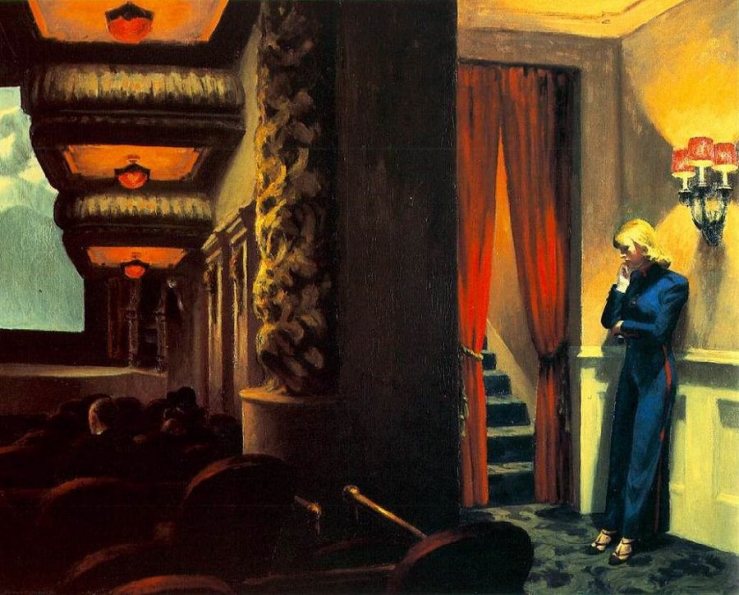
“Edward Hopper’s New York Movie” — Joseph Stanton

“Edward Hopper’s New York Movie”

by

Joseph Stanton


We can have our pick of seats.
Though the movie’s already moving,
the theater’s almost an empty shell.
All we can see on our side
of the room is one man and one woman—
as neat, respectable, and distinct
as the empty chairs that come
between them. But distinctions do not surprise,
fresh as we are from sullen street and subway
where lonelinesses crowded
about us like unquiet memories
that may have loved us once or known our love.
Here we are an accidental
fellowship, sheltering from the city’s
obscure bereavements to face a screened,
imaginary living,
as if it were a destination
we were moving toward. Leaning to our right
and suspended before us
is a bored, smartly uniformed usherette.
Staring beyond her lighted corner, she finds
a reverie that moves through
and beyond the shine of the silver screening.
But we can see what she will never see—
that she’s the star of Hopper’s scene.
For the artist she’s a play of light,
and a play of light is all about her.
Whether the future she is
dreaming is the future she will have
we have no way of knowing. Whatever
it will prove to be
it has already been. The usherette
Hopper saw might now be seventy,
hunched before a Hitachi
in an old home or a home for the old.
She might be dreaming now a New York movie,
Fred Astaire dancing and kissing
Ginger Rogers, who high kicks across New York
City skylines, raising possibilities
that time has served to lower.
We are watching the usherette, and the subtle
shadows her boredom makes across her not-quite-
impassive face beneath
the three red-shaded lamps and beside
the stairs that lead, somehow, to dark streets
that go on and on and on.
But we are no safer here than she.
Despite the semblance of luxury—
gilt edges, red plush,
and patterned carpet—this is no palace,
and we do not reign here, except in dreams.
This picture tells us much
about various textures of lighted air,
but at the center Hopper has placed
a slab of darkness and an empty chair.


“Personal Poem” — Frank O’Hara

“Personal Poem”

by

Frank O’Hara


Now when I walk around at lunchtime
I have only two charms in my pocket
an old Roman coin Mike Kanemitsu gave me
and a bolt-head that broke off a packing case
when I was in Madrid the others never
brought me too much luck though they did
help keep me in New York against coercion
but now I’m happy for a time and interested

I walk through the luminous humidity
passing the House of Seagram with its wet
and its loungers and the construction to
the left that closed the sidewalk if
I ever get to be a construction worker
I’d like to have a silver hat please
and get to Moriarty’s where I wait for
LeRoi and hear who wants to be a mover and
shaker the last five years my batting average
is .016 that’s that, and LeRoi comes in
and tells me Miles Davis was clubbed 12
times last night outside birdland by a cop
a lady asks us for a nickel for a terrible
disease but we don’t give her one we
don’t like terrible diseases, then

we go eat some fish and some ale it’s
cool but crowded we don’t like Lionel Trilling
we decide, we like Don Allen we don’t like
Henry James so much we like Herman Melville
we don’t want to be in the poets’ walk in
San Francisco even we just want to be rich
and walk on girders in our silver hats
I wonder if one person out of the 8,000,000 is
thinking of me as I shake hands with LeRoi
and buy a strap for my wristwatch and go
back to work happy at the thought possibly so

“Kong Looks Back on His Tryout with the Bears” — William Trowbridge

“Kong Looks Back on His Tryout with the Bears”

by

William Trowbridge


If it had worked out, I’d be on a train to Green Bay,
not crawling up this building with the Air Corps
on my ass. And if it weren’t for love, I’d drop
this shrieking little bimbo sixty stories
and let them take me back to the exhibit,
let them teach me to mambo and do imitations.
They tried me on the offensive line, told me
to take out the right cornerback for Nagurski.
Eager to please, I wadded up the whole secondary,
then stomped the line, then the bench and locker room,
then the east end of town, to the river.
But they were not pleased: they said I had to
learn my position, become a team player.
The great father Bear himself said that,
so I tried hard to know the right numbers
and how the arrows slanted toward the little o’s.
But the o’s and the wet grass and the grunts
drowned out the count, and the tight little cheers
drew my arrow straight into the stands,
and the wives tasted like flowers and raw fish.
So I was put on waivers right after camp,
and here I am, panty-sniffer, about to die a clown,
who once opened a hole you could drive Nebraska through.

“Banneker” — Rita Dove

“Banneker”

by

Rita Dove


What did he do except lie
under a pear tree, wrapped in
a great cloak, and meditate
on the heavenly bodies?
Venerable, the good people of Baltimore
whispered, shocked and more than
a little afraid. After all it was said
he took to strong drink.
Why else would he stay out
under the stars all night
and why hadn’t he married?

But who would want him! Neither
Ethiopian nor English, neither
lucky nor crazy, a capacious bird
humming as he penned in his mind
another enflamed letter
to President Jefferson—he imagined
the reply, polite and rhetorical.
Those who had been to Philadelphia
reported the statue
of Benjamin Franklin
before the library

his very size and likeness.
A wife? No, thank you.
At dawn he milked
the cows, then went inside
and put on a pot to stew
while he slept. The clock
he whittled as a boy
still ran. Neighbors
woke him up
with warm bread and quilts.
At nightfall he took out

his rifle—a white-maned
figure stalking the darkened
breast of the Union—and
shot at the stars, and by chance
one went out. Had he killed?
I assure thee, my dear Sir!
Lowering his eyes to fields
sweet with the rot of spring, he could see
a government’s domed city
rising from the morass and spreading
in a spiral of lights….

“The Difference Between Pepsi and Coke” — David Lehman

“The Difference Between Pepsi and Coke”
by
David Lehman

Can’t swim; uses credit cards and pills to combat
               intolerable feelings of inadequacy;
Won’t admit his dread of boredom, chief impulse behind
​               numerous marital infidelities;
Looks fat in jeans, mouths clichés with confidence,
​               breaks mother’s plates in fights;
Buys when the market is too high, and panics during
​               the inevitable descent;
Still, Pop can always tell the subtle difference
​               between Pepsi and Coke,
Has defined the darkness of red at dawn, memorized
​               the splash of poppies along
Deserted railway tracks, and opposed the war in Vietnam
​               months before the students,
Years before the politicians and press; give him
​               a minute with a road map
And he will solve the mystery of bloodshot eyes;
​               transport him to mountaintop
And watch him calculate the heaviness and height
​               of the local heavens;
Needs no prompting to give money to his kids; speaks
​               French fluently, and tourist German;
Sings Schubert in the shower; plays pinball in Paris;
​               knows the new maid steals, and forgives her.

“Noah / Ham: Fathers of the Year” — Douglas Kearney

“Noah/Ham: Fathers of the Year,” a poem by Douglas Kearney

“Fathers” — Grace Paley

“Fathers”

by

Grace Paley


Fathers are
more fathering
these days they have
accomplished this by
being more mothering

what luck for them that
women’s lib happened then
the dream of new fathering
began to shine in the eyes
of free women and was irresistible

on the New York subways
and the mass transits
of other cities one may
see fatherings of many colors
with their round babies on
their laps this may also
happen in the countryside

these scenes were brand new
exciting for an old woman who
had watched the old fathers
gathering once again in
familiar army camps and com-
fortable war rooms to consider
the necessary eradication of
the new fathering fathers
(who are their sons) as well
as the women and children who
will surely be in the way.

“No Complaints” — Nikki Giovanni

“No Complaints”

by

Nikki Giovanni

(For Gwendolyn Brooks, 1917—2001)

maybe there is something about the seventh of June: Gwen,
Prince and me . . . or maybe people just have to be born at some
time . . . and there are only three hundred sixty-five days or three
sixty-six every four years or so . . . meaning that some things
happen at the same time in the same rising sign . . . and the same
houses in Gemini . . . but some of us might also consider the
possibility of reincarnating revolving restructuring that spirit . . .
reshaping that spirit . . . releasing that spirit . . . tucking the use-
less inside and when the useless pushes out again we restructure
again and poetry and song and praisesong go on  . . . because it is
the right thing to do

we always will cry when a great heart . . . a good soul . . . one of
the premier poets of her age restructures . . . reincarnates  . . .
revolves into a resolve that we now carry in our hearts . . . as all
great women and men are alive . . . not by biology but remem-
brance . . . and that’s all right . . . as the old folk say . . . because as
long as they stay on the lips . . . they nestle in our hearts and those
souls which are planted . . . continue growing . . . until generations
not knowing their touch . . . their voice . . . or even the fact
that some Chicago poets are terrible cooks . . . but always fun
to eat with . . . will tell tales of having met someone who knew
someone who once watched a basketball game . . . in which some
Chicago poet cheered for Seattle at the request of some Virginia
poet who wanted more games . . . while Mr. Blakely was amazed
that a Chicago poet was even watching a game . . . and didn’t
we miss him as he slipped away watching baseball . . . and what
a way to go . . . though we then did sort of know . . . that once
gone . . . he would call the woman he loved

and so we come to no more phone calls at six a.m. to chat …
and no more Benihana when we are all in New York . . . and no
more gossiping and questioning and trying to make sense of a
senseless world . . . no more face-to-face . . . only the poetry which
is a great monument from this Topeka daughter to the world . . .
and yet . . . there can be no complaints in this passing . . . no
sorrow songs . . . no if onlys . . . it is all here: the work the love:
the woman: who gave and gave and gave . . . no complaints of too
long or too hard . . . no injustice of accident or misunderstanding
of disease . . . just one great woman moving to the next phase . . .
and us on the ground . . . giving Alleluias

“Black Box” — Randall Mann

“Black Box”

by

Randall Mann


I was someone’s
honor’s student once,
a sticker, a star.
I aced Home Ec and Geometry;
I learned to stab a fork,
steer my mother’s car.
Old enough to work,
I refreshed the salad bar
at Steak & Ale,
scarcity a line
I couldn’t fail.
The summers between university,
interned at AT&T,
in the minority
outreach they called Inroads.
My boss, Vicki, had two
roommates, whom she
called, simply, The Gays,
crashing on her floor.
That was before
I was gay, I won’t try to say
with a straight face.
Like anyone really cares,
I care. What I’m trying to say:
all this prepared
me for these squat blinking
office accessories.
The dry drinking
after the accidental reply-all.
By now there’s a lot to lose.
Little by little, I have become
so careful, no talk
of politics, or orientation:
I let them say, he’s “a homosexual,”
without an arch correction.
At a fondue buffet
in Zurich, our dumb-
founded senior group
director—when I let slip,
damn it, my trip
with a twenty-year-old—inquired,
They’re always over seventeen,
right? I told her of course,
god yes, and, seething, smiled,
which I’m famous for.
I didn’t want to scare
her. But I tell you,
I’m keeping score.
E-mail is no more
than a suicide
I’d like to please recall.
Note my suicide.
I’m paid to multitask,
scramble the life
out of fun:
Monday I will ask—
every dash a loaded gun,
every comma, a knife—
you to bury the black-box file.

“Upon Arrival” — Lena Khalaf Tuffaha

“Upon Arrival”
by
Lena Khalaf Tuffaha

You will need to state the reason for your visit.
Don’t say because I want to walk down old roads
and caress stone walls the color of my skin.
You will need to state the reason for your visit.
Don’t say because the olives are ready for harvest
and I will coax the fruit from the trees,
press it into liquid gold.
You will need to state the reason for your visit.
Don’t say because my parents’ house
still sits empty on a bluff overlooking the sea,
the green shutters my grandfather had just painted
remain sealed shut
and the army listed the property’s owners
as absentees.
You will need to state the reason for your visit.
Don’t say because I am carrying prayers in my suitcase
for a people who wait,
and I’ll unfold them
embroidered linens of verse
and spread them out across the land.

“Once There Came a Man” — Stephen Crane

“Once There Came a Man”
by
Stephen Crane

Once there came a man
Who said:
“Range me all men of the world in rows.”
And instantly
There was a terrific clamor among the people
Against being ranged in rows.
There was a loud quarrel, world-wide.
It endured for ages;
And blood was shed
By those who would not stand in rows,
And by those who pined to stand in rows.
Eventually, the man went to death, weeping.
And those who stayed in the bloody scuffle
Knew not the great simplicity.

“Rite of Passage” — Sharon Olds

“Rite of Passage”
by
Sharon Olds

As the guests arrive at our son’s party
they gather in the living room—
short men, men in first grade
with smooth jaws and chins.
Hands in pockets, they stand around
jostling, jockeying for place, small fights
breaking out and calming. One says to another
How old are you? —Six. —I’m seven. —So?
They eye each other, seeing themselves
tiny in the other’s pupils. They clear their
throats a lot, a room of small bankers,
they fold their arms and frown. I could beat you
up, a seven says to a six,
the midnight cake, round and heavy as a
turret behind them on the table. My son,
freckles like specks of nutmeg on his cheeks,
chest narrow as the balsa keel of a
model boat, long hands
cool and thin as the day they guided him
out of me, speaks up as a host
for the sake of the group.
We could easily kill a two-year-old,
he says in his clear voice. The other
men agree, they clear their throats
like Generals, they relax and get down to
playing war, celebrating my son’s life.