More New Cult Canon

(Context, entries 1-8)

(9-14)

15. Battle Royale, Kinji Fukasaku (2000)

I actually rewatched Battle Royale just the other week. In retrospect, it’s difficult to assess the film against the influence it’s had, especially on video games. In his 2008 New Cult Canon entry, Scott Tobias described the film as “Lord Of The Flies meets The Most Dangerous Game meets perhaps the cruelest year of teenage life.” I think what many of us remember about Battle Royale is first the concept, so widely imitated, and then the violence—but it’s actually a gentler film, with hints of Rebel without a Cause (Nicholas Ray, 1955). It’s also kinda goofy and disjointed.

6/10

Alternate: I don’t think they’re widely available as legal streams, but you could track down Kinji Fukasaku’s early 1970’s crime films, the Battles without Honor or Humanity series.

Alternate alternate: 10 minutes of Friedkin on Fukasaku:

16. Dead Man, Jim Jarmusch (1995)

A perfect film, one that seems better every time I see it. Gary Farmington is amazing as William Blake’s spiritual guide (“Stupid fucking white man” is a sublime line reading), and Jarmusch has a loaded bench to bounce pretty boy Depp off of (Iggy Pop is particularly scary, but Robert Mitchum seems an embodiment of evil from a truly different time—magnificent).

10/10

Alternate: El Topo, Alejandro Jodorowsky (1970)

17. Wet Hot American Summer, David Wain (2001)

I have no idea if Wet Hot American Summer holds up well—I think I was always part of its intended audience, part of the tail end of the “Reagan-era latchkey kids who grew up watching” the kind of films Wain’s movie is—satirizing?—on television. I watched Wet Hot American Summer approximately 100 times in 2003; it was one of a handful of DVDs on repeat at my best friend’s childhood house, where my unemployed unstructured ass spent a few nights a week crashing. His folks were in the beginning of a (permanent) separation, and the house seemed to have been ceded to a loose configuration of a dozen or so of us. We’d drink tallboys on the beach, stumble in, and fall asleep to The Royal Tenenbaums (Wes Anderson, 2001) or Reign of Fire (Rob Bowman, 2002) or Human Nature (Michel Gondry, 2001) or Wet Hot American Summer. There were probably others, but those are the ones I remember.

10/10

Alternate: Porky’s, Roy Clark (1981)

18. The Boondock Saints, Troy Duffy (1999)

The Boondock Saints is a truly awful film. It is relentlessly stupid and when it is funny, it is funny by accident—except when Willem Dafoe’s charm takes over one of the scenes he’s chewing up. The viewer can almost sense Dafoe rewriting Duffy’s sketchy, shoddy, nonsensical script in real time. For all its retrograde bluster (and poor filmmaking), The Boondock Saints actually has a viewpoint.

3/10

Alternate: Payback, Brian Helgeland (1999)

19. Punch-Drunk Love, Paul Thomas Anderson (2002)

Another perfect film. In his original New Cult Canon, Tobias suggested that,

Punch-Drunk Love marked the moment when Anderson threw away the stylistic
crutches of forbears like Martin Scorsese and Robert Altman, and came into his
own as an original filmmaker. That doesn’t mean he’s discarded these and other
influences altogether, which isn’t something he could or would want to do. But Punch-Drunk
Love
has a unique texture that’s unmistakably Anderson’s, marked by a wired, coked-up
intensity and a yen for discord. It’s a film that sets viewers on edge from the
start, almost daring you not to like it.

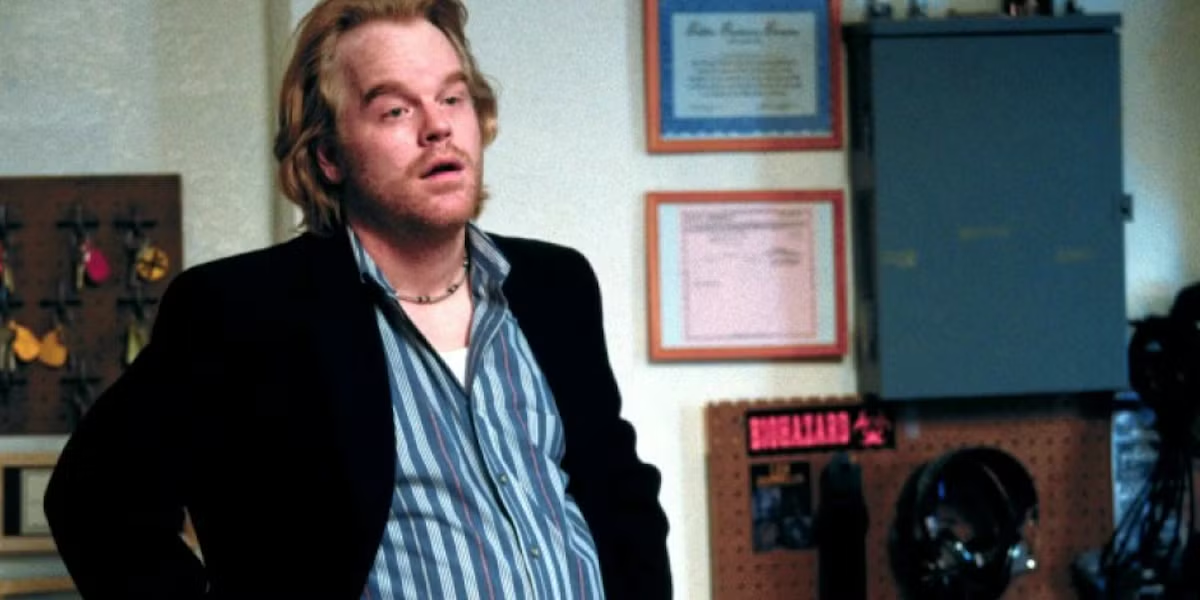
Philip Seymour Hoffman might have stolen the film from Sandler, had he been in it more than the few minutes he’s actually on screen (he’s looming larger in our memory, as always).

10/10

Alternate: Popeye, Robert Altman (1980)

20. Wild Things, John McNaughton (1998)

This is another film that I watched because Tobias wrote about it. I had actually seen McNaughton’s film Henry: Portrait of a Serial Killer entirely by mistake at a “party”; this probably happened around the same time that Wild Things released to theaters. But I never would have connected the two. I thought Wild Things was a different kind of trash than the trash it actually is. Tobias’s write-up makes an argument for Wild Things as high camp, a film told entirely within a set of quotation marks. I think he’s a bit too generous in his admiration for McNaughton’s film, but I ultimately enjoyed it.

6/10

Alternate: Bad Lieutenant: Port of Call New Orleans, Werner Herzog (2009)

I Review The Hunger Games Film (And Mostly Complain About the Jumpy Camera Work)

So the wife and I went to see The Hunger Games last night. By way of readerly context: she ate up the trilogy in a spare week; I listened to the first audiobook last summer, and wrote about it here, including these sentences which loosely sum up my feelings:

Look, I get that these books are for kids, and that they’re probably a sight better than Twilight, but sheesh, exposition exposition exposition. There’s nothing wrong with letting readers fill in the gaps (especially when your book is ripping off The Running Man + a dozen other books). Also, there’s a character in this book who I think is named after pita bread.

However, I was prepared to accept that the plot of The Hunger Games could make for a fine film—I mean, it’s basically “The Most Dangerous Game,” or Lord of the Flies, or The Running Man, or Logan’s Run or whatever—so I went with an open mind.

By way of context/citation, here’s a trailer that gives a fairly accurate visual sense of the film—up to a point (I will belabor that point momentarily):

Short review:

Plot—fine.

Dialogue—fine.

Pacing—not bad.

Acting—better than average, especially Jennifer Lawrence as lead Katniss. (Lawrence stars in a better film called Winter’s Bone, which is like the real hunger games, by the bye). Woody Harrelson brought more to his character, drunken mentor Haymitch, than Collins’s cardboard book allowed, so kudos, bro.

Music/score—surprisingly good and rarely overused. I think T-Bone Burnett supervised. Also, no forced obtrusive pop songs from the “soundtrack.”

Set design—fine, I guess, although who knew the dystopian future would look like Coal Miner’s Daughter (for the plebes) and future-Vegas/Logan’s Run (for the aristocrats). The scenes in the capital city will look incredibly dated in ten years, but whatever. The thunderdome itself where the kids fight it out was underdeveloped, but this had more to do with plotting and pacing. But hey, the movie was already almost two and a half hours long, which is long, so, fine, I guess.

Editing/camera work: Not fineHorrible. I’m probably referring more to the director’s choices than to the acutal work of the DP and cinematographer here—I mean the lighting was good — what I’m talking about was the shoddiness of the framing of each shot, of the camera’s faux-unsteadiness, as if a shaky-cam in someway connotes realism or drama. The shaky cam connotes headache and nausea — especially when used so liberally. The camera seemed unable to ever simply rest on an image, particularly during the first 30 minutes. The shots—from bizarre and disparate angles—jump-cut around, refusing to actually show the audience the staging and action.

Particularly frustrating is an opening scene where Katniss hunts a deer in a lush green forest. There’s the potential here for an excellent introduction to the character—to her seriousness, her gravity, her skill, her keen attenuation to environment (all extremely relevant later, of course) — the camera could simply show the audience the hunt, linger a bit even — I’m not talking about Malickian nature-gazing, but simply taking the time to attune character to setting. Instead, the camera whips around frenetically with a nervous energy that seems to have nothing to do with Katniss’s calm, steady bowhand. It’s as if the director does not trust the audience to attend to a specific shot or angle for more than 2 seconds.

My frustration grew after this initial scene, as the director seemed determined to withhold any simple shot that would establish place or character. This frustration culminated in a climactic scene at the beginning of the Battle Royale—excuse me, Hunger Games tournament—where the contestants, admitted to the arena, either run for weapons or cover. There’s a bloodbath here, one that highlights the intense Darwinian stakes in play—only, again, we don’t really get to see it. The camera whirls around as if it were in the hands of someone’s dad at a birthday party, two beers in, as he tries to capture everything all at once on his cheap Sony — and therefore misses everything. Sure, the conceit might be that this shaky unsteady whirling is how Katniss experiences the scene, but the Hunger Games tourney is televised, so obviously we could see what the home audience could see, right? I’m not asking for gore or explicit violence here, to be clear: I simply don’t understand why the camera refused to show the basic action that was happening on the screen. Repeat this criticism for every single fight scene.

The clunky, clumsy fight scenes reminded me of Christopher Nolan’s shoddy work in the Batman films or even the sheer incomprehensibility of Michael Bay’s stuff : is this what audiences will accept? Are these what pass for action films? I’m not arguing that these Hollywood blockbusters need to adhere to the precision that we can find in Hong Kong martial arts films (or even Ang Lee’s arty take on such films, Crouching Tiger, Hidden Dragon)—but, c’mon, even the Jason Bourne movies and recent James Bond movies respected their audiences enough to adhere to a modicum of verisimilitude.

Verdict: The Hunger Games, like any dystopia, succeeds or fails by how well it synthesizes—and then surpasses—its myriad sources. The film, in this case, is simply okay. Dystopia has so assimilated our culture’s collective imagination (from the aforementioned Batman films to political ads to the wild financial success of Collins’s HG trilogy) that its tropes are overly-familiar, to the point that they have become comfortable, well-worn. A more successful dystopian vision—let’s take Cormac McCarthy’s The Road or Alfonso Cuarón’s film Children of Men or Margaret Atwood’s Year of the Flood as ready recent examples—offers familiarity with one hand and utter strangeness with the other. Successful dystopian visions are strange, disruptive, and uncanny—they allow us to project ourselves into worlds we pray are impossible. The Hunger Games feels, dare I say, dull, predictable, and somehow awfully normal. Catch it on cable in two years.