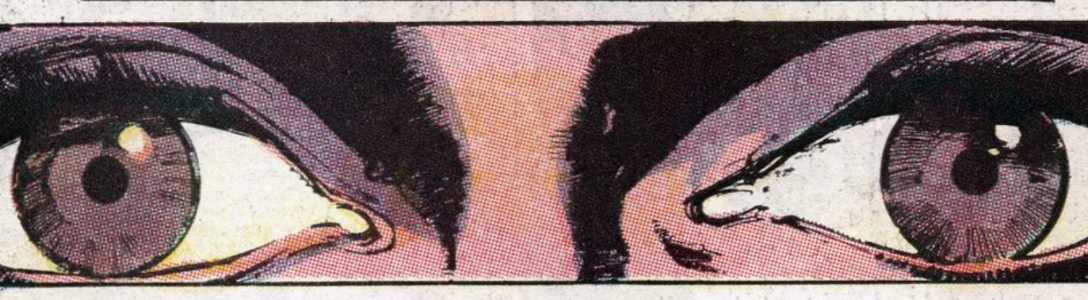
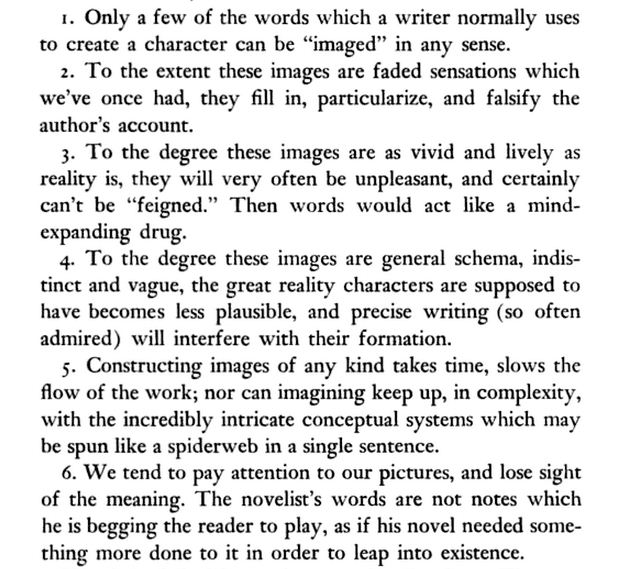
It has been said that fictional characters are underdetermined that is, we know only a few of their properties while real individuals are completely determined, and we should be able to predicate of them each of their known attributes. But although this is true from an ontological point of view, from an epistemological one it is exactly the opposite: nobody can assert all the properties of a given individual or of a given species, which are potentially infinite, while the properties of fictional characters are severely limited by the narrative text and only those attributes mentioned by the text count for the identification of the character.
In fact, I know Leopold Bloom better than I know my own father. Who can say how many episodes of my father’s life are unknown to me, how many thoughts my father never disclosed, how many times he concealed his sorrows, his quandaries, his weaknesses? Now that he is gone, I shall probably never discover those secret and perhaps fundamental aspects of his being. Like the historians described by Dumas, I muse and muse in vain about that dear ghost, lost to me forever. In contrast, I know everything about Leopold Bloom that I need to know—and each time I reread Ulysses I discover something more about him.
From Umberto Eco’s essay “Some Remarks on Fictional Characters,” collected in Confessions of a Young Novelist.
 Biblioklept