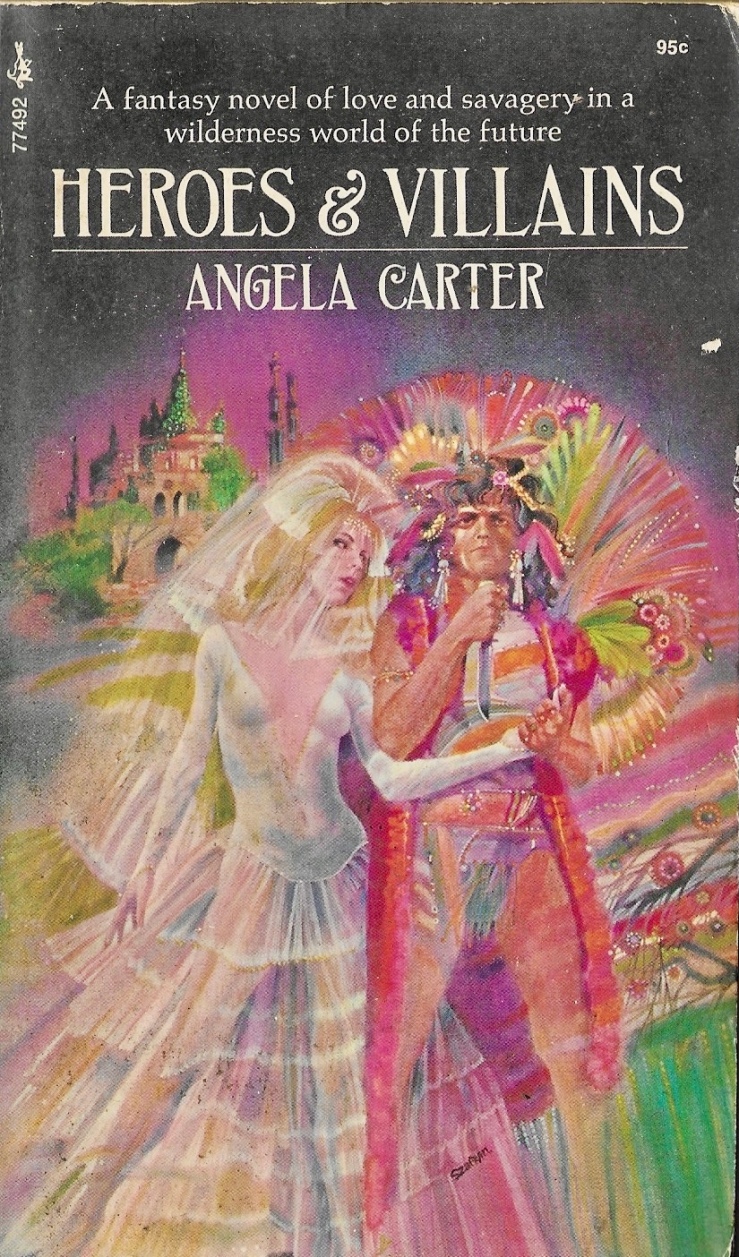
Mass-market Monday | Angela Carter’s Heroes and Villains

Heroes and Villains, Angela Carver. Pocket Books Edition (1972). No cover artist credited. 176 pages.

While no cover designer or artist for this edition of Angela Carter’s 1969 novel Heroes and Villains, I’m pretty certain that the work is by Gene Szafran.

I wrote briefly on the novel in 2020:

One of Carter’s earlier novels, Heroes and Villains takes place in a post-apocalyptic world where caste lines divide the Professors, the Barbarians, and the mutant Out People. After her Professor stronghold is raided, Marianne is…willingly abducted?…by the barbarian Jewel. Marianne goes to live with the Barbarians, and ends up in a weird toxic relationship with Jewel, marked by rape and violence. Heroes and Villains throws a lot in its pot—what is consent? what is civilization? what is language?—but it’s a muddled, psychedelic mess in the end.


Angela Carter’s Heroes & Villains (Book acquired 30 Nov. 2020)

I went to the bookstore today to take one last shot at finding a copy of Walker Percy’s 1971 novel Love in the Ruins (preferably a first-edition hardback…why not signed, while I’m dreaming? In pristine condition? Or an interesting beat up mass market paperback? I would’ve settled for an ugly tasteful prestige trade paperback at this point). No luck, but I just checked out a digital copy from my library.

I came across this lovely 1972 Pocket Books mass market paperback copy of Angela Carter’s 1969 novel Heroes and Villains. I’m pretty sure the hornyassed so-seventies cover is by Gene Szafran, but no illustrator is credited. The back cover illustration is some psychedelic horniness too:

I know I’ve ranted on here about the trend towards tasteful book covers over the past few decades. I appreciate simple, handsome covers, to be clear—hey, look at this copy of Mark Spilka’s 1963 study Dickens and Kafka—

—I mean appreciate simple, handsome covers, to be clear—but there’s a sameness in contemporary design that is a bit wearying—I see so many new books that look like every other new book. I suppose though that the same could be said about the two examples above, each specimens of their time. Perhaps a few decades from now I’ll reflect fondly on the bold, oh-so Instagrammable cover for the first edition of Marlon James’s novel Black Leopard, Red Wolf. (jacket design by Helen Yentus; jack illustration by Pablo Gerardo Camacho):

img_2496