
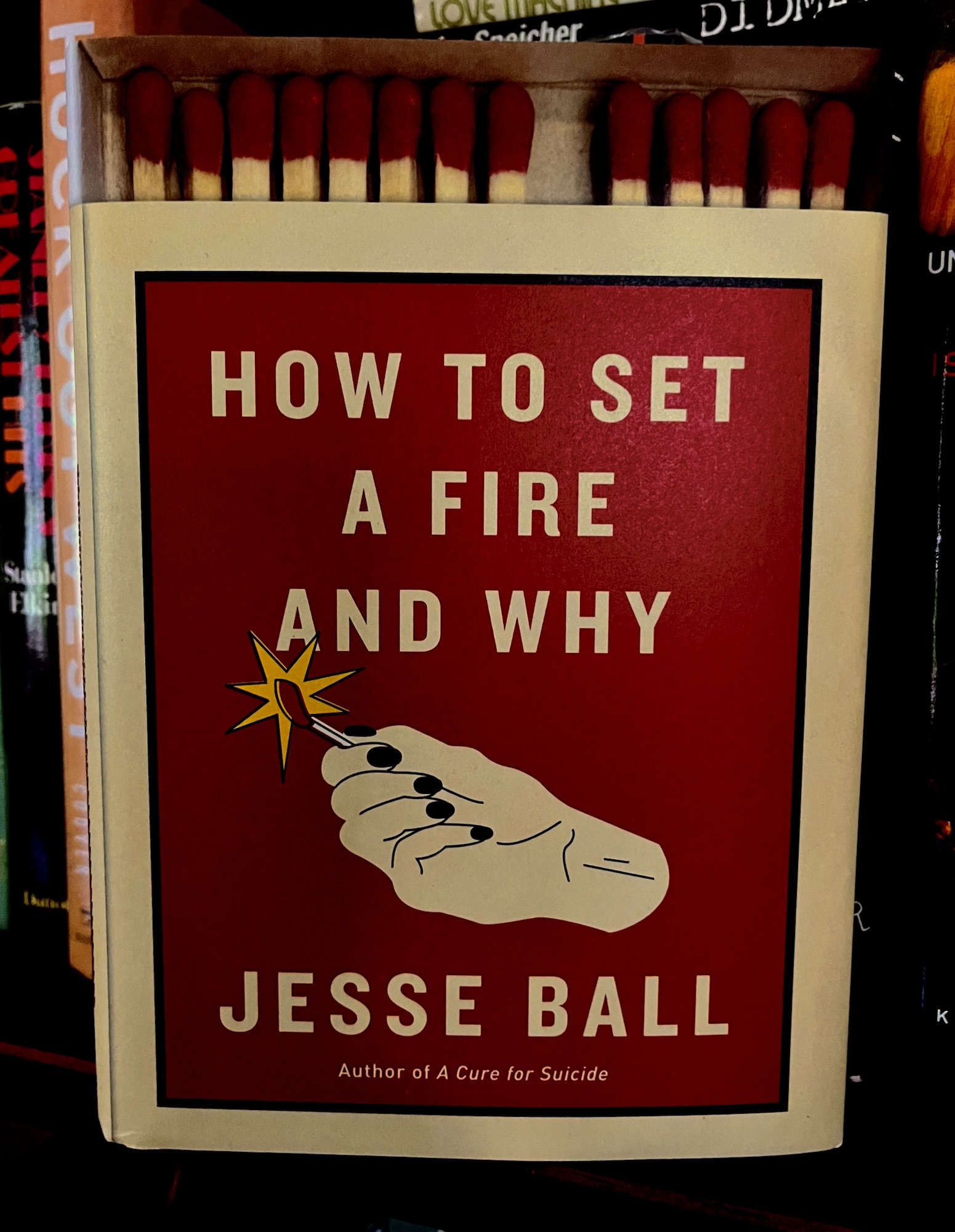
Jesse Ball’s 2016 novel How to Set a Fire and Why covers a few tumultuous months in the life of Lucia Stanton, anarchist daughter of anarchist parents, now living with her aging anarchist aunt after the death of her (anarchist) father and subsequent mental breakdown and institutionalization of her (anarchist) mother.
The narrative begins with the aftermath of Lucia’s expulsion from school for stabbing a classmate with a pencil. The classmate’s crime? Touching Lucia’s lighter, a capital offense. I wrote Lucia’s lighter, but she—Lucia, the first-person narrator of Jesse Ball’s 2016 novel How to Set a Fire and Why—she always refers to it as her father’s lighter: “His corpse is actually on it—I mean, not his death corpse, but his regular one, the body that falls off us all the time. It’s what I have left of him, and I treasure it.”
So Lucia’s off to a new school, trailed by rumors of graphite-based violence that don’t help her win new friends. Her poverty doesn’t help her popularity either (did I mention that she and her aunt are practicing anarchists?) But she’s in luck, sorta, because she hears that this school has a “Sonar Club”:
I’m sure that doesn’t mean anything to you. You’re wondering, why is she happy about some Sonar Club. That doesn’t sound even remotely fun. Well, I have a friend—I do—who told me about something he heard about from someone else—and what it is, is this:
Right now, there are clubs forming up all over the country. They call themselves sonar clubs, or even radio clubs—but what they are is clubs for people who want to set fires, for people who are fed up with wealth and property, and want to burn everything down.
S – O – N – A – R = A – R – S – O – N
And there’s the essential surface conflict of How to Set a Fire and Why: will Lucia, like, shift her collectivist-anarchist ideals toward something more, uh, destructive? Will she burn it all down?
The real plot of the book though is about a teenage girl going through some shit. Lucia is sharp, witty, but caustic and clearly depressed. She is also incredibly observant and very, very intelligent. Ball’s greatest strength in the novel is harnessing Lucia’s spiky but vulnerable intellect; we ride her first-person narration persuaded by her maybe-genius, but also aware of all of her blind spots. Teens know the Truth, but the Truth often blinds them to reality. Not that Lucia isn’t self-aware; consider her take on her own intellect:
My aunt says that I am naturally curious. That means that I don’t need to be taught how to learn. Some people have a disadvantage at the beginning, and they are not curious. These people have trouble learning. It seems like not being curious is the worst thing of all. Curious people aren’t necessarily good at learning what you want them to learn, though. They are too busy learning about other things.
The best bits of How to Set a Fire let Lucia riff on her observations. There’s a poignant detailed description of her father’s lighter (“My father’s is matte black and has a white dot in the center. I haven’t seen another like it”). There’s an explanation and analysis of the rules of cee-lo, which Lucia decides exploits outsiders. She praises both My Dinner with Andre and the music of Erik Satie. She makes predictions and shares their outcomes. She has sex and takes drugs. She visits her mother at the institution. She’s afraid a lot, and probably with good reason: “When I think about what my future holds, it is a bit like looking into the sun. I flinch away, or I don’t and my eyes get burned down a bit, like candles, and then I can’t see for a while.”
Most of Lucia’s observations are about people: I did not count the nouns in the novel, but I imagine people would have to be up there as one of its most common words. A representative sample might be this early simple nugget: “History is just people behaving badly.” Lucia is cynical, sure, and with good reason. How to Start a Fire often echoes the coming-of-age cynicism of The Catcher in the Rye, whose narrator was also flawed and intelligent and blind to what he could not see. (We are all of course blind to what we cannot see.) But Lucia’s not entirely unforgiving. “People aren’t all horrible. They aren’t. Sometimes you find a good one, at least for a while—even if it’s just for twenty minutes or so,” she concedes.
Lucia’s voice is the reason to read How to Start a Fire. It’s compelling and funny and persuasive and hurt. It seems authentic, and I admire the risk Ball has taken—it’s not easy to write a teenage girl who is also maybe-genius-would-be-arsonist. The plot proper of How to Start a Fire never really commits to anarchism or revolution however—sure, things happen—but we never really find out why Sonar Clubs might be taking off around the nation, let alone, like, how Lucia fits into all that. But I don’t think that’s really what Ball is doing here—I think he’s marking off a measure of time in a character’s life:
When people write books about childhood, and about being a kid—they always talk about how endless it is, and about how there is no thought of time. Everything just stretches and stretches. I think the opposite is the case. When you’re young, you feel like things are constantly ending. As soon as you get used to something, it goes away.


 Biblioklept