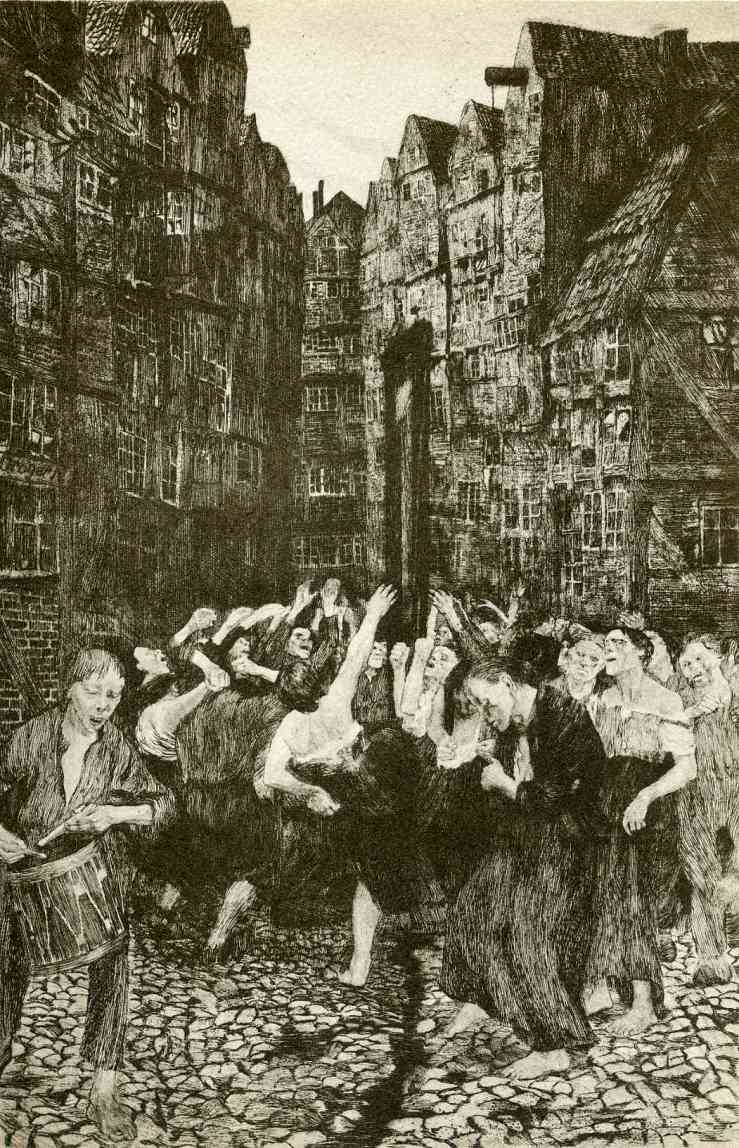
The Carmagnole (Dance around the Guillotine) — Kathe Kollwitz (1867-1945)

The Carmagnole (Dance around the Guillotine) — Kathe Kollwitz (1867-1945)


He photographed Lenin’s corpse lying in state, and captured many emotion-laden scenes, but the full power of images first impressed itself upon the young Roman Karmen later on in that same year, 1924, when he passed by an exhibition of German art arranged by Otto Nagel. Amidst the other flotsam hung “The Sacrifice” by Käthe Kollwitz. How can I describe this woodcut? The mother’s black cloak is open to reveal her breasts as she offers up her baby to death.
In the same folio, which was called “War,” Karmen, stunned and riveted, saw “The Parents,” a black woodcut of a man mourning, supporting the hand in which his face is buried upon the back of his wife, who mourns in his lap; this couple comprise a dark mass of mourning, silhouetted against a white background and their outlines printed negatively in white.
These two prints moved him to tears. But when, now scanning the walls almost ferociously in his determination to find every scrap of paper by this artist, he discovered “Hunger,” which would become leaf number two of most versions of her great “Proletariat” folio of 1925, the emotion which overcame him was anger—anger against an order which made people suffer in this way. And how strange it was that he was moved! For he had known hunger himself; and his father had suffered at the hands of the White Guards. This was the moment when he understood that the representation of reality can be more real than reality itself.
From William T. Vollmann’s Europe Central.

The woodcuts here are of course the Kollwitz pieces that inspire young Karmen Roman, who would go on to become one of the most prolific filmmakers of the Soviet era.
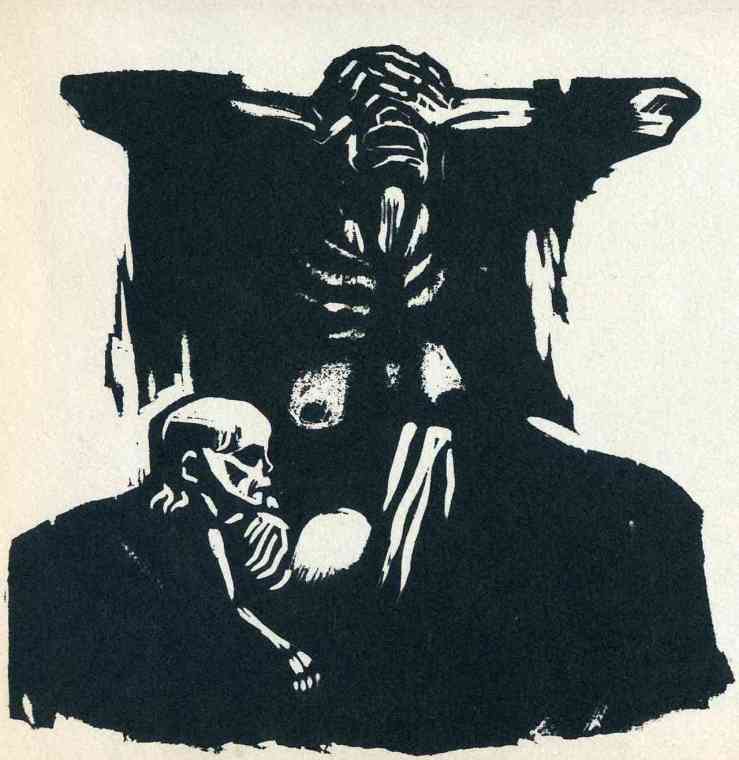
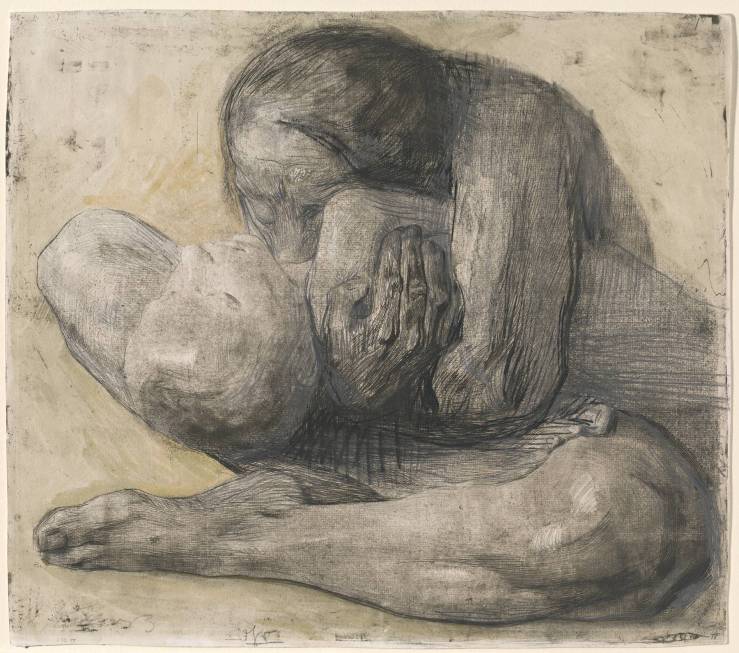
She worked without reference to the fiery proto-Cubism of those years, the representational, classical past as dead as the Second Reich itself, dead, dead!—as dead as the Tsarist officers who’d now sunk beneath their own weedy mucky parade grounds so that the Party of Lenin and Stalin could march across their moldering faces. Since 1912 she had kept a room on Siegmund-shof for her plastic arts. That was where she would create the mourning woman out of stone. Mostly she carved, etched, and painted in that flat on Weissenbürgerstrasse. Those were the years when the figures in other people’s paintings began to go ever flatter, more garish, more distorted, the colors hurtful to her although she liked some of the galloping calligraphic riders in Kandinsky. Grosz’s desperately angry caricatures, the X-ray bitterness of Otto Dix, not to mention abstract constructivism; she didn’t swim with that tide. Käthe Kollwitz kept painting poor people, starving people (white figures in dark fields, dark chalk on brown Ingres paper), raped women, mothers with dying children, mothers with dead children. In the end she depicted mainly herself, her stricken, simian face thinking and grieving. She too was a mother with a dead child.
From William Vollmann’s Europe Central.
 Biblioklept